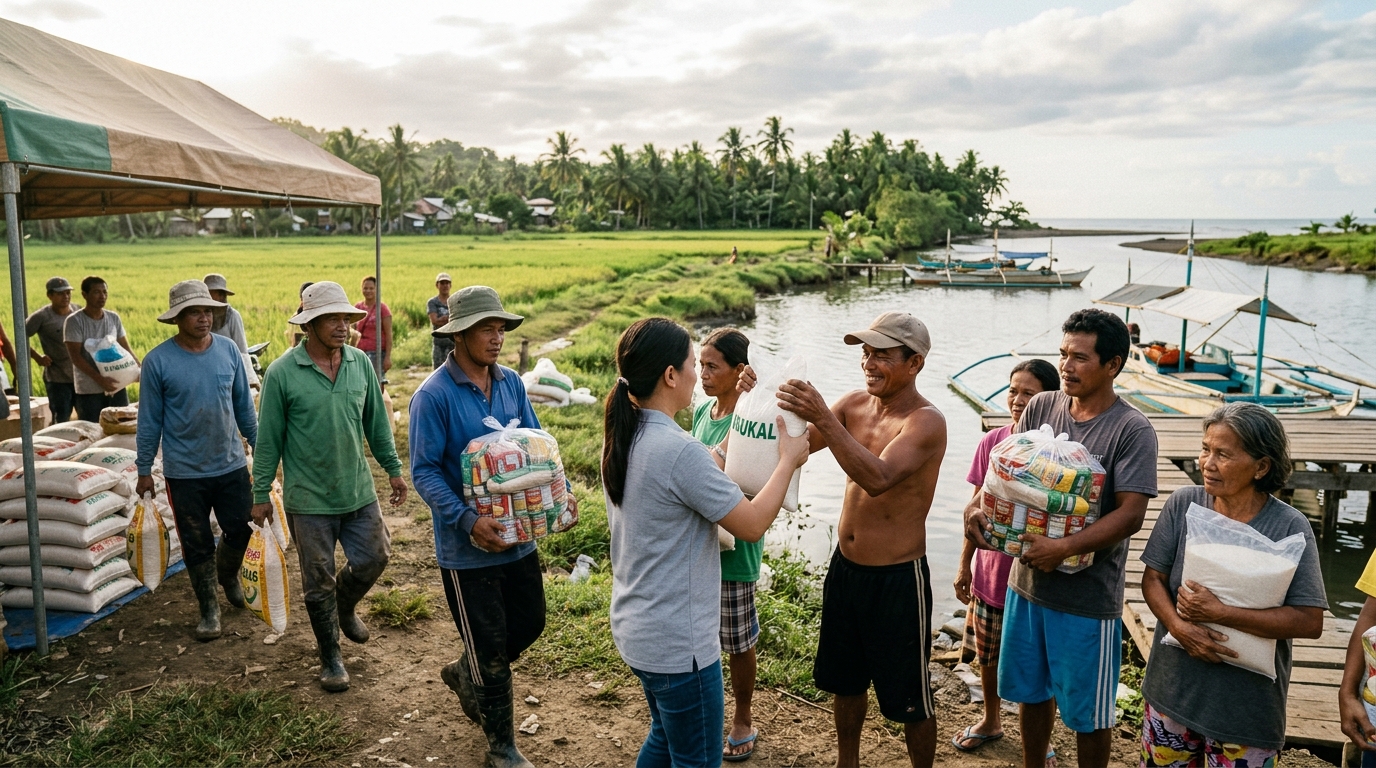
PAMPANGA — On May 6, 2026, as the week‑long Sampaguita Festival entered its culminating days, the space in front of the Lubao Municipal Hall transformed into something more layered than a distribution site. A mini marketplace appeared, where farmers and fisherfolk sold fresh produce and seafood directly to the public. Inside the hall, 2,000 of them—the hands that till Lubao's soil and cast its nets—lined up not for a loan or a lecture but for recognition. Each received ₱2,000 in cash, a food pack, and sugar aid from the provincial and municipal governments. It was Farmers' Day, and the message from the two women governing Pampanga was unusually direct: your body matters as much as your yield.
Governor Lilia "Nanay" Pineda and Mayor Esmeralda Pineda led the distribution themselves, joined by members of the Provincial Board, Sangguniang Bayan, and barangay officials. "Alam naman natin na ang ating mga farmers ay kabilang sa mga higit na nahihirapan, kaya mahalagang mabigyan sila ng assistance at suporta upang mas maipromote at maibenta ang kanilang mga produkto," Mayor Pineda said. "Sa simpleng paraan na ito, nace‑celebrate at nabibigyan natin sila ng pagkilala." The acknowledgment was specific. These were not generic beneficiaries. They were the farmers and fisherfolk whose labor underwrites Lubao's identity as one of Pampanga's primary agricultural towns—and, alongside neighboring Floridablanca, a top supplier of the sampaguita that becomes garlands in Manila.
Beyond Cash: Diesel, Sprayers, and the Machinery of Dignity
The ₱2,000 cash assistance, modest as it may appear, was not the only thing that changed hands on May 6. Fifty‑eight farmers' associations each received 100 liters of diesel fuel—assistance distributed twice yearly to cushion the impact of rising fuel prices on farming operations. Fertilizer assistance was scheduled for distribution later in the month. Several associations were provided with knapsack sprayers and coolers to improve agricultural productivity. These are not ceremonial items. A knapsack sprayer is the difference between a field treated efficiently and a field that costs a farmer extra hours of backbreaking labor. A cooler is the difference between fish sold fresh and fish sold at a discount.
Governor Pineda used the occasion to deliver a message that was as much about healthcare as agriculture. "Kung may kailangan o nararamdaman po kayo, lumapit lamang po kayo sa Kapitolyo sa pamamagitan ng inyong mga kapitan, lalo na kung may problema kayo sa pagbabayad sa pribadong ospital," she said. Then, in a sentence that condensed her administration's preventive healthcare doctrine into a single, blunt appeal: "Ayaw na po ni Nanay na may ma‑dialysis, mabulag, o magka‑cancer pa. Lahat ito ay maiiwasan kung tutulungan ninyo ako sa aking preventive program." The governor, who has built a province‑wide healthcare network anchored on zero‑balance billing for indigent patients, was effectively telling Lubao's farmers that their bodies are assets the province cannot afford to lose. Medical assistance and healthcare services, she assured them, remain readily available through the provincial government whenever needed.
A Festival Rooted in a Flower, Sustained by Resilience
The Sampaguita Festival that served as the backdrop for Farmers' Day is not an arbitrary celebration. Mayor Pineda has described it as a symbol of the community's resilience and commitment to sustaining its signature industry. "The celebration is not only a cultural event but also a way to bring attention to sampaguita farming and its importance to local livelihoods," she said. This year's festival featured seven clusters of barangays competing in street dancing and interpretative dance contests, alongside a parade of floats that highlighted the sampaguita industry and Lubao's cultural icons. The mayor expressed hope that the festival will help preserve the industry and inspire future generations to carry on Lubao's sampaguita‑growing tradition.
The 2026 Farmers' Day distribution is not an isolated event. It builds on a pattern of sustained agricultural support that has included the "Benteng Bigas, Meron Na!" program—the flagship food security initiative of President Ferdinand Marcos Jr.—rolled out in Lubao in February 2026 to provide affordable rice to qualified beneficiaries. A P270‑million food security complex is set to open in Lubao this year, designed to reduce postharvest losses, improve rice quality, and help eliminate middlemen. The 58 associations that received diesel on May 6 will receive it again later this year, a recurring commitment that transforms a one‑time aid distribution into a predictable component of farm operations. For the 2,000 farmers and fisherfolk who walked away from the municipal hall with cash, food, sugar, and the knowledge that their health is a provincial priority, Farmers' Day 2026 was not merely a ceremony. It was a contract renewed.