



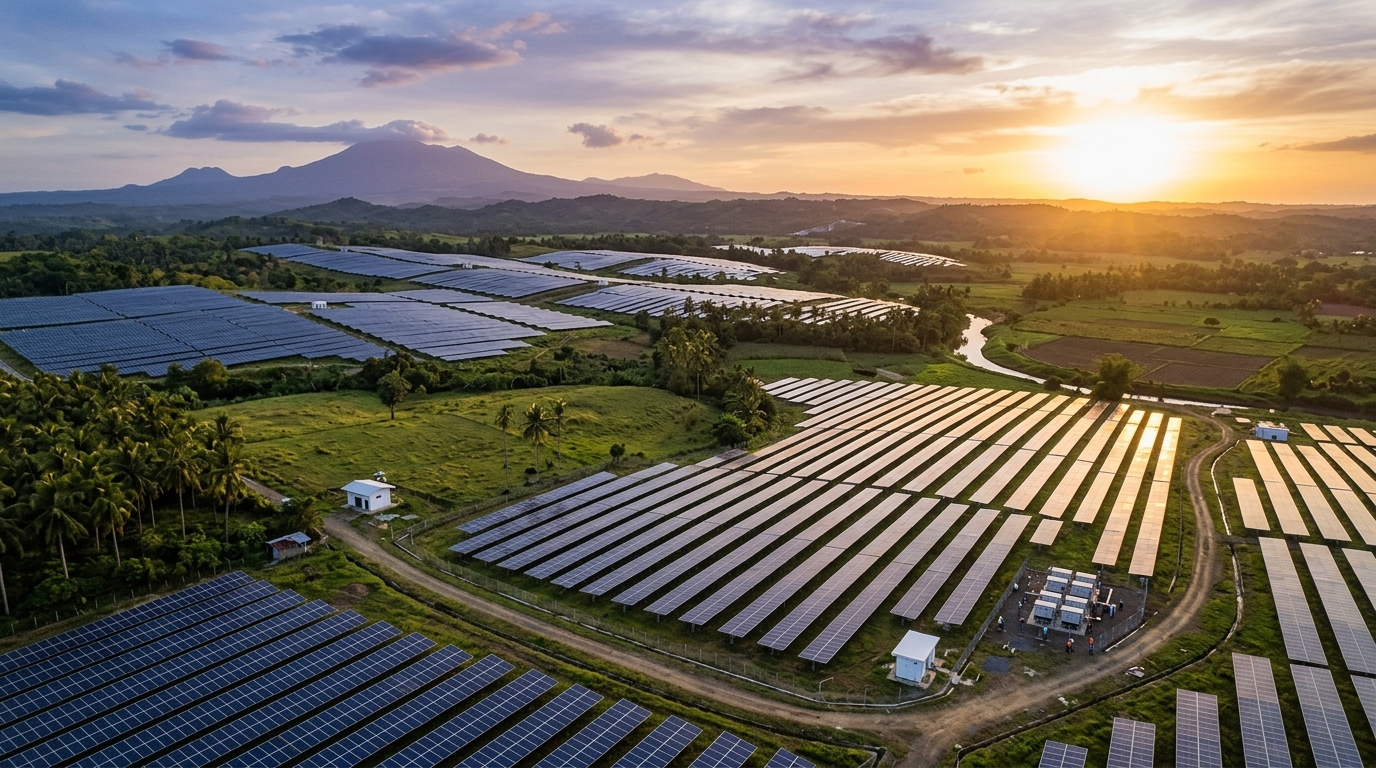
CONCEPCION, ILOILO — Developers confirmed in January 2026 that a 142‑megawatt solar power project is moving toward construction on a 150‑hectare site at the foothills of Mt. Apitong, covering areas in Barangays Lo‑ong and Nipa, and the timeline has tightened since. MGen Renewable Energy Inc., the clean‑energy arm of Meralco PowerGen Corporation, is partnering with Saudi‑based ACWA Power to deliver what will be one of the largest solar installations in northern Iloilo. Once operational—targeted for November 2027—the facility will deploy approximately 300,960 photovoltaic modules across 135 hectares, feeding power directly into the Visayas grid through the NGCP Concepcion 138‑kV substation. For the property sector, the signal is unmistakable: Concepcion is about to acquire the kind of infrastructure that historically precedes a sustained lift in land values.
Governor Arthur Defensor Jr. welcomed the project in terms that reveal both its scale and the province’s deliberate approach to balancing energy development with agricultural land use. “They are very welcome here. I told them we will work together. Here in Iloilo, we have designed a device we call the agricultural impact assessment where energy and agriculture will be balanced,” he said during a January 22 press conference. The statement signals to property investors that the provincial government is not opening the floodgates to unregulated energy sprawl but rather calibrating the entry of large‑scale solar to coexist with the farming communities that anchor northern Iloilo’s economy. That calibration—energy development that does not displace agriculture—is precisely the kind of governance predictability that institutional developers and land bankers track when they evaluate entry into second‑ and third‑class municipalities.
A Township in Waiting: The Infrastructure That Converts Land into Lots
To understand what the Concepcion solar farm means for real estate, one must first understand what it is not. It is not a small, distributed rooftop array. It is a utility‑scale generation asset that will employ local residents during construction, with the municipal government confirming that “priority will be given to hiring local residents, both skilled and unskilled.” Those wages will circulate through local sari‑sari stores, palengkes, tricycle terminals, and small construction projects in a municipality where every incremental peso of household income moves the needle on housing demand.
The Visayas grid, where electricity demand is projected to grow at an average annual rate of 4.5 percent through 2030—outpacing Luzon—requires an additional 1,700 MW of new capacity by that year. The Concepcion solar farm contributes directly to closing that gap, but for the property sector, the more consequential figure is what happens on the ground beneath the panels. The project is expected to generate substantial tax revenues that the municipal government has said “can be channeled into public services such as healthcare, education, and infrastructure.” In Philippine municipalities, improved public services and infrastructure are the two most reliable predictors of residential lot price appreciation. The solar farm, in this sense, is not merely an energy asset. It is a municipal revenue engine that will, over its operational lifespan, fund the roads, health centers, and school improvements that make a town attractive to homebuyers.
A Northern Corridor Emerging
Concepcion’s solar play does not exist in isolation. It arrives alongside a broader northern Iloilo infrastructure push that includes the ongoing rehabilitation of the Lumpatan Rock Trail on Pan de Azucar Island under the “Turista sa Barangay” program, the 120‑MW solar farm proposed in nearby towns, and MPIW’s 65‑MLD desalination plant advancing through the permitting pipeline in Iloilo City. Each of these projects layers a different kind of infrastructure—energy, water, tourism access—onto a geography that is increasingly legible to developers as a coherent growth corridor rather than a scattered collection of coastal municipalities.
The solar farm’s location at the foothills of Mt. Apitong, near Barangays Nipa and Lo‑ong, places it within commuting distance of Concepcion’s town center and within reach of the broader northeastern Iloilo road network. For families currently renting in Iloilo City, a municipality that can offer employment opportunities at a utility‑scale solar facility, improving public services funded by its tax revenues, and the kind of rural tranquility that urban subdivisions cannot replicate becomes a plausible alternative to a city‑center condominium. The Bangko Sentral ng Pilipinas has documented that 17 percent of household remittances now flow into real estate. Some portion of that capital, increasingly, will land in Concepcion.
