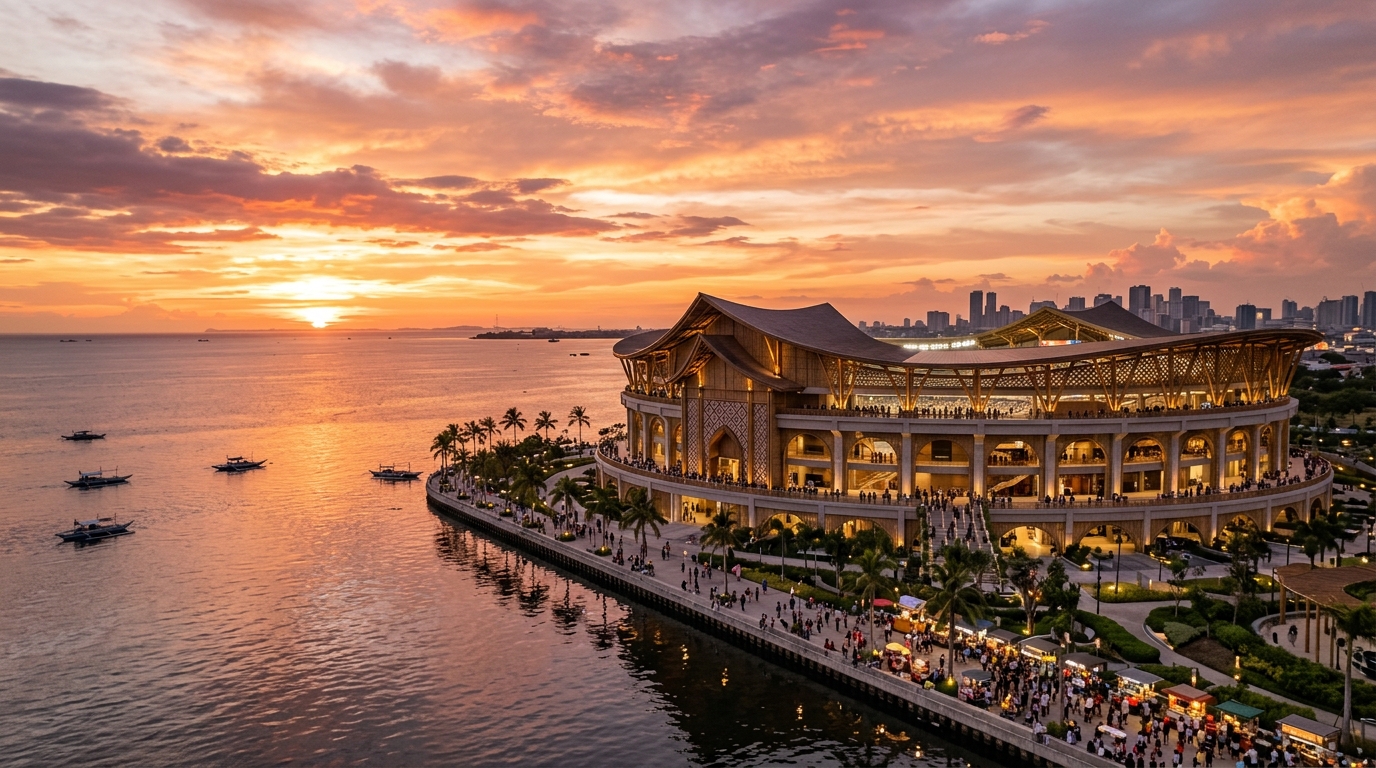
ILOILO CITY — The sprawling waterfront of the recently‑opened Iloilo Sunset Boulevard—a 5‑kilometre, eco‑friendly thoroughfare built at a cost of ₱2.261 billion and lined with bike lanes, esplanades, and solar‑powered streetlights—has already begun to attract residential and hospitality investors betting on a new growth corridor. Now, a proposal championed by Uswag Ilonggo Party‑list Representative Jojo Ang and Governor Arthur Defensor Jr. promises to anchor that corridor with a project of a scale Western Visayas has never seen: the P2‑billion Regional Sports Facilities and Events Center and Regional Cultural Center, an integrated mega‑hub capable of seating 15,000 to 20,000 spectators for major sporting competitions, conventions, exhibitions, concerts, and cultural showcases. The real estate signal is unambiguous. Where a government places a 20,000‑seat arena, the surrounding land values follow, and follow quickly.
The project, unveiled in mid‑May 2026, is currently undergoing site selection, with the Sunset Boulevard and the Iloilo Circumferential Road emerging as the leading candidates. Both locations were chosen for their accessibility and capacity to accommodate a development of this magnitude. Ang disclosed that the initial P2‑billion funding commitment was secured in 2025, though the release was temporarily deferred pending a final decision on the project site. To minimise government expenditure, the lawmaker is also pursuing the possibility of acquiring donated land rather than purchasing a parcel outright. "Officials believe the project could trigger major economic activity in Iloilo by attracting tourism, investments and business opportunities while generating jobs during and after construction," the Iloilo Metropolitan Times reported on May 14, 2026.
A Mañosa‑Designed Landmark and the Tourism Multiplier
A major highlight of the proposal is the planned involvement of Mañosa & Company Inc., the architectural firm founded by the late National Artist for Architecture Francisco Mañosa. Mañosa, who passed away in 2019, is revered for championing a distinctly Filipino architectural vocabulary—most famously expressed in the iconic Coconut Palace in Pasay City. Ang confirmed that discussions are underway with the firm to design the Regional Cultural Center component of the mega‑complex, a decision that signals an ambition beyond mere utility. "Ang said the project is intended not only to build a world‑class events venue, but also to create a lasting cultural landmark that would showcase the artistry, heritage and creative spirit of Ilonggos for generations to come," the May 14 report noted.
The cultural centre anchors a mixed‑use vision that includes a world‑class indoor arena, multipurpose convention and exhibition halls, performing arts theatres, cultural galleries, athlete and delegate facilities, landscaped public spaces, commercial areas, and integrated transport and parking infrastructure. For the tourism and MICE sectors, the mega‑hub addresses a structural constraint that has capped Iloilo's growth as a convention destination. The Iloilo Convention Centre, which hosted over 150 events in 2025, entered 2026 fully booked with a waitlist extending up to one year. A 20,000‑seat indoor arena adds an entirely new event tier—national sporting championships, major concert tours, and large‑scale trade fairs that currently bypass the city for lack of a suitable venue.
A Township‑Scale Catalyst for Land Value Appreciation
For the property market, the mega‑hub is the kind of infrastructure that historically triggers what urban economists call a "stadium effect"—a measurable lift in both commercial and residential property values within a defined radius of a major event venue. The Sunset Boulevard corridor, which already offers a five‑year Real Property Tax incentive programme for new investors, has been explicitly envisioned by the city government as a mixed‑use zone with residential, commercial, and recreational facilities. The addition of a Mañosa‑designed cultural landmark and a 20,000‑seat arena accelerates that trajectory, converting a scenic waterfront drive into a legitimate growth corridor.
Iloilo's property fundamentals are already the strongest outside Metro Manila. Colliers Philippines reported in its first‑quarter 2026 briefing that the city's house‑and‑lot take‑up rate reached 96 percent—the highest in the Visayas‑Mindanao region—while condominium take‑up stood at 89 percent. Iloilo outpaced Metro Cebu in total occupied office space, driven by high‑value outsourcing firms and global capability centres. Into this low‑vacancy, high‑demand environment, the sports and cultural mega‑hub introduces a qualitative variable that developers and investors track closely: a government‑backed, architecturally significant anchor project that will attract visitors, athletes, delegates, and performers from across the Philippines and beyond.
The project's economic multiplier extends beyond the arena walls. Planned facilities include landscaped public spaces, commercial areas, and integrated transport infrastructure that will serve the venue's catchment area long after events conclude. Employment generation is expected during construction—a phase that will inject wages into the local economy—and after completion, when a permanent workforce will operate the venue and the surrounding retail and service businesses. For landowners along the Sunset Boulevard and Circumferential Road corridors, the window between project announcement and groundbreaking is the narrow interval in which pre‑development land prices still obtain. Once the site is finalised and construction begins, that window closes, and the "stadium effect" begins its inexorable arithmetic.