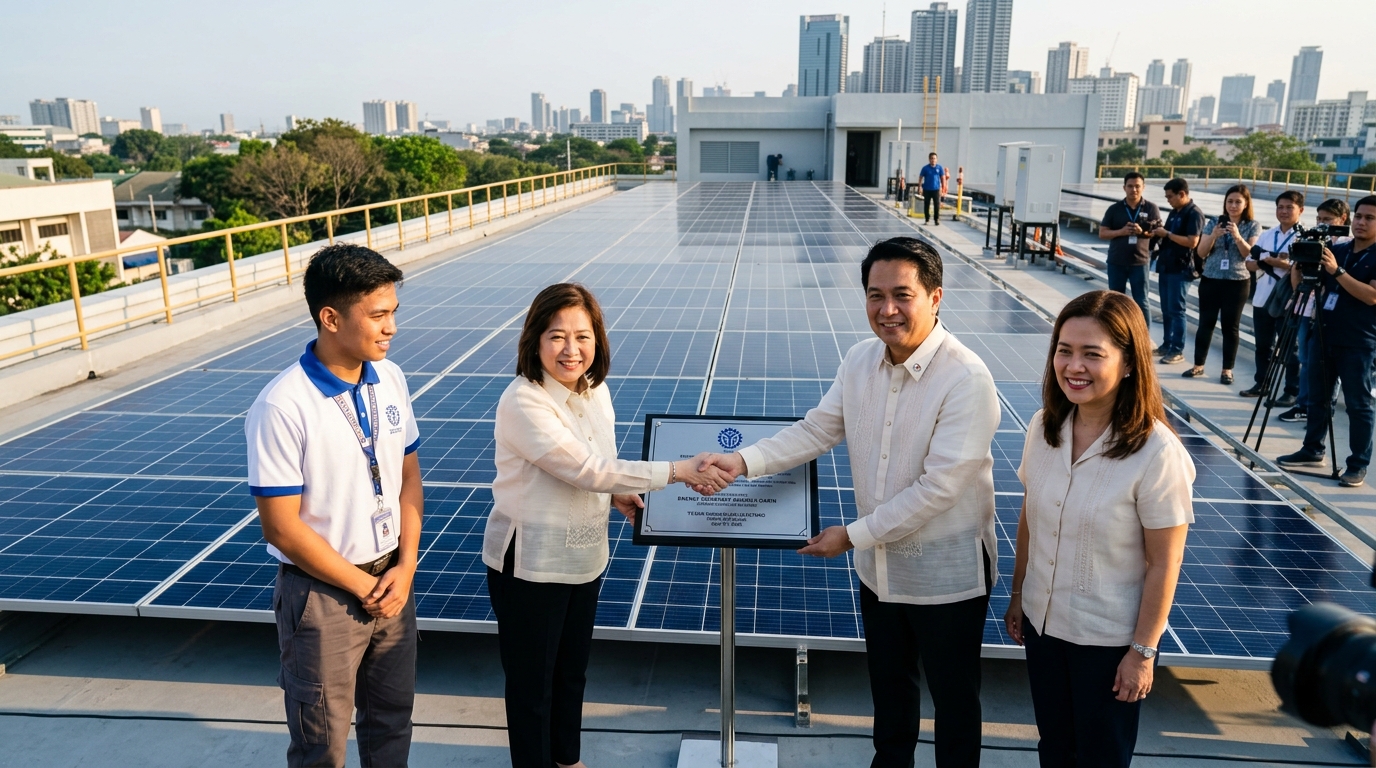
TAGUIG CITY — On the morning of April 27, 2026, a section of the TESDA Complex rooftop in Taguig stopped being a mere architectural lid and became a quiet engine of transformation. The Department of Energy (DOE) formally turned over a 40-kilowatt peak solar photovoltaic system to the Technical Education and Skills Development Authority, a handover that carried none of the ceremonial weight of a groundbreaking but all of its significance. The panels, already bolted into place and feeding electricity into the building below, now do two things at once: they lower the government's power bill, and they train the workforce that will install the next generation of panels across the archipelago.
The ceremony, led by DOE Undersecretary Mario Marasigan on behalf of Energy Secretary Sharon S. Garin, coincided with the groundbreaking of TESDA's Regional TVET Innovation Center, a deliberate pairing that aligned bricks and circuits in a single morning. "This is proof that the country's clean energy ambitions are taking shape in government institutions, in training centers, and in communities," Garin said in a statement delivered at the event. "Through this 40-kWp Solar PV System, we are showing that the government must lead by example."
A Facility That Teaches by Doing
The solar installation is a flagship demonstration project under the Government Energy Management Program (GEMP), which mandates energy efficiency and renewable energy adoption across state-run facilities. But what distinguishes the TESDA project from similar rooftop arrays is its second, more deliberate function: it is a learning platform. Trainees enrolled in electrical installation, solar night light assembly, and related courses will not study photovoltaic theory from a textbook alone. They will walk upstairs and see a live system generating power, its inverters humming and its meters ticking downward.
TESDA Director General Kiko Benitez, who attended the turnover alongside Taguig City Mayor Lani Cayetano, noted that the savings from reduced electricity expenses would be redirected toward improving learning facilities and expanding access to technical-vocational education. The arithmetic is straightforward but rarely articulated with such institutional clarity: lower operational costs mean more students trained, more toolkits purchased, and more competencies certified. The panels, in this sense, are not merely an energy asset but an educational one.
Preparing the Workforce for a 35 Percent Target
The Philippines has set a target of 35 percent renewable energy in its power mix by 2030, rising to 50 percent by 2040. Hitting those numbers will require not only more solar farms and wind turbines but also thousands of technicians who can install, maintain, and repair them. The Department of Labor and Employment has projected that the green economy could generate millions of jobs globally over the coming decades, and the Philippines is positioning itself to capture a share of that employment through its technical-vocational pipeline.
"TESDA plays a critical role in preparing Filipinos for the jobs of today and tomorrow," Garin said. "As the country works toward 35-percent renewable energy by 2030 and 50 percent by 2040, institutions like TESDA will help ensure that our workforce is ready for the opportunities of the clean energy economy." The DOE further emphasized that energy security, affordability, and sustainability require action not only from the power sector but from every public institution.
A Model Engineered for Replication
The Government Energy Management Program is not an experiment in a single building. The DOE has framed the TESDA installation as a replicable model for other public institutions, and the department is working to scale similar solar projects across more government facilities. The logic is systemic: if every state-run building reduces its grid consumption during peak hours, the cumulative easing of demand strengthens the entire power system.
The project's placement at the TESDA complex is strategically significant. The campus is a hub for the very skills training that will staff the renewable energy sector. Students who train on a working solar system are more likely to enter the workforce with the confidence that comes from hands-on experience. The project does not merely lower electricity costs; it lowers the barrier to entry for a generation of Filipino technicians entering the green economy. What began on a Taguig rooftop in April 2026 contributes to a narrative the DOE has been building for years: that the energy transition is not a distant policy abstraction but a series of concrete, replicable acts—facility by facility, panel by panel, trainee by trainee.