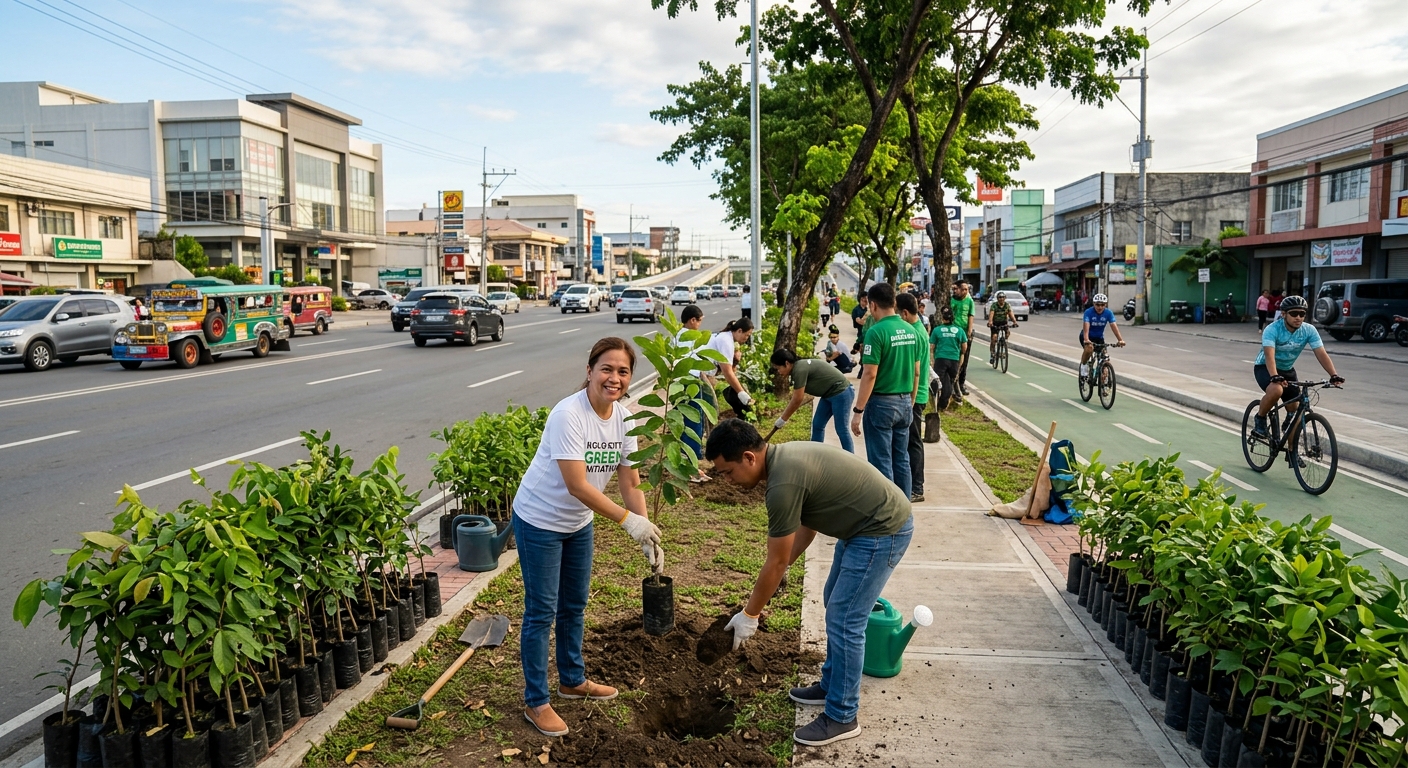
ILOILO CITY — The four-kilometer stretch of Diversion Road that connects Mandurriao district to the Jaro boundary has long been a corridor of commerce—a sun-baked artery carrying taxis, jeepneys, and private vehicles past fast-food chains, auto shops, and office buildings. By mid-2027, it will be something else entirely: a shaded, breathable urban forest that tourists and residents alike can traverse on foot or bicycle without flinching at the heat index. On May 8, 2026, the city government formally announced its plan to plant 10,000 native trees along the Diversion Road median and sidewalks, transforming a 4-kilometer segment from the corner of Gen. Luna Street to Ungka in Jaro district into what it calls a "green corridor."
General Services Office head Neil Ravena described the initiative as the city's definitive answer to an intensifying climate reality. The cooling hubs that opened along Diversion Road on May 6, while necessary, were never meant to be permanent. "What is needed is one that is sustainable," Ravena said. "We target to plant more trees because that is the long-term and sustainable solution." The corridor, once mature, will deliver a cascade of benefits that read like a tourism brochure written in ecological terms: cooler ambient temperatures, improved air quality, strengthened biodiversity, better stormwater management, and a pedestrian experience that invites lingering rather than escape. Approximately 2,000 native trees already stand along Diversion Road from earlier planting cycles. The new push will multiply that canopy fivefold, creating the kind of continuous shade that turns a utilitarian highway into a destination in its own right.
A Rideable, Walkable Tourism Asset Hidden in Plain Sight
For a city that has invested heavily in its bike lane network—solidifying its reputation as the Bike Capital of the Philippines—the green corridor is the missing piece that makes cycling tourism viable year-round. "One of our targets is the bike lane so that at any time of the day, the public can go biking because of the shade," Ravena said. The statement carries deeper resonance for inbound tourists who increasingly seek active, low-carbon ways to explore a city. A visitor who lands at Iloilo International Airport, picks up a rental bike, and rides a shaded Diversion Road toward the Esplanade or the Calle Real heritage district is experiencing the city not through a tour van window but through their own senses.
The green corridor also extends the geography of walkability that the Iloilo River Esplanade pioneered. Where the Esplanade offers a waterside promenade, the Diversion Road canopy will offer a different kind of pedestrian experience: a tree-lined urban boulevard that connects Mandurriao's commercial core to the northern barangays. Tourists staying at the hotels clustered in the Iloilo Business Park—Richmonde, Courtyard by Marriott, the new Belmont Hotel—will find the corridor a direct, shaded route to neighborhoods and eateries they might otherwise have needed a taxi to reach.
From ASEAN Climate Week Recognition to Ground-Level Action
The green corridor arrives at a moment when Iloilo City is actively converting its sustainability accolades into tourism bookings. During ASEAN Climate Week 2026, national officials and regional policymakers highlighted Iloilo as a model for climate-resilient urban planning, citing the river Esplanade and the city's network of interconnected parks as examples of how ecological restoration can drive both environmental quality and visitor appeal.
The tree-planting plan adds a tangible, ground-level proof point to that narrative. Sustainability credentials, when backed by visible green infrastructure, influence the destination decisions of a growing segment of eco-conscious travelers. The city's request for 100,000 native and fruit-bearing trees from the Department of Environment and Natural Resources—far exceeding the 10,000 designated for Diversion Road—suggests that the corridor is not a standalone beautification effort but the leading edge of a citywide canopy expansion that could eventually shade multiple barangays.
Seedling retrieval from the DENR nursery in Tangalan, Aklan, begins on May 29, with planting scheduled for July, subject to El Niño monitoring to ensure survival rates. Ravena noted that native species have already been identified based on their suitability for the local soil and climate. The deliberate focus on native trees—rather than ornamental or exotic species—replicates the ecological logic that guided the Esplanade's mangrove restoration, where biodiversity recovery has been documented alongside flood mitigation benefits.
A Greenprint for Philippine Urban Tourism
What Iloilo City is assembling—a UNESCO Creative City of Gastronomy with an ASEAN Clean Tourist City award, a growing MICE sector that attracted over 150 events in 2025, a heritage museum tour launched in May 2026, a Human Rights City declaration in progress, and now a climate-resilient green corridor—is a destination portfolio built on substance rather than spectacle. The green corridor does not compete with the festivals, the food trails, or the ancestral homes. It complements them, providing the connective tissue that turns a collection of attractions into a coherent urban experience.
For cities across the Philippines watching Iloilo's trajectory, the green corridor offers a replicable framework. It is not a megaproject requiring billions in capital. It is a municipal initiative that leverages existing road infrastructure, DENR partnerships, and native species adapted to local conditions. The primary inputs are political will, a nurseries-to-planting pipeline, and a timeframe measured in growing seasons rather than election cycles. What it produces—for residents, for tourists, and for the city's long-term livability—is the kind of infrastructure that appreciates over time, both ecologically and economically.