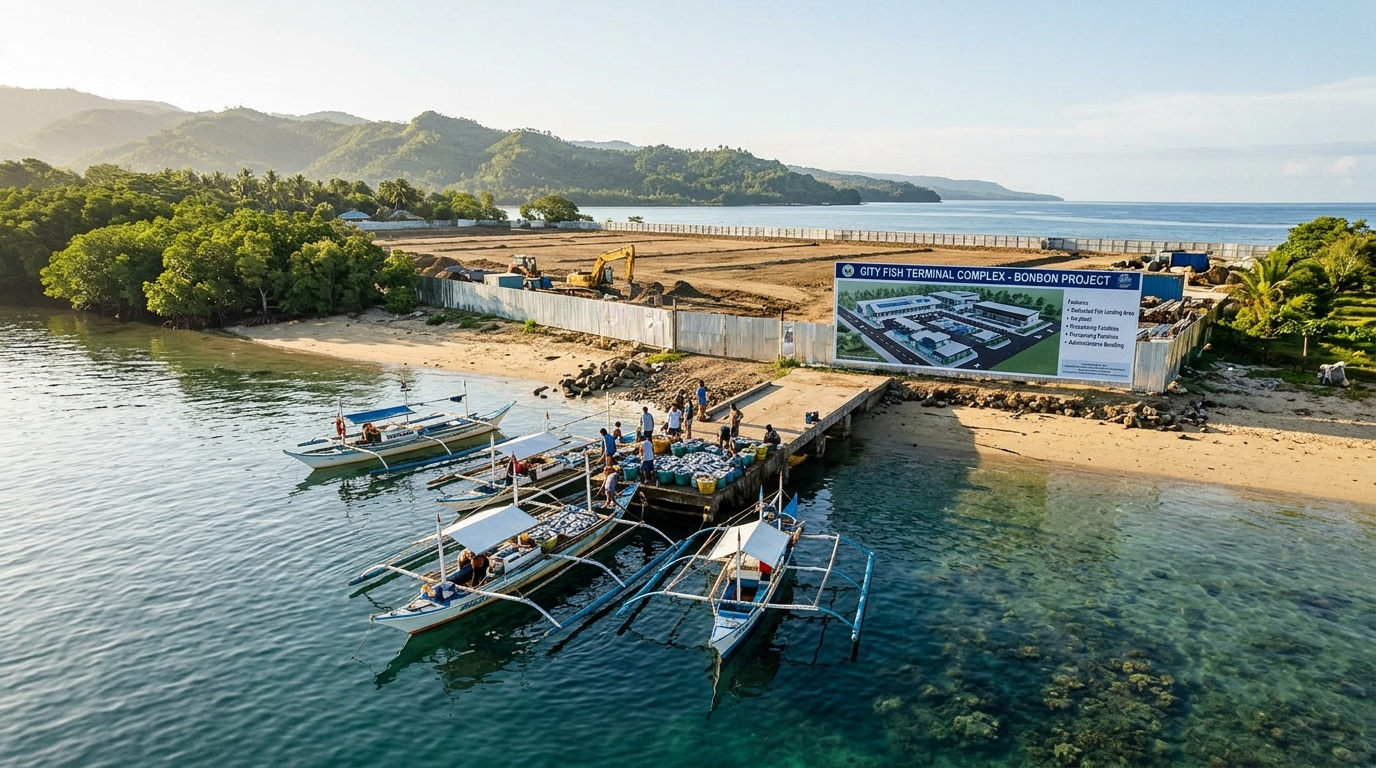
CAGAYAN DE ORO CITY — Fishermen in Bonbon will soon no longer need to navigate to Bulua just to unload their catch. A modern fish terminal complex is set to rise in the coastal barangay, replacing a decades‑old facility, and the project has moved closer to reality following a high‑level site inspection and a post‑evaluation meeting last April 13.
While the immediate goal is to provide a compliant and efficient hub for the local fishing industry, the ₱50‑million project is also a catalyst for a much larger vision: transforming Bonbon into an ecotourism and biodiversity destination. A new, modern terminal could be the cornerstone that finally unlocks the area’s potential as a diving haven and a sustainable seafood tourism spot.
A Modern Hub for a Growing Industry
The proposed City Fish Terminal Complex will rise on a 2.9‑hectare lot in Zone 1, Punta, Bonbon. The integrated facility will feature a dedicated fish landing area, an ice plant, fish processing facilities, and an administrative building—features that the current Bulua port lacks. The move to Bonbon was prompted by a notice of violation issued by the Department of Environment and Natural Resources (DENR) against the Cagayan de Oro Seafoods Association, which highlighted the need for a facility that fully complies with environmental laws.
The ocular inspection was led by City Councilor Juancho Pascual, Chairperson of the Committee on Agriculture and Aquatic Resources, and involved several key agencies, including the Bureau of Fisheries and Aquatic Resources (BFAR)–Region 10 and Central Office, the Philippine Reclamation Authority (PRA), the Philippine Fisheries Development Authority (PFDA), and the Fisheries and Coastal Resiliency (FishCoRe) Team.
Bonbon: From ‘Bonracay’ to Sustainable Seafood Hub
Barangay Bonbon, often dubbed the “Bonracay of Cagayan de Oro” for its fine beaches, is already known for its abundant marine resources and the annual “TambaNipa Festival.” The village has been officially identified by the city’s environment office as a potential ecotourism hub, with a marine sanctuary that boasts thriving coral reefs and diverse aquatic life. However, the area has long lacked the basic infrastructure to serve and attract visitors.
Now, building a modern terminal will solve key infrastructure gaps. It creates space for amenities like parking and dining, enhancing “attraction,” “accessibility,” and “activities”—essential factors for tourism growth. Additionally, it elevates a simple fish landing into a potential seafood market experience. In Cagayan de Oro, the Cogon Public Market already draws culinary tourists with its fresh seafood offerings; a new, organized terminal in Bonbon could replicate that appeal closer to the coast.
A Long‑Term Vision for the Coastline
The Bonbon fish terminal is not an isolated project. It aligns with a broader push for coastal development in the region. The nearby Opol municipality is constructing a ₱100‑million seaside boulevard designed to be one of the most modern tourism infrastructures in Mindanao, aimed at boosting local tourism and attracting investors.
With the land identified, environmental assessments moving forward, and the ₱50‑million budget approved, the terminal could become operational within the next two to three years. As the city works to ensure the project is both economically viable and environmentally compliant, the fishing community and the nearby shoreline await a future that promises both sustained livelihoods and a new wave of visitors.