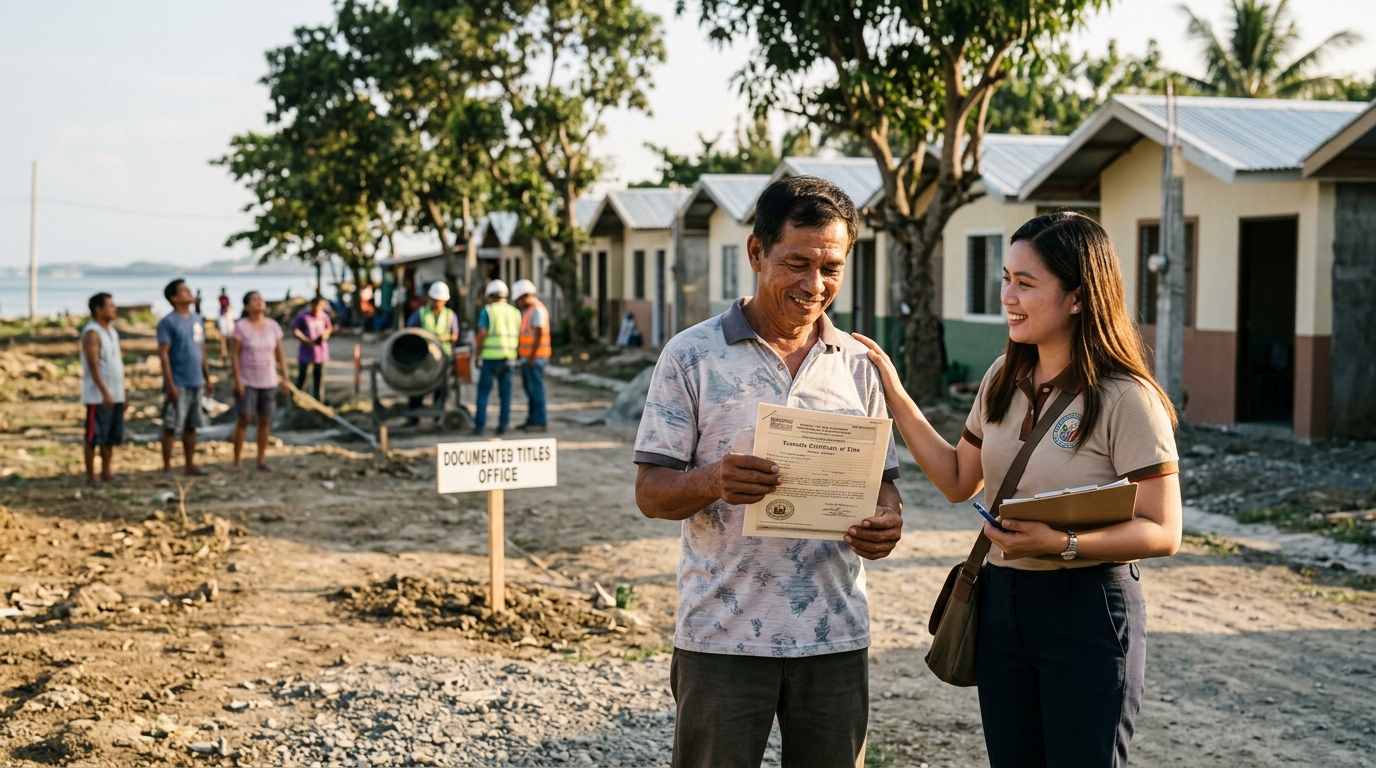
PHILIPPINES — On May 15, 2026, the Department of Human Settlements and Urban Development (DHSUD) reported that its Enhanced Community Mortgage Program has now reached three additional regions, extending land acquisition assistance to hundreds more informal settler families in Cagayan Valley, Zamboanga Peninsula, and the Negros Island Region. The milestone—209 families in Bacolod City, 77 in Solana, 134 in Cordon, and 115 in Zamboanga City—is more than a tally of beneficiaries. For the Philippine property sector, it represents the methodical conversion of the country's most marginalized occupants into documented, titled stakeholders with a direct claim on the land beneath their feet.
Since its revival in July 2025 under President Ferdinand R. Marcos Jr.'s Expanded Pambansang Pabahay para sa Pilipino (4PH) Program, the ECMP has approved 45 projects benefiting more than 7,700 families across the country. Of these, 18 communities have already received checks for land acquisition, advancing their transition toward legally secured homeownership. "Alinsunod sa direktiba ni Pangulong Marcos Jr., patuloy ang DHSUD at SHFC sa pagsusulong ng pamumuhay na may dignidad para sa ating mga kababayan," Secretary Jose Ramon Aliling said. "Sa pamamagitan ng ECMP, maraming pamilya ang nagkakaroon ng seguridad, kapanatagan, at higit sa lahat, bagong pag-asa para sa mas magandang bukas."
A Program That Buys the Land, Not Just Builds on It
What distinguishes the ECMP from conventional socialized housing is its operational logic. Instead of constructing new units on vacant land far from urban centers, the program purchases the very land that organized informal settler communities already occupy—often for decades—and finances the acquisition through affordable, long-term amortization. The SHFC facilitates the purchase, and beneficiaries repay the cost over extended periods. In Iloilo City, for example, 580 informal settlers secured lot ownership in February 2026 through an ECMP-funded purchase of the private land they occupied. Their monthly amortization: PHP1,150 over 30 years.
The property market implications are structural. Every family that transitions from informal occupant to titled owner enters the formal property system—their land becomes taxable, transferable, and bankable. For the neighborhoods where these communities are located, the conversion of informal settlements into titled parcels reduces the legal uncertainty that depresses adjacent property values. A barangay with a high concentration of untitled occupants is a barangay where formal developers hesitate to invest. When those occupants receive land titles, the risk profile of the surrounding area shifts, often triggering a gradual but sustained increase in property valuations.
The Bacolod Breakthrough and What It Signals
The first ECMP implementation in the Negros Island Region marked a milestone with the awarding of land acquisition assistance to the LK Yuman Phase 1 and 2 Homeowners Associations in Barangay Cabug, Bacolod City. A total of 209 families gained security of tenure—and the eventual promise of ownership—over land they had occupied for years without legal recognition. For Bacolod's property market, which has seen PHINMA Properties break ground on the PHP12-billion Saludad Township and Megaworld deepen its provincial footprint, the formalization of informal settlements represents the next frontier of urban consolidation.
In Region 2, the ECMP reached two municipalities in distinct provinces. In Solana, Cagayan, 77 member-beneficiaries of the CMP Homeowners Association received support covering more than 11,000 square meters of land. In Cordon, Isabela, 134 households under the Amianan CMP Homeowners Association benefited from land acquisition assistance spanning over 29,000 square meters. In Region 9, the 115 members of the Maria Navarro Homeowners Association in Barangay Recodo, Zamboanga City, were formally awarded documents securing land tenure after what Aliling described as years of uncertainty.
A Pro-Poor Pipeline That Doubles as a Market Stabilizer
Aliling framed the ECMP in terms that deliberately connect housing policy to economic dignity. "Ang ECMP ay pro-poor, people-centric approach para maiangat ang antas ng pamumuhay ng ating mga kababayang parte ng urban poor sector na kasama sa mga prayoridad ng ating Pangulong Marcos Jr.," he said. The SHFC, which implements the program, has emphasized that the ECMP goes beyond land acquisition assistance by integrating essential development components including access to water, electricity, sanitation, and livelihood training.
For the broader real estate sector, the ECMP functions as a market stabilizer. By providing a formal pathway to land ownership for communities that would otherwise remain outside the property system, the program reduces the pressure on illegal settlements to sprawl into environmentally vulnerable or commercially valuable land. It also creates a pipeline of future property taxpayers whose contributions will fund the municipal infrastructure—roads, drainage, streetlights—that sustain residential property values across entire barangays. The 7,700 families now enrolled in the ECMP pipeline are not merely beneficiaries of a social program. They are the newest entrants into the Philippines' formal property market, and their titles will reshape the neighborhoods they have called home for generations.