


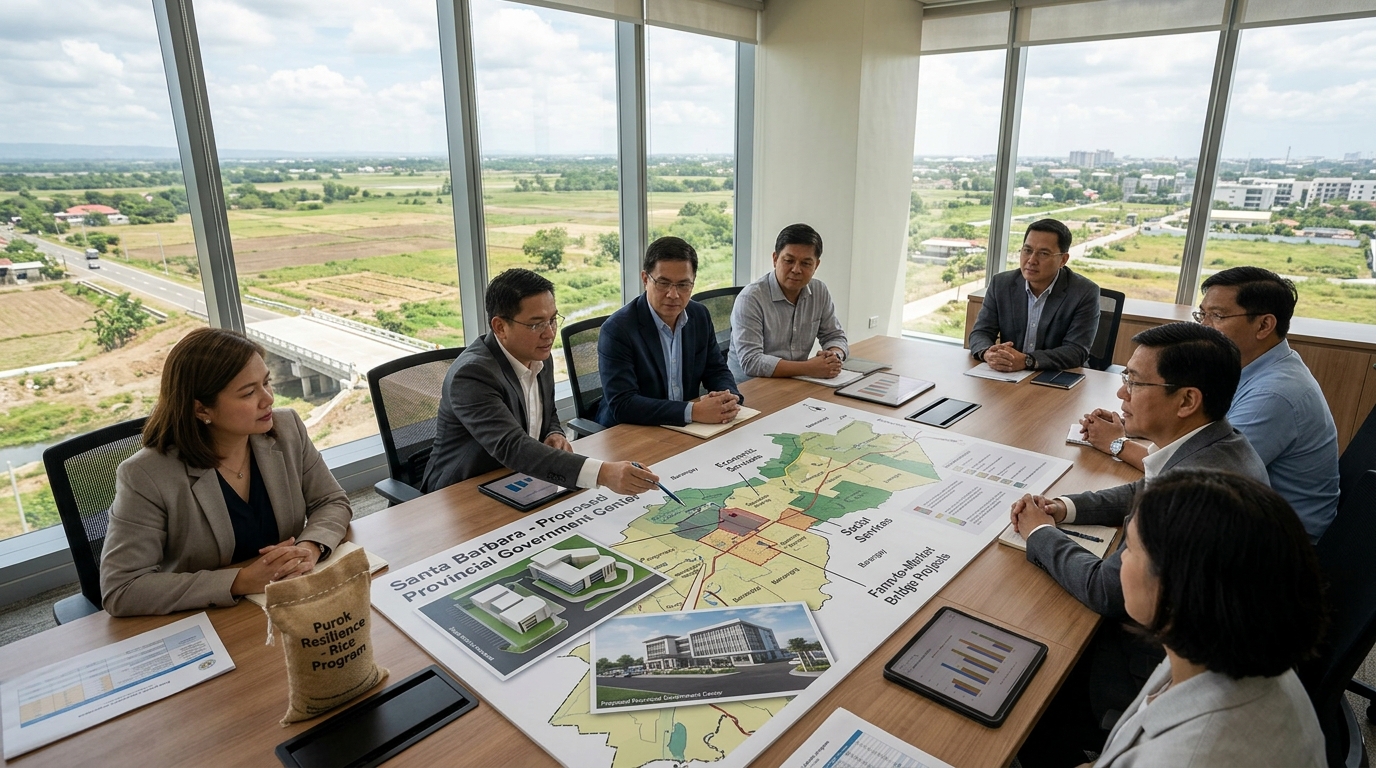
ILOILO CITY — The Iloilo Provincial Development Council (PDC) has endorsed a massive Php 30.11 billion Annual Investment Program (AIP) for 2026, a fiscal blueprint that property analysts are already reading as a map of where land values will rise next. Approved during an en banc meeting chaired by Governor Arthur Defensor Jr. at Days Hotel, the AIP channels funds into social services, economic infrastructure, and rural connectivity, each peso functioning as a signal to developers, homebuyers, and landholders about which parts of the province are next in line for transformation.
The AIP is not a wish list. It is the province's formal work and financial plan for the year, a document that aligns priority programs, projects, and activities with actual budget execution. For the real estate sector, which has watched Iloilo City outpace Metro Cebu in office transactions and post a 96 percent house-and-lot take-up rate in early 2026, the investment plan provides the kind of forward guidance that developers use to time land acquisitions, plan township expansions, and calibrate residential launches. When a province commits Php 7.1 billion to economic services, the market listens.
Farm Bridges as the First Ripple of Rural Appreciation
Among the most closely read items in the AIP is the endorsement of the Department of Agriculture's farm bridges project, slated for implementation across four barangays: Camandag in Leon, Gemumua Agahon in Passi City, Abaca in San Enrique, and Nueva Invencion in Barotac Viejo. These are not the towns that dominate property headlines. They are precisely the kind of locations where a single piece of connective infrastructure can rewrite the local real estate arithmetic.
A farm bridge does more than shorten a farmer's journey to market. It makes the barangay accessible to delivery vehicles, service providers, and, over time, residential developers seeking affordable land parcels within striking distance of economic centers. Property valuations in rural areas tend to track road quality and bridge access more closely than any other variable. The four barangays named in the AIP are likely to see gradual but sustained upward pressure on land prices as the bridges move from endorsed project to completed structure, a pattern that has played out across growth corridors from Cavite to Cebu.
The Social Services Sector Anchors Residential Demand
The largest single allocation in the AIP is the Php 13.9 billion directed toward the Social Services Sector, nearly half of the total investment plan. This includes funding for public health, education, and social welfare programs, as well as the full implementation of the Php 20 per kilo rice subsidy under the SiPAG at Tyaga for MoRProgres Iloilo program.
The link between social services and real estate is indirect but structural. A province that subsidizes rice and invests in public health is a province that lowers the cost of living for its workforce. Lower household expenditure on food and healthcare frees up income for rent, mortgage payments, and eventually property acquisition. The Purok Resilience Program, which provides climate-adaptive housing for families in high-risk areas, was also discussed during the PDC meeting, signaling that the province is building both the safety net and the physical housing stock that underpin a stable residential market.
A Provincial Government Center That Could Anchor a New Growth Node
The proposed Provincial Government Center in Santa Barbara emerged during the PDC meeting as another initiative with real estate implications. Government centers function as economic anchors. They concentrate employment, attract ancillary services, and generate demand for both residential and commercial property in their immediate catchment areas. Santa Barbara, a first-class municipality in the second district of Iloilo, is positioned along the Iloilo-Capiz Road and within reasonable distance of the Iloilo International Airport.
If the Provincial Government Center proceeds as discussed, Santa Barbara could follow the trajectory of other provincial capitals that have seen land values rise sharply once a government complex breaks ground, a pattern visible in municipalities from Batangas to Davao del Norte. Developers who secure land positions early in such areas typically capture the appreciation that accrues between project announcement and completion.
Macro-Level Coordination Reinforces Market Confidence
The AIP arrives amid a broader infrastructure push in Western Visayas that includes the Panay-Guimaras-Negros Inter-Island Link Bridge, airport modernization, and the expanding Iloilo Business Park. Colliers Philippines has noted that infrastructure projects in key provinces are improving accessibility and unlocking long-term property value. JLL Philippines has described infrastructure development as a critical catalyst for real estate growth in 2026.
Governor Defensor framed the AIP as a reflection of the province's commitment to inclusive growth. The plan's sectoral breakdown—Php 2.7 billion for General Public Services, Php 13.9 billion for Social Services, Php 7.1 billion for Economic Services, and Php 6.3 billion for Other Services—reveals a province that is investing in both human capital and physical connectivity. For the real estate sector, this dual focus is precisely what transforms a regional economy from a single-city story into a province-wide growth narrative.
