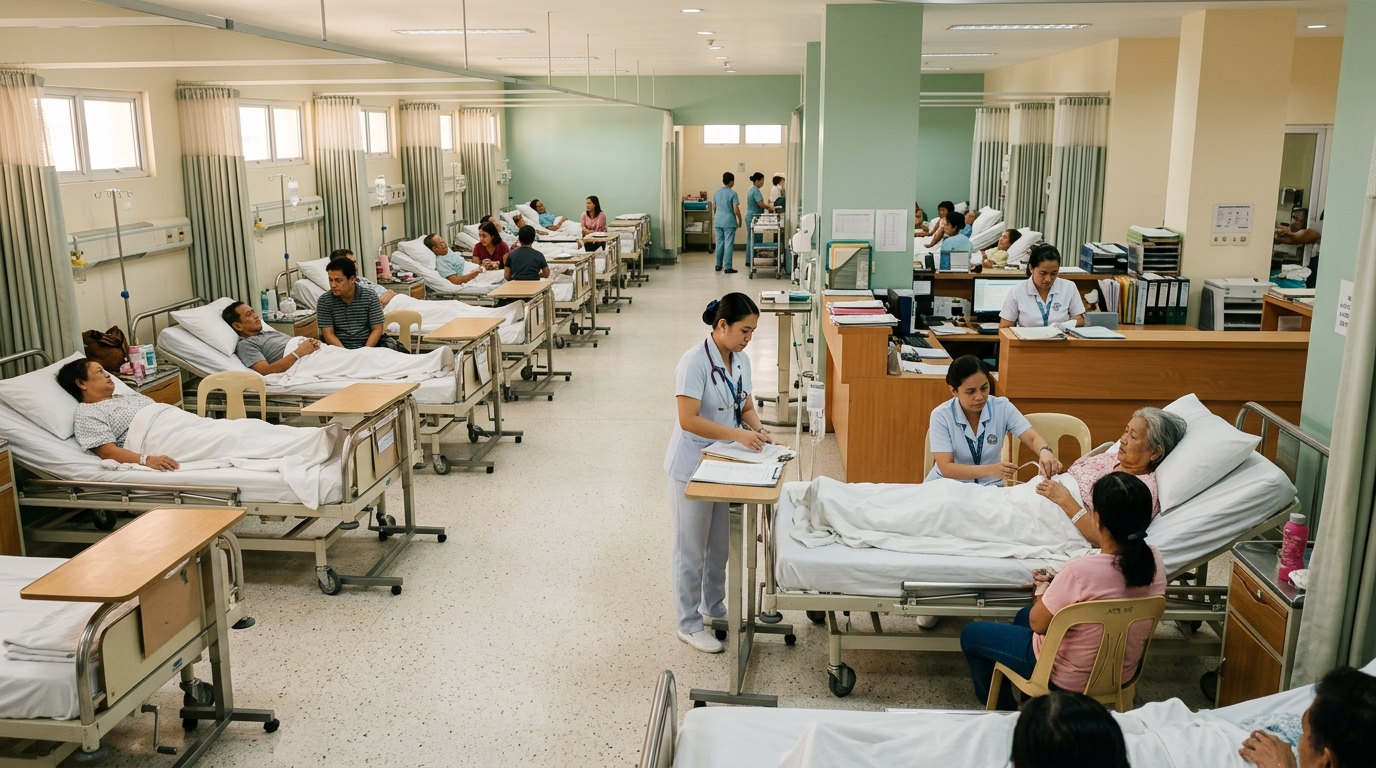
ILOILO CITY — On March 7, 2026, Governor Arthur Defensor Jr. stood before a gathering of Ayala healthcare executives, provincial officials, and hospital administrators at the Iloilo Provincial Hospital in Pototan and launched something that most property analysts would not think to track. The Iloilo Province Dialysis Project, a ₱200-million public-private partnership with Healthway Qualimed Hospital Iloilo, will build and operate 13 dialysis centers across the province's 12 district hospitals and the Iloilo Provincial Hospital. For the 50,000 Ilonggos estimated to need renal care, the project promises life-prolonging treatment without the punishing commute to Iloilo City. For the real estate sector, it promises something quieter but equally structural: a province where healthcare infrastructure has finally caught up with residential demand.
The connection between dialysis chairs and property values is neither rhetorical nor sentimental. A province that cannot treat its own kidney patients is a province that compels its sickest residents to migrate toward the city center—or to leave the province entirely. By embedding specialized renal care into the public hospital network, the Defensor administration is effectively anchoring families in the municipalities where they already live. Governor Defensor acknowledged the fiscal logic behind the partnership: "We need our partners in the private sector because that is the only way we can address our limitations in budget and in processes." The Ayala-led Healthway Medical Network, through President and CEO Jet Peeters, committed the ₱200-million investment to build and operate the facilities under a lease agreement signed on November 25, 2025.
Two Phases, Thirteen Hospitals, One Structural Shift
The rollout will proceed in two phases. The first phase covers seven hospitals, with the remaining six to follow based on readiness and access to essential utilities. Each center will occupy space within an existing provincial or district hospital, eliminating the need for standalone construction and accelerating the timeline to operation. The model is replicable, and the PPP Center has already flagged the Iloilo dialysis project as a precedent for other provinces seeking to close healthcare gaps without straining local budgets.
For the municipalities that will host these centers—from the coastal towns of the north to the inland barangays of the south—the arrival of a functional dialysis unit represents a transformation in local livability. A family with a dialysis-dependent member can now consider living in a municipality where treatment is available within minutes rather than hours. The economic calculus shifts: the money previously spent on transportation and city-based accommodation during treatment weeks can now remain in the local economy, circulating through sari-sari stores, palengkes, and eventually, housing payments.
Why Healthcare Infrastructure Is the Next Real Estate Frontier
Iloilo's property market in 2026 is already operating at historic highs. Colliers Philippines reported in its first-quarter briefing on May 5 that the province's house-and-lot take-up rate reached 96 percent—the highest in the Visayas-Mindanao region—while condominium take-up hit 89 percent and lot-only purchases stood at 80 percent. The city has outpaced Metro Cebu in total occupied office transactions, driven by high-value outsourcing firms and global capability centers. The Bangko Sentral ng Pilipinas confirms that 17 percent of household remittances now flow directly into real estate.
But sustained demand at these levels requires more than office towers and remittance flows. It requires that the municipalities beyond Iloilo City's urban core offer the amenities that make a location viable for long-term settlement. Healthcare infrastructure—particularly specialized care like dialysis—is one of the few public investments that demonstrably influences residential location decisions. Colliers Research Director Joey Roi Bondoc noted that developers are "starting to integrate wellness features" into their projects, an observation that applies equally to the barangay as to the building. The dialysis project extends that wellness integration into the public realm, effectively upgrading the healthcare profile of every municipality that hosts a center.
A Province That Treats Its Sick Retains Its People
Governor Defensor has signaled that the dialysis project is the leading edge of a broader healthcare expansion. He noted that the province is exploring similar collaborations for cancer treatment and cardiovascular services, signaling to the market that Iloilo intends to build a comprehensive specialty care network across its public hospital system. For property developers, this trajectory reduces location risk: a municipality with a district hospital that offers dialysis today is a municipality whose healthcare profile will likely improve further, making it a safer bet for residential investment. In a province where house-and-lot packages are being absorbed at 96 percent, that safety translates into sustained pricing power.