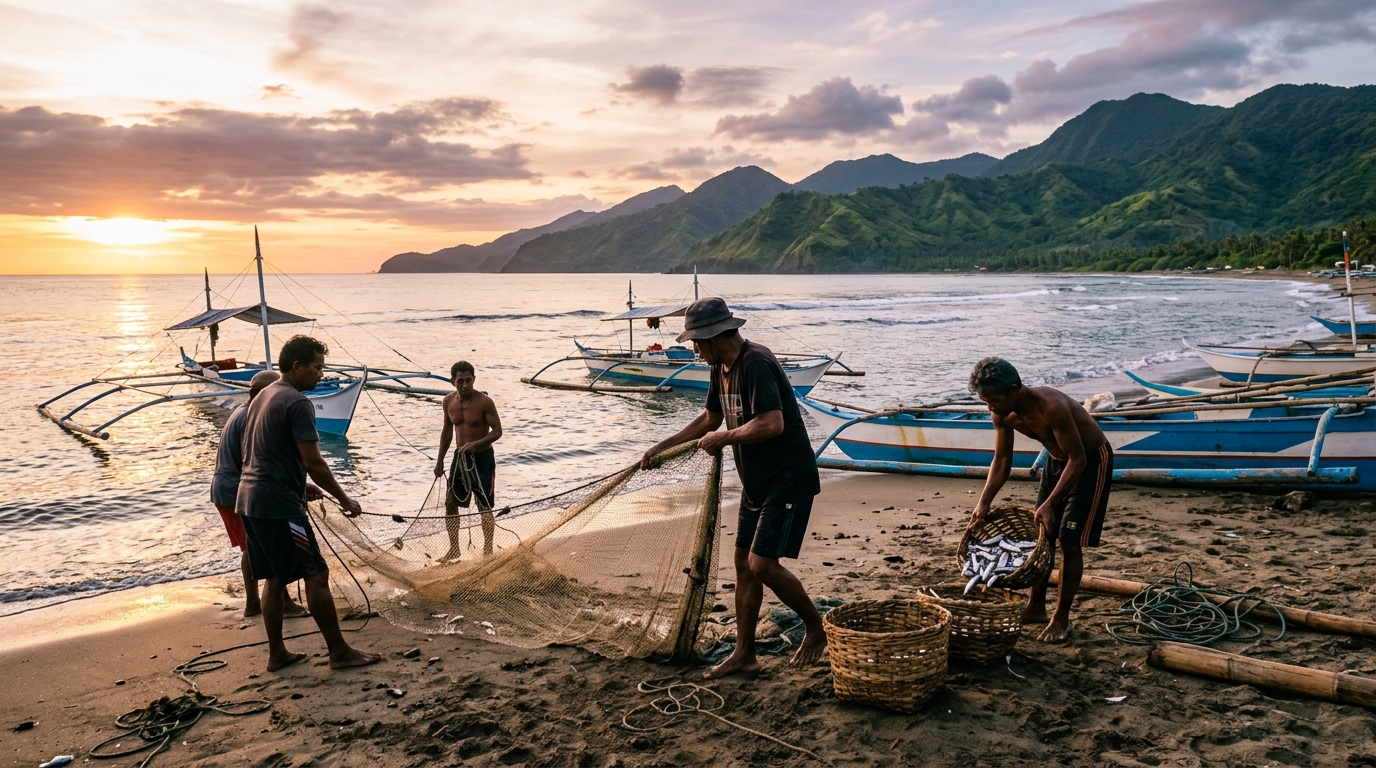
PAMPANGA — In mid‑April 2026, President Ferdinand R. Marcos Jr. personally handed over PhP205.58 million in financial assistance to thousands of farmers and fisherfolk across Pampanga whose livelihoods had been scorched by the prolonged El Niño phenomenon. The distribution, held at the Bren Z. Guiao Convention Center in San Fernando, was not merely a ceremonial cheque handover. It was the single largest lump of the national government's PhP10‑billion Presidential Assistance to Farmers and Fisherfolk (PAFF) program to land in Central Luzon that month, and for the rice growers, corn planters, and fishing families who lined up to receive their share, it meant the difference between abandoning a planting cycle and surviving it.
The aid, disbursed in cash cards loaded with PhP2,325 per beneficiary, forms part of a nationwide rollout that reached 4.175 million farmers and fisherfolk simultaneously on April 15, 2026. In Pampanga alone, the PhP205.58‑million envelope covered beneficiaries across the province's municipalities and cities, from the rice granary of Candaba to the coastal communities of Sasmuan. Each peso was calibrated to cushion the impact of rising fuel costs and the El Niño‑driven dry spell that had already damaged standing crops, delayed planting calendars, and driven up the price of irrigation. The Department of Agriculture, under Secretary Francisco Tiu Laurel Jr., described the PAFF as "financial aid on top of the fuel subsidies" earlier released to registered farmers and fishers.
A President's Promise Delivered at the Bren Z. Guiao Convention Center
Speaking before a packed convention hall that included Governor Dennis "Delta" Pineda, former President Gloria Macapagal‑Arroyo, and the governors of Bataan, Bulacan, Tarlac, and Zambales, Marcos framed the aid in terms that extended beyond the transactional. "Pinalitan po namin ang pagkakaunawa sa salitang kalamidad," he said. "Ang pinagdaanan ng ating mga magsasaka at mangingisda dahil sa El Niño, sa tagtuyot na dala ng El Niño, ay kalamidad din dahil marami talagang nahirapan." The statement was not rhetorical. It was operational: by reclassifying El Niño as a calamity, the government unlocked the presence of the Department of Social Welfare and Development at the distribution, alongside the Department of Agriculture, the Department of Labor and Employment, and other agencies deployed to provide a whole‑of‑government response.
The multi‑agency format meant that farmers and fisherfolk who arrived at the convention center did not simply receive a cash card and leave. They encountered a one‑stop shop of government services. The Technical Education and Skills Development Authority offered skills training slots. The Department of Trade and Industry provided livelihood kits. The Department of Health set up medical consultation desks. Governor Delta Pineda, whose administration has invested over PhP1 billion in agricultural aid and infrastructure from 2022 to 2024, described the presidential visit as a validation of the province's long‑standing argument that Pampanga's food producers deserve national‑level support.
Beyond the Cash Card: A Province‑Wide Safety Net
The PhP205.58‑million distribution in San Fernando was not an isolated event. Earlier, in February 2026, 12,000 Candaba farmers received 1,755 bags of certified inbred seeds, 8,461 fertilizer discount vouchers, and 3,680 cash cards loaded with PhP5,000 each under the Rice Farmer Financial Assistance Program. In May, 1,250 farmers from the municipality of Mexico each received PhP2,325 in aid through the PAFF program, distributed at the Mexico Mini Convention Center. These layered interventions—cash assistance, input subsidies, and fertilizer support—form a safety net that the Marcos administration has described as "ayuda with a purpose," distinguishing it from emergency cash transfers by linking it directly to productive capacity.
For Pampanga's agricultural economy, the aid arrives at a critical juncture. The province is Central Luzon's second‑largest rice producer and a major source of poultry, swine, and aquaculture products. The El Niño phenomenon, which PAGASA projected to persist into the third quarter of 2026, has already reduced yields in rain‑fed areas and driven up the cost of irrigation for those dependent on shallow tube wells. The PAFF cash assistance, while modest at PhP2,325 per beneficiary, is structured to cover immediate input costs—a bag of fertilizer, a tank of fuel for a water pump, a day's wage for a farm laborer—that keep a smallholder operation viable through a single planting season.
A Whole‑of‑Government Approach That Travels Beyond the Capital
Marcos made clear that the Pampanga distribution was part of a regional strategy, not a standalone photo opportunity. "Ang programang ito ay hindi lamang dito sa Pampanga, kung hindi para sa buong region. Ganyan po ang aming ginagawa, by region ang aming pagdala ng ating mga tulong," he said, with the governors of Bataan, Bulacan, Tarlac, Zambales, and the vice governor of Nueva Ecija seated before him. The regional approach acknowledges that El Niño does not respect provincial boundaries and that the supply chains linking Pampanga's farms to Metro Manila's markets depend on the productivity of the entire Central Luzon corridor.
The PAFF program, funded under the Department of Agriculture's 2026 budget, is the largest single‑year allocation of direct cash assistance to the agricultural sector in Philippine history. It targets 2.197 million rice farmers, 1.475 million corn producers, over 102,000 sugar farmers, and about 399,000 fishers nationwide. The simultaneous release on April 15—from Pampanga to Zamboanga, from Catanduanes to Antique—was designed to inject liquidity into rural economies at the moment when planting decisions for the wet season were being made. For the farmers and fisherfolk of Pampanga, the Bren Z. Guiao Convention Center on that April afternoon was not merely a venue. It was a threshold between a season of drought and the promise of a season of recovery.