
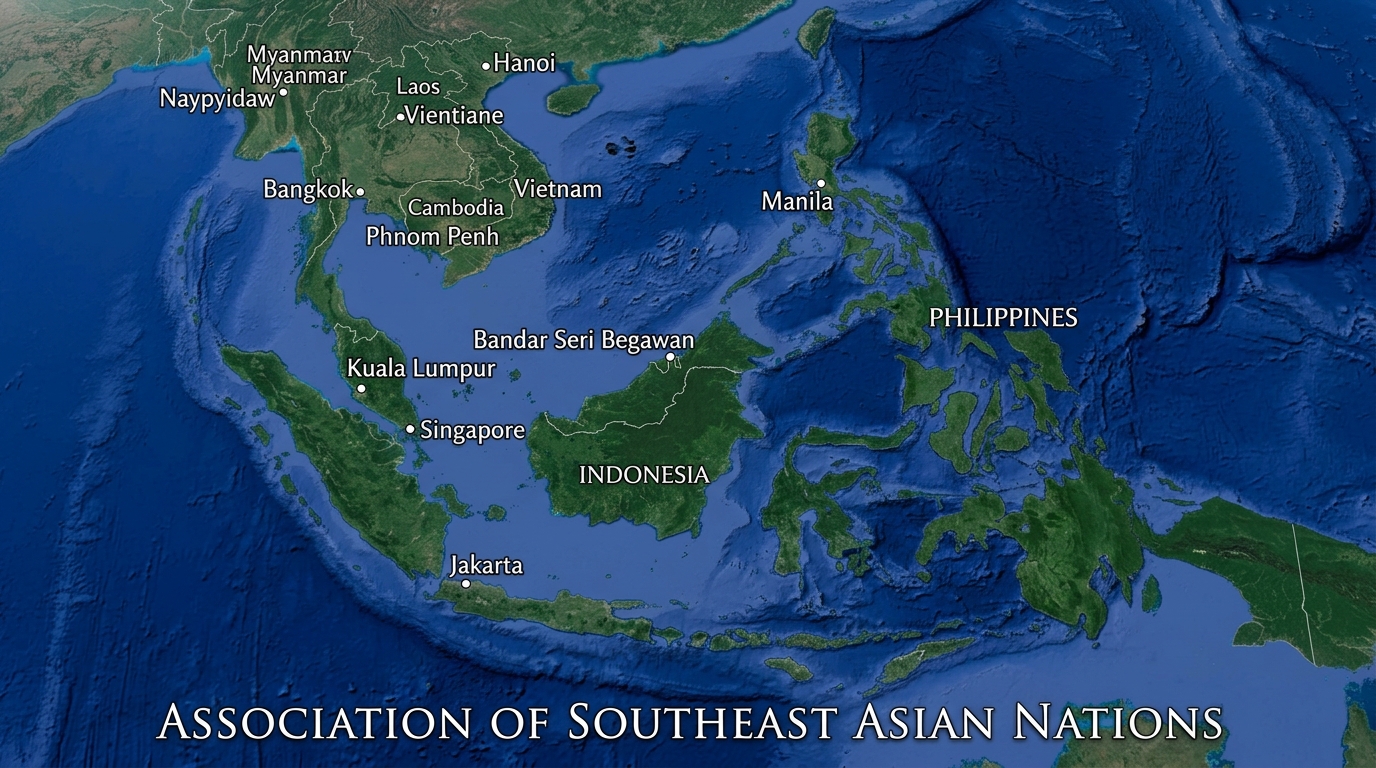
The landscape of modern diplomacy changed forever on August 8, 1967, when five visionary foreign ministers gathered in Bangkok to sign the ASEAN Declaration. Born from the friction of the Cold War, the Association of Southeast Asian Nations (ASEAN) was designed as a shield for regional stability and a vehicle for shared economic prosperity. What began as a defensive pact between Indonesia, Malaysia, the Philippines, Singapore, and Thailand has transformed into a sophisticated, rules-based intergovernmental organization. Today, it stands as a testament to the "ASEAN Way"—a unique diplomatic style that prioritizes consensus and non-interference to maintain peace across one of the most diverse regions on Earth.
The Visionary Roots of Regional Unity
The organization's foundation was laid by the "Founding Fathers"—Adam Malik, Narciso Ramos, Tun Abdul Razak, S. Rajaratnam, and Thanat Khoman—who sought to counter external interference and foster social progress. This initiative succeeded where earlier attempts like Maphilindo failed, gradually expanding its reach across the decade to include Brunei, Vietnam, Laos, Myanmar, and Cambodia. A historic milestone was reached in October 2025 when Timor-Leste was officially admitted as the 11th member state, completing the modern map of the association. This expansion reflects a long-term commitment to inclusive growth, ensuring that every nation in the Southeast Asian corridor has a seat at the diplomatic table.
A Framework for Peace and Prosperity
Over the decades, ASEAN has solidified its influence through landmark documents like the 1971 ZOPFAN Declaration, which established the region as a Zone of Peace, Freedom, and Neutrality. The 1976 Treaty of Amity and Cooperation (TAC) further entrenched the principles of peaceful dispute resolution, while the 1992 launch of the ASEAN Free Trade Area (AFTA) dismantled trade barriers to boost global competitiveness. In 2008, the organization gained its legal personality through the ASEAN Charter, providing the institutional backbone necessary to navigate complex 21st-century challenges. These milestones have collectively moved the region from a collection of fragmented states to a cohesive, rules-based entity.
The Rise of the Triple-Pillar Community
By 2015, the organization formalized the ASEAN Community, a structure built on three distinct pillars: Political-Security, Economic, and Socio-Cultural. This holistic approach has propelled the region into a major global player, with a combined GDP that would rank as the world's seventh-largest economy if it were a single nation. As the 48th ASEAN Summit unfolds in 2026, the focus remains on "Centrality"—the idea that Southeast Asia must remain the driver of its own destiny in global diplomacy. For the hundreds of millions living within its borders, ASEAN represents a shared future where economic integration and cultural pride serve as the primary engines of regional success.