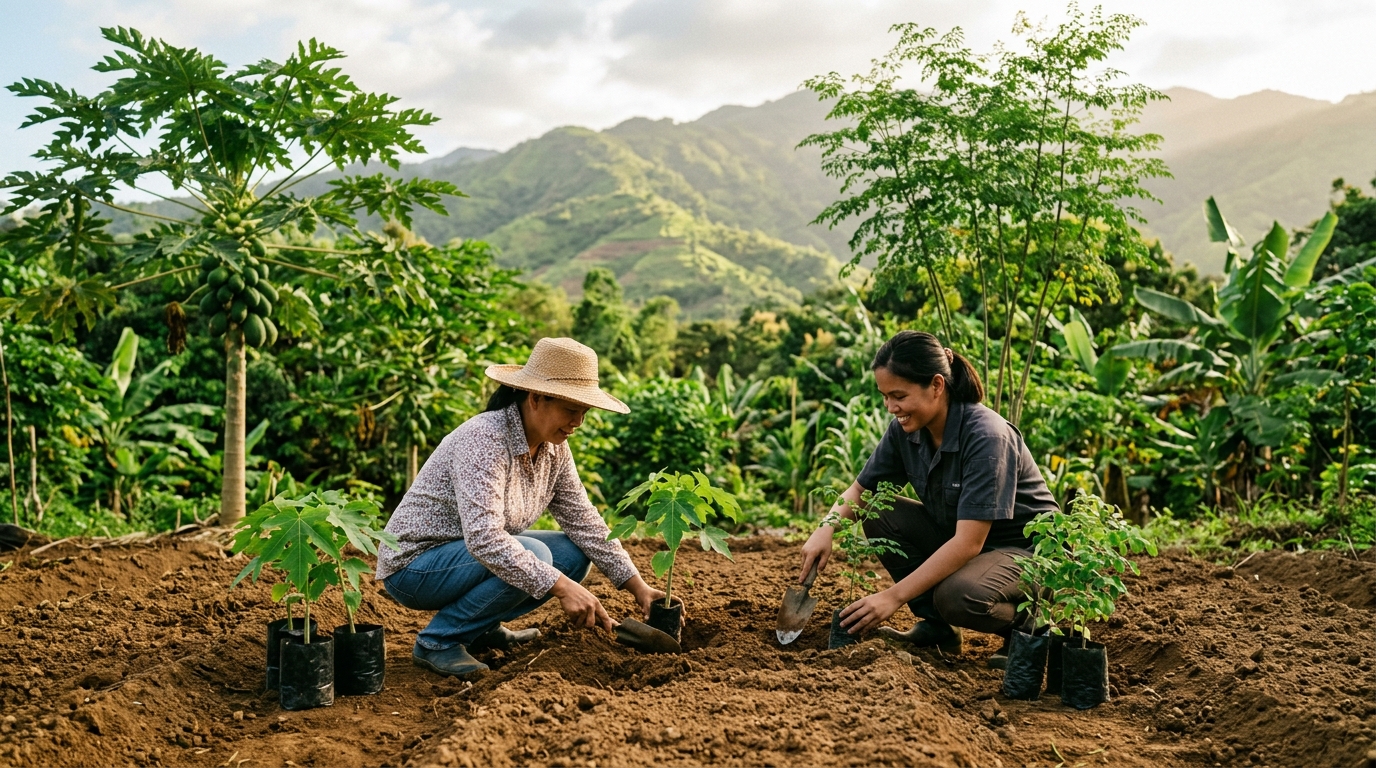
ILOILO — On April 22, 2026, as Earth Day observances unfolded across the globe, something quieter but arguably more consequential was taking root in three Iloilo municipalities. In Pototan, Mina, and Oton, approximately 450 members of the Rural Improvement Club (RIC) gathered simultaneously to plant papaya and malunggay seedlings, an act that on its surface registers as a modest environmental gesture. But for property analysts tracking Iloilo's record-setting 96 percent house-and-lot take-up rate—the highest in the Visayas-Mindanao region—the RIC Green Day represents something far more structural: the grassroots economic empowerment that transforms rural women from renters into mortgage-ready homebuyers.
The event, led by the Iloilo Provincial Agriculture Office in coordination with municipal agriculture units, was institutionalised through Provincial Ordinance No. 2018-188, which declares April 22 of every year as RIC Green Day. "Malunggay and papaya, known for their high vitamin content, are seen as practical additions to rural households' daily nutrition, particularly benefiting mothers and children," the Provincial Agriculture Office stated. "By linking climate action with nutrition and livelihood advocacy, the program strengthens their capacity to drive inclusive and sustainable development at the grassroots level." For the property sector, that last phrase—"inclusive and sustainable development"—is not an abstraction. It is a description of the consumer base that underwrites Iloilo's residential demand.
The Household Economics of a Seedling
The connection between a papaya seedling and a housing loan is neither tenuous nor romantic. A malunggay tree, once established, produces leaves year-round—a free, high-protein, high-vitamin supplement that reduces household food expenditure. A papaya tree delivers fruit within months of planting, generating both household nutrition and, when sold, supplemental income. For a rural family in Pototan or Mina, savings on food translate directly into disposable income that can be channeled toward Pag-IBIG contributions, lot amortisation, or home improvement.
Multiply those savings across the 450 RIC members who planted seedlings on April 22, then across the 3,000-plus hectares of farmland that the Rural Improvement Clubs actively steward across Iloilo's five districts, and the cumulative effect on provincial purchasing power becomes substantial. The municipalities chosen for the 2026 Green Day were not random. Oton hosts Savannah by Camella, the 500-hectare master-planned township that has become one of Iloilo's most significant horizontal residential developments. Pototan has proposed a 2026 Schedule of Market Values through the Provincial Assessor's Office, and is constructing a multi-purpose building that signals ongoing public investment in the town's civic infrastructure. Mina has been described by property listing platforms as "more progressive, with modern developments rising in the area," attracting buyers who recognise long-term appreciation potential.
MoRProGRes and the Institutional Framework Behind the Plants
The RIC Green Day does not exist in isolation. It operates under Governor Arthur Defensor Jr.'s MoRProGRes framework, which integrates environmental sustainability, food security, and economic development into a single governance architecture. The Province's recently retooled 66 Rural-Based Organization coordinators—completed in two batches on April 23–24 and April 29–30, 2026—are the personnel who mobilise the Rural Improvement Clubs across the province. Their training focused on strengthening capacity to guide Farmers Associations, RICs, Provincial Agri-Fishery Councils, and 4-H Clubs, building an institutional pipeline that converts agricultural productivity into household economic stability.
The Philippine Statistics Authority reported that Western Visayas was the country's fastest-growing regional economy in 2025, expanding by 6.4 percent against a national average of 4.4 percent. Colliers Philippines confirmed in its first-quarter 2026 briefing that Iloilo's condominium take-up rate reached 89 percent, its lot-only take-up stood at 80 percent, and its house-and-lot segment hit 96 percent—all figures that outpace the Visayas-Mindanao average. Bangko Sentral ng Pilipinas data indicate that 17 percent of household remittances now flow into real estate. But remittances are not the only source of housing demand. The 450 women who planted seedlings in Pototan, Mina, and Oton on Earth Day represent a different, quieter engine: the household that saves, the family that improves, the mother who invests in a home because the daily arithmetic of living has finally tilted in her favour.
Oton, Pototan, Mina: The Next Frontier of Iloilo's Property Expansion
Oton has already emerged as a residential corridor, absorbing demand that Iloilo City's limited inventory cannot satisfy. Its proximity to the city centre, combined with the presence of Camella's township, has made it a primary destination for families seeking house-and-lot packages at accessible price points. Pototan, a larger municipality with a commercial complex and an active tourism office, is modernising its market valuation schedule to capture the rising land values that accompany provincial growth. Mina, though smaller, is attracting attention from buyers on platforms like Lamudi and OnePropertee, where listings describe the town as increasingly progressive with modern developments underway.
For developers scouting land in these municipalities, the RIC Green Day provides a soft indicator of community stability—a signal that the women who live there are organised, engaged, and supported by provincial institutions that have been systematically strengthening rural organisations. A municipality with an active Rural Improvement Club is a municipality where the social fabric is intact, where households are incrementally improving their circumstances, and where the pool of potential homebuyers is expanding rather than contracting. That is the kind of intelligence that shapes site acquisition decisions and informs pricing strategies. As Iloilo's property market continues to outpace its regional competitors, the seedlings planted in Pototan, Mina, and Oton on April 22, 2026, will continue to grow—not only into trees, but into the economic capacity that turns a renter into an owner.