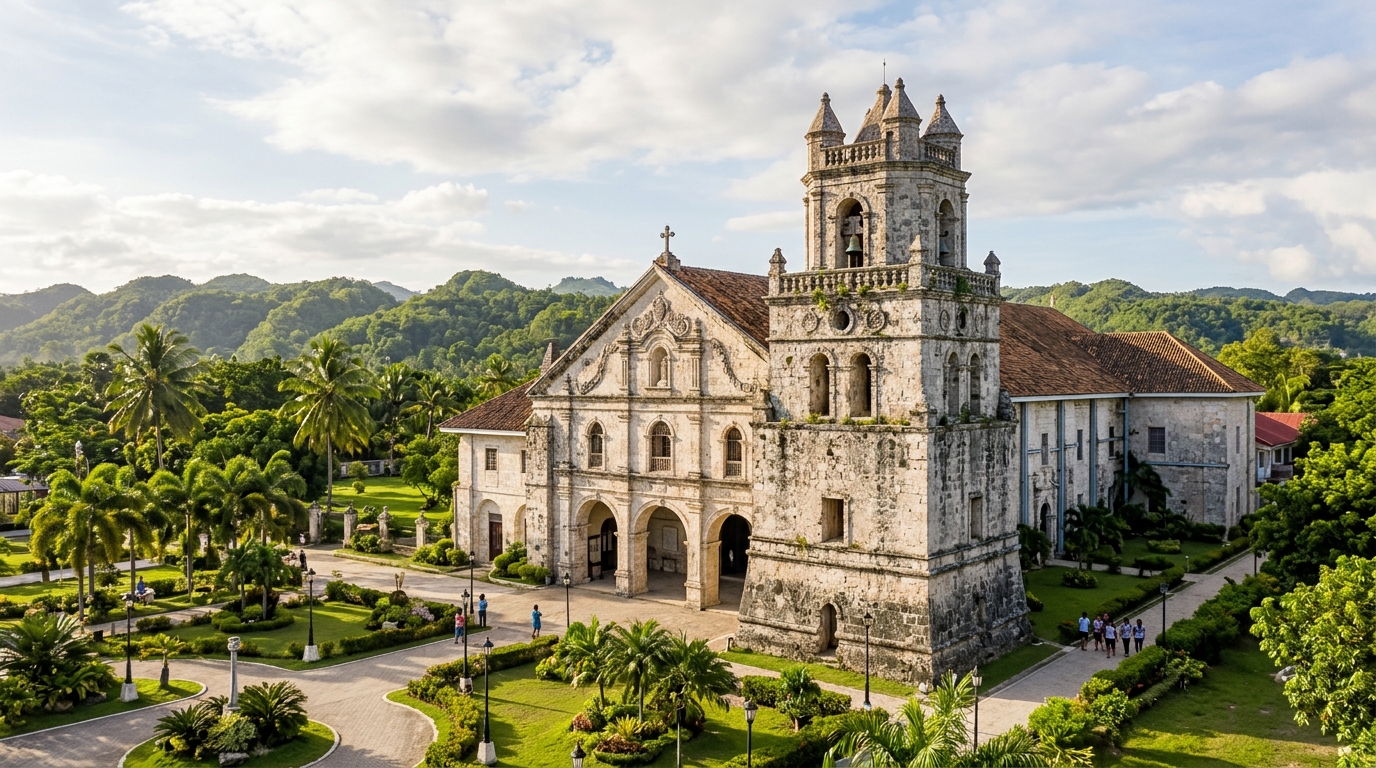
Heavy hand-hewn coral stone and egg-white mortar have once again become the pride of the Visayas as Bohol completes a massive decade-long mission to save its spiritual heart. While the 7.2 magnitude earthquake of 2013 left many of these 16th and 18th-century giants in ruins, a meticulous restoration effort has successfully brought them back to their former glory. Today, visitors can witness a rare intersection of colonial-era artistry and advanced seismic engineering, ensuring these National Cultural Treasures survive for centuries more
Echoes of the Jesuit Mission in Baclayon
Stepping into the Baclayon Church (Immaculate Conception) feels like a direct dive into 1595, where the air is thick with the scent of aged stone and history. The site is famous not just for its massive facade, but for a convent museum that houses some of the most precious 16th-century religious artifacts in the Philippines. Its restoration after the 2013 quake was a masterclass in mineralogy, utilizing traditional lime mortar to ensure the coral stones can breathe while maintaining structural integrity. You can still find the "face of a priest" naturally etched into one of the exterior pillars, a quirk of the coral that locals have marveled at for generations.
The Miraculous Waters of Dauis and Loboc
On the island of Panglao, the Dauis Church holds a secret beneath its altar: a freshwater well that miraculously appeared when the town was besieged by pirates. Even though the church sits just yards from the salty sea, the water remains fresh and is sought after by pilgrims for its purported healing properties. Not far away, the Loboc Church stands as a testament to the town's musical soul, having served as a center for instrument training during the Spanish era. While its location near the river made it vulnerable to floods and quakes, the recent completion of its structural reinforcement has preserved its unique Baroque silhouette and stunning interior murals.
The Rebirth of the Crown Jewels
The Loon Church, once known as the "crowning glory" of Recollect architecture in Bohol, was almost entirely leveled in 2013. After eight years of grueling work, the National Museum of the Philippines officially reopened the site in 2021, featuring reconstructed twin octagonal bell towers and Ray Francia’s restored ceiling murals. Similarly, the Maribojoc Church saw its entire structure crumble into a pile of rubble, leaving only a single statue of the Sacred Heart of Jesus standing amidst the debris. The church has since been painstakingly rebuilt piece by piece, reopening its doors on Gaudete Sunday in 2021 to serve once again as a beacon for the faithful and a marvel for history buffs.