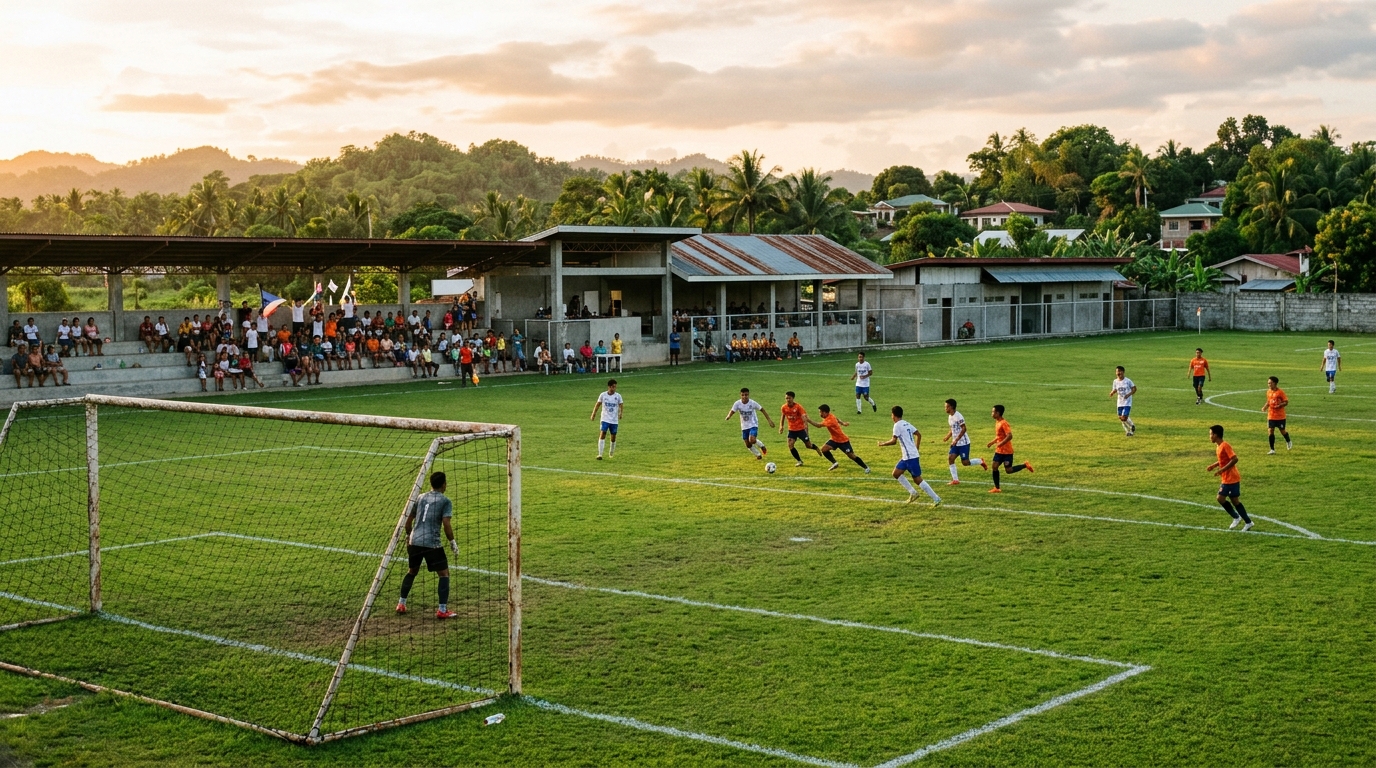
AJUY, ILOILO — On May 7, 2026, inside a municipal hall in northern Iloilo, Vice Mayor Jett Roxas received a package that property analysts tracking Western Visayas will likely ignore: 10 footballs. Provincial Administrator Dr. Raul Banias handed them over alongside Rey Cabarles of the Iloilo Sports Development and Management Office and Sports Consultant Pablito Araneta, acting on behalf of Governor Arthur Defensor Jr. The event was small. No billboard announced it. No property developer attended. Yet the donation—and the broader sports infrastructure strategy it represents—constitutes exactly the kind of quality-of-life investment that sustains residential demand beyond Iloilo City's urban core.
Ajuy, a coastal municipality of roughly 55,000 residents, sits within commuting distance of the economic centers that have made Iloilo the fastest-growing regional economy in the country. For the real estate sector, the footballs are not the story. The story is that the provincial government is methodically building out the amenities—playing fields, training programs, regional athletic meets—that transform provincial towns from places people leave into places people choose to raise children. And families that choose to stay buy homes.
The Field That Five Municipalities Will Share
The 10 footballs handed to Vice Mayor Roxas are not destined for a random patch of grass. Ajuy is one of the beneficiaries of Governor Defensor's "One Town, One Football Field" program, which has already secured P15 million in funding for the construction of six football fields across the province. The program was established in coordination with the Philippine Football Federation and represents a deliberate attempt to embed regulated, facility-based sport into municipalities that have long relied on informal play spaces. When the field in Ajuy is completed—alongside those in the other five recipient towns—it will serve not only local youth but also attract regional competitions, visiting teams, and the small economic activity that accompanies weekend tournaments.
This is where the link between sport and property becomes legible. A municipality that hosts football tournaments hosts visiting families. Those families eat at local restaurants, buy fuel at local stations, and—over time—register the town as a possible place to live. Real estate economists have long documented a "stadium effect" around major sports infrastructure, but the rural equivalent is quieter and more gradual. It operates at the scale of the football field, not the arena. It takes years, not quarters. And it depends not on a single ribbon-cutting but on a sustained pattern of investment—footballs delivered, fields built, coaches trained, leagues formed—that signals to prospective homebuyers that the municipality is functioning, improving, and worth the commitment of a mortgage.
A Quality-of-Life Premium That Buyers Recognize
Iloilo's property market in 2026 is the strongest outside Metro Manila. Colliers Philippines reported that the province recorded a 96 percent house-and-lot take-up rate and an 89 percent condominium take-up rate in the first quarter, figures that outpace Metro Cebu and anchor a regional economy that expanded by 6.4 percent in 2025. The Philippine Statistics Authority has noted that Western Visayas leads the country in growth. Seventeen percent of household remittances now flow into real estate, according to Bangko Sentral data.
But sustained demand at these levels requires more than office towers and BPO seats. It requires that the towns surrounding Iloilo City—the Ajuy, the Concepcion, the Sara—offer a quality of life that makes them competitive with urban subdivisions. A family choosing between a P3-million house-and-lot in a Leganes subdivision and a P1.5-million home in Ajuy makes a calculation that includes commute time, school access, and safety. Increasingly, that calculation also includes what the town offers their children on weekends. A football field with a trained coach and a provincial league to aspire to is not a trivial variable in that equation. It is, for a growing number of families, the variable that tips the decision.
The Governor's Bet on Durable Growth
Governor Defensor's administration has invested in sports infrastructure with a consistency that suggests it is not a legacy project but a planning doctrine. Ajuy and Concepcion have received greenhouse facilities from the provincial government in partnership with Angat Buhay. The province now hosts a growing calendar of athletic events, including the Western Visayas Regional Athletic Association (WVRAA) meet. The Philippine Sports Commission has publicly lauded the province's grassroots sports development program. These are not disconnected initiatives; they share a common logic of embedding institutional infrastructure in municipalities that have historically been bypassed by the growth concentrated in Iloilo City and its immediate suburbs.
For the real estate sector, this logic carries a name that every developer recognizes: the livability premium. Towns that invest in youth development, public facilities, and community-building amenities are towns where property values appreciate not because of speculation but because people want to live there. The 10 footballs that arrived in Ajuy on May 7 are a small, tangible expression of a larger provincial strategy, one that treats the decision to build a football field in a coastal municipality as being, in its own way, as consequential to long-term property values as the decision to widen a road.