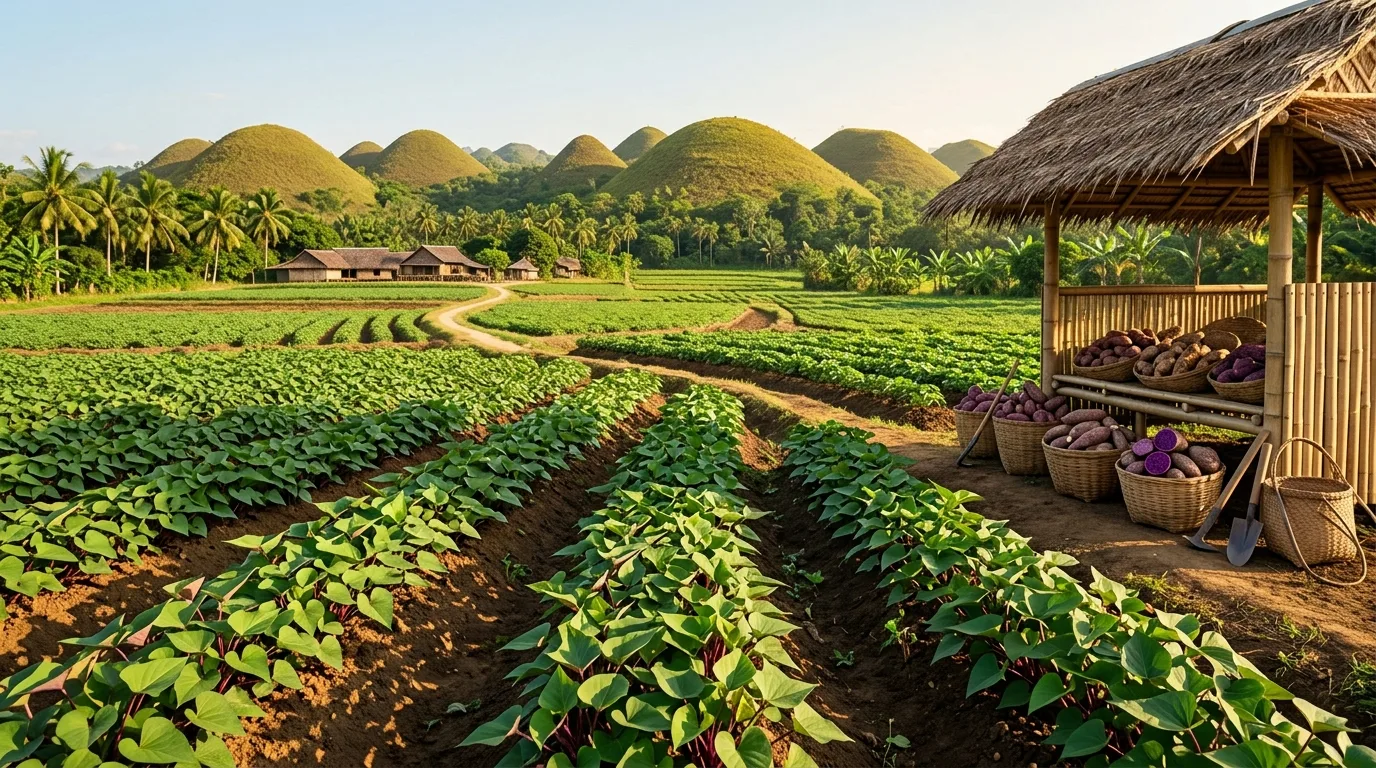
Bohol — In a major push to preserve Bohol’s agricultural heritage and boost local livelihoods, the Provincial Government of Bohol (PGBh) and the Department of Agriculture Regional Field Office 7 (DA-RFO 7) met on July 2, 2026, to forge a strategic plan for the province’s famed "ubi" industry. Presided over by Provincial Administrator Asteria Caberte on behalf of Governor Aris Aumentado, the coordination meeting signaled a renewed commitment to elevating ubi—specifically the prized "Ubi Kinampay"—from a traditional crop to a competitive global commodity. With the province currently pursuing Geographical Indication (GI) protection for its purple yam, this interagency alignment is a crucial step in ensuring that Bohol remains the undisputed "Ubi Capital of the Philippines."
Science-Based Strategies for Ubi Resilience
The discussion centered on bridging the gap between current production limitations and the soaring global demand for purple yam. DA-RFO 7 officials highlighted that while Bohol remains the top producer, the industry faces significant hurdles, including seasonal constraints, pest and disease outbreaks, and the need for more advanced farm-level technologies. To counter these, the Capitol is looking to integrate science-based practices—such as rapid propagation techniques and disease surveillance—to ensure year-round supply and higher yield quality. By leveraging the expertise of researchers and focusing on crop protection, the province aims to empower farmers to transition from traditional subsistence farming to more resilient, commercial-scale production.
Securing International Support for the Value Chain
A key highlight of the meeting was the move to position Bohol to access external financial assistance, including a proposed partnership with the U.S. Department of Agriculture (USDA) to strengthen the ubi value chain. Officials identified the need for a comprehensive development roadmap that covers the entire journey of the crop—from laboratory-tested planting materials to processing and market distribution. Provincial Administrator Caberte emphasized that while modernization is the goal, preserving the cultural significance and "Boholano identity" of ubi remains non-negotiable. As a UNESCO Global Geopark, Bohol is setting a precedent for how a community can use regenerative and sustainable agricultural practices to protect a heritage crop while fostering economic growth for local farmers.