ILOILO CITY — When the Department of Human Settlements and Urban Development (DHSUD) and the Department of Environment and Natural Resources (DENR) unveiled the "Green Resilient Home" at the Iloilo River Esplanade on April 24, 2026, they presented more than a model unit. They laid down a blueprint that is already reshaping how developers price properties, how lenders evaluate risk, and how homebuyers in Iloilo calculate long-term housing costs.
A model unit that doubles as a product preview
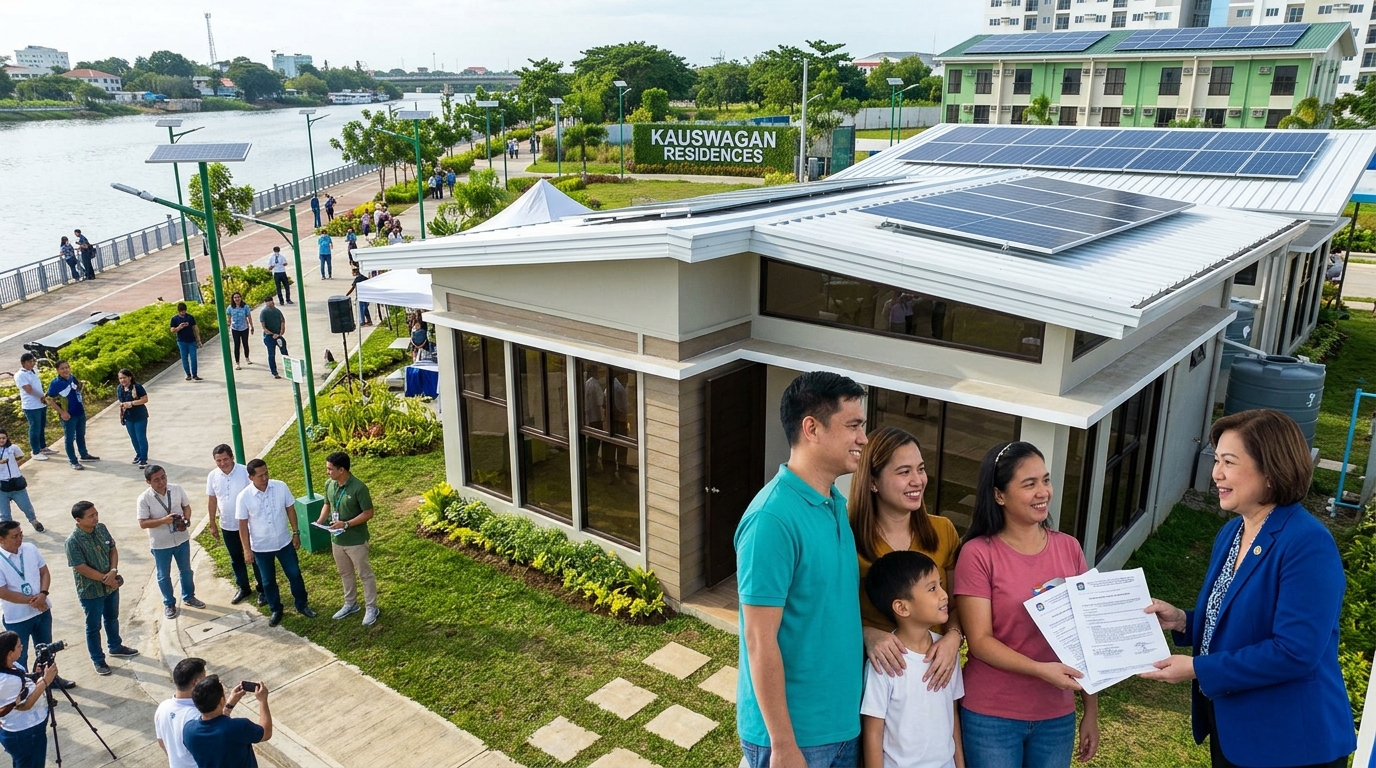
The Green Resilient Home, built in just two and a half days by private partner Eon Realty Development Corporation, showcased three key features: cool roofs that deflect solar heat, rainwater harvesting systems that reduce dependence on municipal water supply, and solar-ready infrastructure wired for future photovoltaic panel installation. DHSUD Secretary Jose Ramon Aliling framed the model as a preview of future national housing standards, signaling that sustainability is no longer a premium add-on but a baseline specification. DENR Secretary Juan Miguel Cuna reinforced this direction, calling the pilot homes "ready protection for families" against rising temperatures and unpredictable weather.
Lower carrying costs redefine affordability
From a real estate perspective, the model's features translate directly into reduced household operating expenses. Cool roofs lower indoor temperatures, shrinking air-conditioning loads. Rainwater harvesting cuts monthly water bills. Solar-ready wiring removes one of the biggest barriers to renewable energy adoption: the upfront cost of retrofitting. For homebuyers, these savings improve debt-service ratios and expand borrowing capacity. For developers, the model provides a replicable template that differentiates their inventory in a competitive market where Colliers Philippines reports condominium prices have grown by approximately 5.4 percent annually from 2016 to mid-2024.
Pag-IBIG puts a price tag on green design
Banks and financing institutions are also adjusting. During the launch, Pag-IBIG Fund CEO Marilene C. Acosta announced a 20 percent premium incentive for developers who incorporate green features, larger open spaces, and edible landscaping into housing projects. The policy effectively reduces the cost of building sustainably, making green-certified homes more viable at the affordable and mid-income tiers. The fund simultaneously awarded housing loans to beneficiaries of Kauswagan Residences, proving that green financing is already moving from announcement to implementation in Western Visayas.
Two projects turn concept into neighborhood
The Green Resilient Home did not launch in isolation. The event included the ceremonial awarding of Certificates of Entitlement to Lot Allocation to 25 beneficiaries of Batiano Village, a 173-unit climate-resilient development in Iloilo City featuring loft-type, disaster-resilient units for families relocated from hazard-prone riverbanks. Five additional certificates went to beneficiaries of the Purok Resilience Village in Batad, Iloilo, where 30 families have already moved into 36-square-meter homes equipped with solar streetlights, underground power lines, and rainwater harvesters. Both projects demonstrate that climate-adaptive housing is operational at multiple price points, from socialized relocation sites to mid-density urban developments.
A ripple effect across private development
Private developers are taking note. On April 22, just two days before the Green Resilient Home launch, SM Development Corporation energized its first renewable energy system in the Visayas at Style Residences in Iloilo City, with solar panels powering common-area lighting and shared facilities. SMDC subsequently announced that renewable energy integration will become standard across all future SMDC Nature developments, a commitment that aligns with the national push toward climate-resilient housing. The convergence of public-sector standards and private-sector adoption is creating a market environment where green-certified properties command growing buyer preference.