ILOILO — At the southernmost edge of Iloilo province, where the Panay Gulf opens into the Sulu Sea, a quiet revolution in community-led conservation has been unfolding for over a decade. Kuliatan Marine Sanctuary, an 80-hectare protected area in Barangay Sinogbuhan, has spent years safeguarding its coral gardens and reef fish far from the tourist spotlight. In March 2026, the Department of Tourism and the Department of Environment and Natural Resources formally admitted it into the Western Visayas Ecotourism Loop, a network of certified destinations that prioritise nature-based, community-driven tourism. For the traveler, the certification is both a credential and an invitation: this is the year to point the car south, past the sugarcane fields and the old Spanish cemeteries, and discover a stretch of Iloilo coastline that has been quietly waiting.
A Community That Guarded Its Own Waters
Kuliatan was not handed down by a government agency or imposed by a distant NGO. It was established by the residents of Barangay Sinogbuhan themselves, a community of fisherfolk who understood that the depletion of their coastal resources was not an abstraction but a threat to their next meal. A 2024 study by Central Philippine University surveyed 201 household heads in the barangay and found a striking consistency: regardless of age, sex, educational attainment, or sectoral affiliation, residents shared a uniform commitment to the sanctuary’s environmental and socio-economic sustainability.
That commitment translates into daily practice. Wardens patrol the waters, ensuring carrying capacity limits are observed during peak season. The Philippine Coast Guard District Western Visayas reinforced this ethic in June 2025 when it conducted a SCUBASURERO underwater cleanup at the sanctuary, recovering six sacks of assorted waste from the seabed. The operation, led by the Coast Guard Special Operations Group, was part of the agency’s 42nd anniversary preparations and served as a public reminder that marine protection is an active, ongoing discipline rather than a ceremonial designation.
What the 2026 Certification Means for the Traveler
The inclusion in the Western Visayas Ecotourism Loop places Kuliatan in a select group of 12 new sites that passed a rigorous assessment covering ecological sustainability, visitor safety, and community participation. DENR Regional Executive Director Raul L. Lorilla emphasised that the certification is not about adding destinations to a map but about creating “a sustainable ecosystem where tourism supports the environment rather than draining it.”
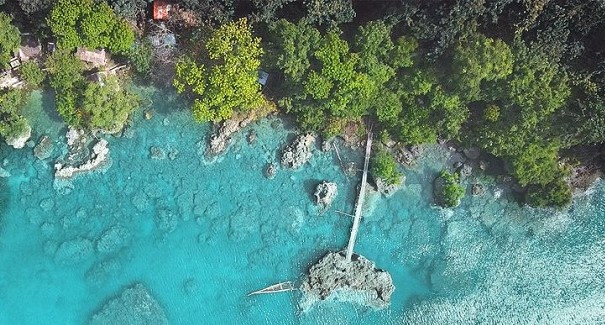
For the visitor, this means a deliberately low-impact experience. The sanctuary’s infrastructure is functional rather than flashy: a view deck perched on the rocky cliffs for panoramic vistas, native-style huts available for day use at ₱250 and overnight stays at ₱750, and a cantilevered footpath that descends from the elevated entrance down to the sandy shoreline fronting the Panay Gulf. Entrance is priced at ₱50 per person, with snorkeling gear available for an additional ₱20 and life vests for ₱30. A small cave and a natural pool area add variety to the site, while the rocky coastline itself—weathered into dramatic formations—provides a visual drama that photographers will find difficult to exhaust.
Beneath the surface, the sanctuary delivers the biodiversity that its protectors have spent years defending. Angelfish, butterflyfish, and surgeonfish school through the shallows, while the deeper sections harbour hard and soft corals, sea turtles, and clownfish. The shallow reef area is forgiving enough for beginner snorkelers, while more experienced divers can explore the outer zones where the seafloor drops away. American visitor Michael Thayer, who has made Kuliatan a regular stop, described it plainly: “It’s the scenery, the tranquility of it, it’s the relaxing environment, a lot less tourists and it’s just peaceful. If anybody wants to get away and have an amazing experience, come to Iloilo with the off the beaten path locations. It’s the way to go to get the true mental health escape.”
Getting There and What to Bring
San Joaquin sits roughly two hours south of Iloilo City by private car, with frequent buses and jeepneys servicing the route for those relying on public transport. The drive itself is a gradual unwinding: the urban density of the city thins into rice paddies, then into coconut groves, and finally into the rocky, sun-bleached coastline that defines southern Iloilo. The sanctuary’s entrance is located on higher ground, so visitors should expect a steep descent by foot to reach the shore. Reef-safe sunscreen, a dry bag, and cash are essential; ATMs are scarce in this part of the province.