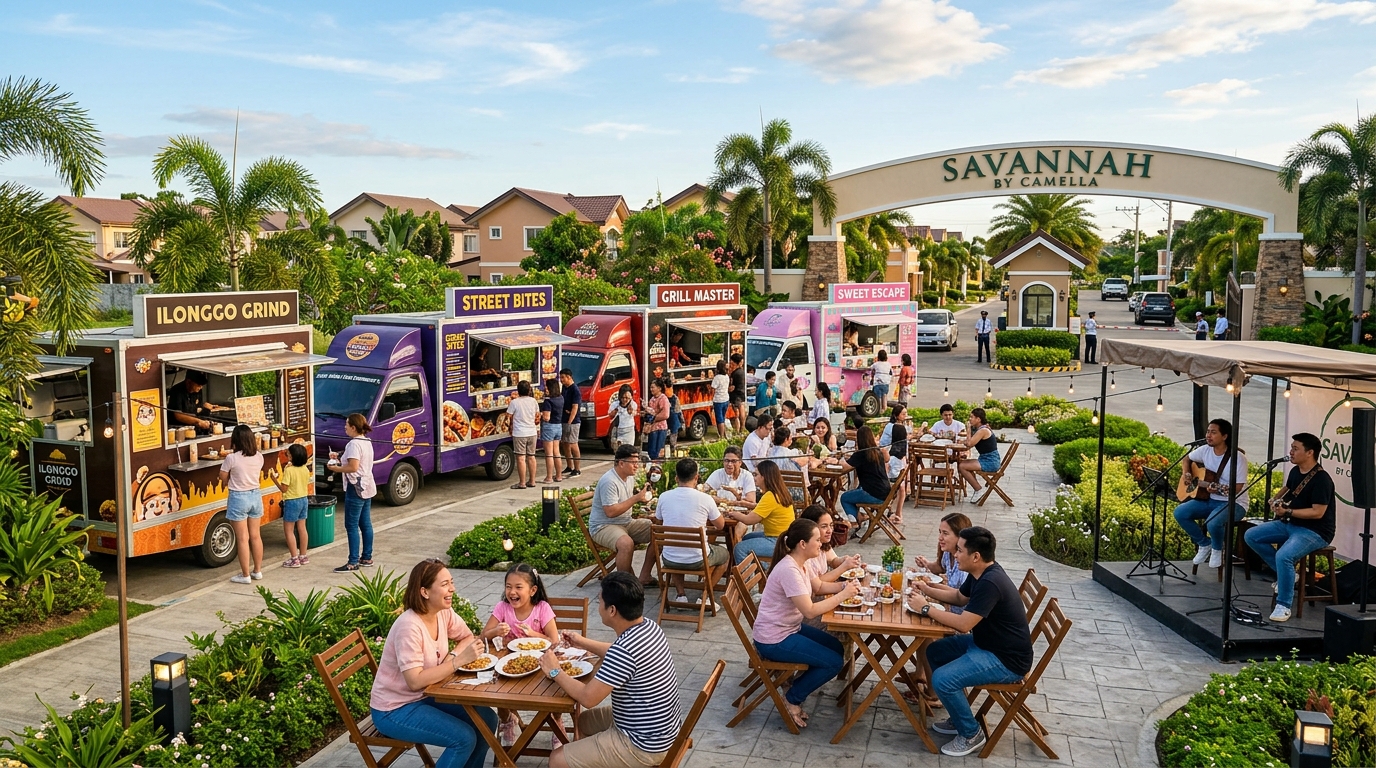
OTON, ILOILO — There is something quietly transformative about the smell of grilled cheese and sizzling garlic drifting across a manicured lawn just as the afternoon light turns golden. That sensory shift has now become a weekend ritual at Savannah by Camella, where the main gateway has been transformed into a bustling open-air culinary hub. In partnership with the Iloilo Mobile Food Community, the sprawling master-planned township now hosts a food truck assembly every Saturday and Sunday, turning a residential landmark into one of the province’s most inviting community dining destinations.
The assembly is the brainchild of Iloilo Mobile Food Community President Julix Mendoza, who has spent years cultivating a grassroots collective of mobile kitchen entrepreneurs. His vision for Savannah is both simple and carefully observed: create a “chill spot” where families can unwind without driving far from home, while giving small-scale food vendors a platform to reach a discerning, community-oriented audience. “This assembly is a celebration of flavors and community,” Mendoza said. “We are thrilled to bring our grassroots collective of entrepreneurs to Savannah, providing a platform for local mobile food vendors to connect.”
A Mobile Feast That Brings the City to the Suburbs
The lineup of vendors is a curated mix of Ilonggo creativity and culinary ambition. The Blu Kitzen serves visually striking artisanal drinks, while Tea Lab PH caters to the city’s growing thirst for thoughtfully crafted beverages. Sillyoldman and J Pizza bring inventive street food and stone-fired comfort classics, and Chicken Inato 2 Go offers a mobile take on the region’s beloved roasted chicken heritage. Each truck represents a small business that has found in Savannah a stable weekend venue, a break from the uncertainty of transient vending.
The format is deliberately unhurried. Live music sets the mood, cozy seating encourages lingering, and the open-air layout gives children room to play while parents catch up with neighbors. It is the kind of scene that blurs the line between public market and private gathering, and in doing so, it solves a familiar suburban problem: the need to drive to the city center for a decent evening out. Savannah’s food truck assembly brings the downtown energy to the doorstep of its residents.
A Culinary Collaboration Rooted in Urban Progress
The partnership between Savannah and the Iloilo Mobile Food Community arrives at a moment when the city’s mobile food sector is entering a new era of legitimacy. In early 2026, the Iloilo City Council passed an ordinance regulating food trucks and mobile kiosks, authored by Rudolph Jeffrey Ganzon. The measure requires permits and enforces sanitation, safety, and zoning standards, effectively professionalizing a sector that has long operated informally. Ganzon described food trucks as “emerging drivers of economic activity” that “showcase Iloilo’s vibrant culinary culture” while providing employment.
Savannah’s embrace of mobile food vendors aligns neatly with this regulatory shift. By hosting vendors within a private, well-managed estate, the township provides a controlled environment that satisfies city requirements while offering entrepreneurs a dignified, stable venue. It is a model that other suburban communities might soon replicate, especially as Iloilo’s reputation as a UNESCO Creative City of Gastronomy continues to draw attention to its food scene. The assembly is not simply a weekend diversion; it is a living laboratory for how curated mobile dining can integrate into master-planned residential life.
More Than a Meal: The Role of Food in Building Neighborhood Identity
Savannah by Camella has long positioned itself as Iloilo’s premier residential address—a 500-hectare township where Spanish-Mediterranean elegance meets the warmth of Ilonggo community spirit. The development has previously hosted fun runs, medical missions, and frisbee tournaments as part of its community-building calendar. The food truck assembly adds a weekly, recurring ritual that transforms the main entrance from a pass-through point into a gathering place.
For residents, the assembly changes the texture of weekend life. It is the difference between a subdivision where people wave from their cars and one where they sit across picnic tables, sharing a pizza and a conversation. In an age when digital devices often fragment household interactions, the simple act of eating together outdoors—with live guitar chords in the background and the scent of brewing coffee on the breeze—carries an almost countercultural weight. Savannah’s weekend food truck assembly is, in this sense, not just a lifestyle amenity but a quiet investment in the social fabric of the community.