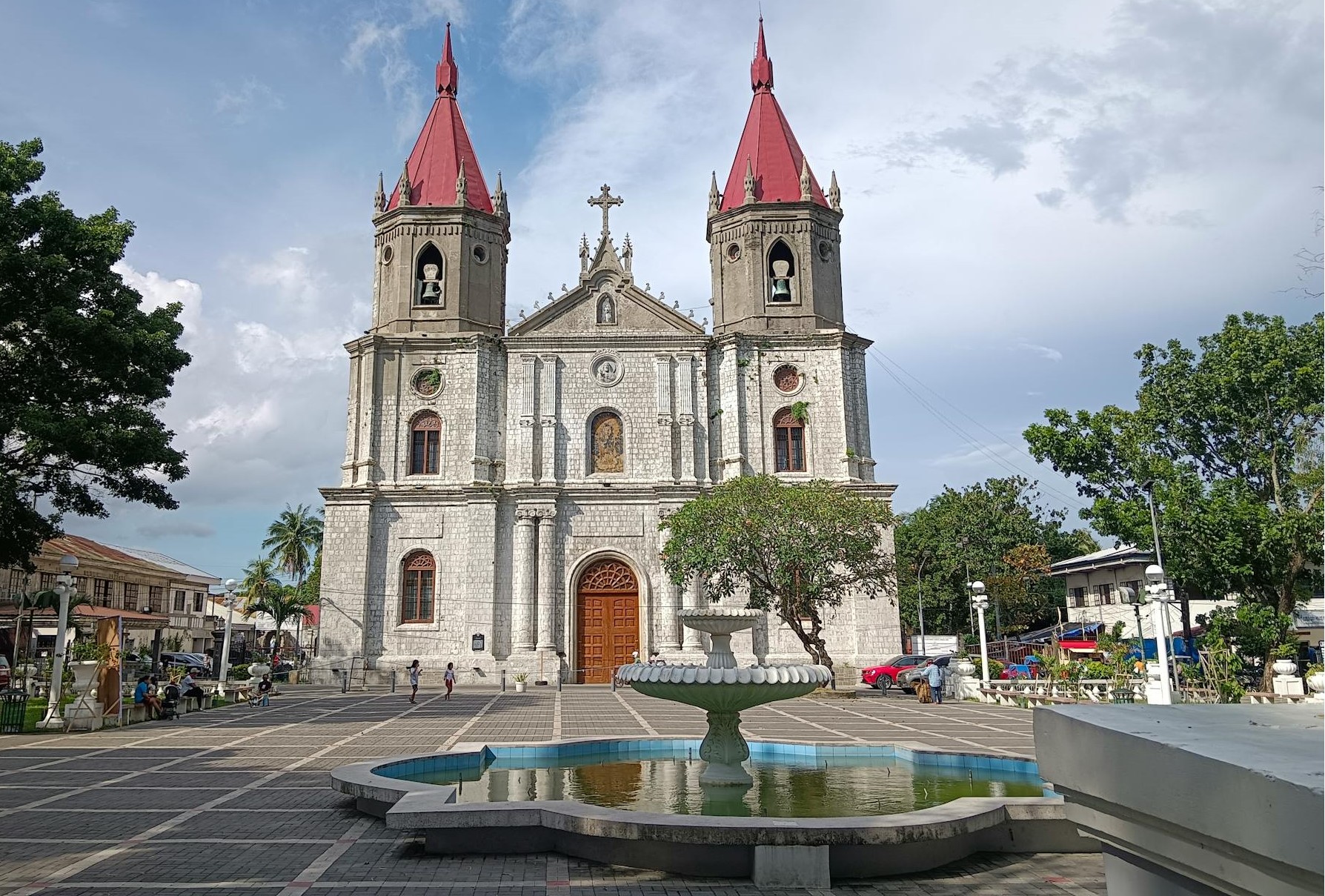
ILOILO CITY — A short jeepney ride from the bustling city center, past the molave trees of Molo Plaza, two red spires rise above the rooftops like a signal to travelers that something rare awaits. This is Molo Church—officially the Santa Ana Parish Church—but to the thousands who stream through its coral-stone doors each year, it is simply "the feminist church." No other church in the Philippines does what this one does: line its nave with the statues of 16 female saints, two rows of silent, stone women gazing down from their pedestals as if presiding over a centuries-long council. For the visitor, stepping inside is less a passive act of sightseeing and more an encounter with a theological counter-narrative built in coral, limestone, and stained glass.
The church's nickname is not a modern invention or a tourism rebrand. It is rooted in architecture and iconography. Saint Anne, the mother of the Blessed Virgin Mary, occupies the center of the altar beneath a Gothic-style canopy, flanked by the Blessed Virgin and the Holy Trinity. Around the nave, the 16 female saints—Marcela, Apolonia, Genoveva, Isabel, Felicia, Ines, Monica, Magdalena, Juliana, Lucia, Rosa de Lima, Teresa, Clara, Cecilia, Margarita, and Marta—stand in two orderly rows, a congregation of women immortalized in stone. Two archangels, Michael and Raphael, guard the main portal, but inside, the visual language belongs overwhelmingly to the feminine. Travel writer RJ Dexplorer described the sight as reflecting "Molo's progressive and intellectual heritage, once celebrated as the Athens of the Philippines."
A Fortress of Coral That Refused to Fall
The church that stands today was completed in 1888, but its roots stretch back to 1831. Built predominantly of coral rock and limestone, the structure is the only Gothic-Renaissance church in the country outside Manila—a hybrid architectural statement that fuses the pointed arches and soaring verticality of Gothic design with the balanced proportions and domed ceiling of the Renaissance. Its two red belltowers, visible from as far as the Iloilo Esplanade, house 30 bells of varying sizes. The white coral-stone facade, weathered by nearly a century and a half of typhoons and salt air, gives the church a texture that feels both ancient and enduring.
Enduring is precisely what Molo Church has proven to be. During the Second World War, it served as an evacuation center, its thick coral walls shielding civilians from the bombardment that shattered much of the city around it. It has withstood several powerful earthquakes and countless storms. In 1992, the National Historical Institute declared it a national landmark. More recently, Republic Act No. 10555 designated Molo Church, along with Jaro Cathedral, Molo Plaza Complex, and Plaza Libertad Complex, as part of a Cultural Heritage Tourism Zone—a legislative acknowledgment that the church is not merely a parish but a pillar of the regional visitor economy.
National hero Dr. Jose Rizal is said to have visited the church in 1866, drawn by biblical paintings that can no longer be seen. The paintings are gone, but the church's magnetism endures. During the Dinagyang Festival in January 2026, a young girl lifted the Santo Niño high inside the nave and led dancers down the aisle in a vivid reenactment of the image's discovery—neo-Gothic stillness giving way to motion, as the Daily Tribune described it.
Beyond the Church Doors: A Complete Heritage District
What makes Molo Church a complete tourism experience rather than a single stop is the district that surrounds it. Directly across the plaza stands the Molo Mansion, also known as the Yusay-Consing Mansion, a neoclassical heritage house built in the 1920s during Iloilo's sugar boom. Now owned by the SM Group and housing a Kultura boutique, the mansion is open to the public and provides a seamless architectural complement to the church. The plaza itself, shaded by molave trees and scented with kalachuchi blooms, hosts a statue of suffragette Pura Villanueva Kalaw—a reminder that Molo's feminist legacy extends well beyond its church walls.
For the food-oriented traveler, Molo offers its eponymous dish: Pancit Molo, a pork-and-shrimp dumpling soup with Chinese influences that reflects the district's history as Iloilo's original Chinatown. Kap Ising's Pancit Molo and Panaderia de Molo, founded in 1872, both sit within walking distance of the plaza. The Iloilo Esplanade, a 10-kilometer green corridor along the river, begins a short walk away, allowing visitors to transition from heritage interiors to riverfront views in a single morning. Entrance to the church is free, and visitors are welcome to explore or attend mass. The best months for a visit are November through February, when temperatures ease and the city's festival calendar reaches its peak. The Feast of St. Anne, celebrated every July 26, offers a more crowded but culturally immersive alternative.