



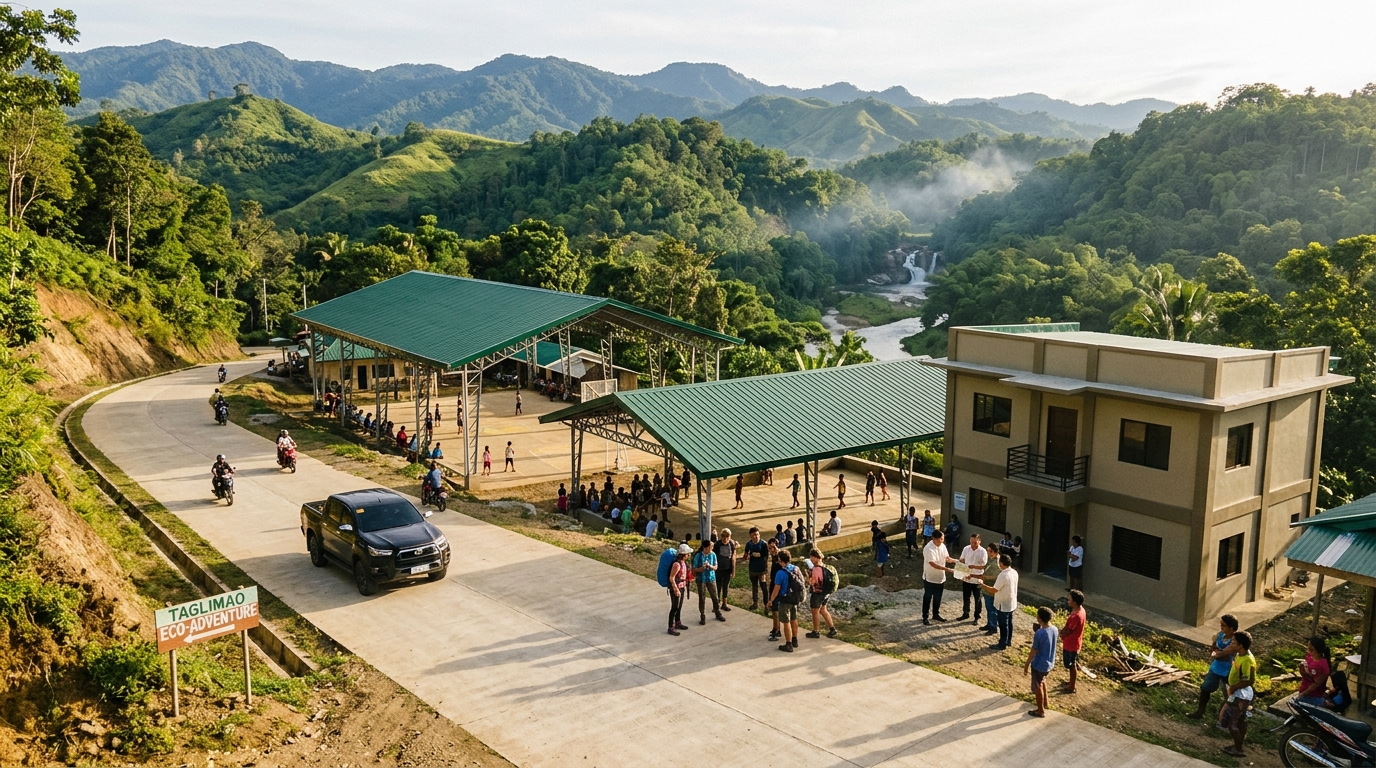
CAGAYAN DE ORO CITY — The city government has turned over four infrastructure projects worth over ₱23 million in Barangay Taglimao, a move that local officials say will not only improve daily life for residents but also unlock the upland village’s long‑recognized potential for eco‑tourism and adventure travel.
The projects—a two‑storey barangay hall, covered courts for the high school and elementary school, and a road concreting link between Sitio Nabitay in Taglimao and Barangay Tagpangi—were formally turned over by Mayor Rolando “Klarex” Uy. The new facilities, worth a total of ₱23,086,111.06, are designed to serve governance, education, and transport needs.
A Gateway to Upland Wonders
Beyond their immediate civic benefits, the infrastructure upgrades are seen as a critical first step in turning Taglimao into a jump‑off point for eco‑adventure. The barangay sits in the city’s hinterland, an area that has long been eyed for tourism development. A 2018 proposal by the CDO Upland Initiatives Federation identified Taglimao as one of several upland barangays with caves, natural spring areas, and waterfalls that could be developed into tourist destinations.
“The group wants to develop the caves, natural spring areas, waterfalls, and other sites particularly in Barangays Tagpangi, Pagalungan, Taglimao, Tuburan, Pigsag‑an, Tumpagon, Lumbia, Mambuaya, Bayanga, Tignapoloan, Dansolihon and Balubal,” the federation told the City Council’s tourism committee.
That vision has been echoed more recently. In early 2026, the city council moved to develop the Bungkalalan River in Barangay Baikingon as an eco‑adventure destination, signaling a broader push to tap the tourism potential of CDO’s upland communities.
Concreting the Path to Adventure
The newly concreted road connecting Sitio Nabitay in Taglimao to Barangay Tagpangi is expected to improve mobility and support the transport of agricultural products, but its tourism implications are just as significant. Better roads mean easier access for visitors who may want to explore Taglimao’s natural attractions, while the covered courts can serve as staging areas for tour groups or community‑based eco‑tourism activities.
“Kini nga mga proyekto, dili lamang mga imprastraktura nga gama sa semento, kini usa ka direktang tubag sa nagkadaiyang panginahanglan sa atong komunidad,” Mayor Uy said during the turnover. (These projects are not just infrastructures made of cement; they are a direct response to the various needs of our community.)
From Farm‑to‑Market to Farm‑to‑Tourism
The road project also dovetails with larger regional efforts to link agriculture with tourism. The Regional Development Council has been championing a Farm‑to‑Market Bridges Development Program, and local planners see Taglimao as a potential hub for agri‑tourism, where visitors could experience upland farming while enjoying the area’s natural scenery.
A Model for Inclusive Tourism
Residents and barangay officials, led by Punong Barangay Nick Nick D. Sablada, received the projects. Former barangay captain Ruben Obsioma was also present. The turnover underscores the city’s commitment to spreading the benefits of tourism beyond the downtown core.
As CDO continues to diversify its tourism portfolio—from whitewater rafting to eco‑adventure and cultural heritage—infrastructure investments like those in Taglimao ensure that even the city’s farthest barangays can share in the growing visitor economy. For travelers looking to go off the beaten path, Taglimao may soon be worth the trip.
