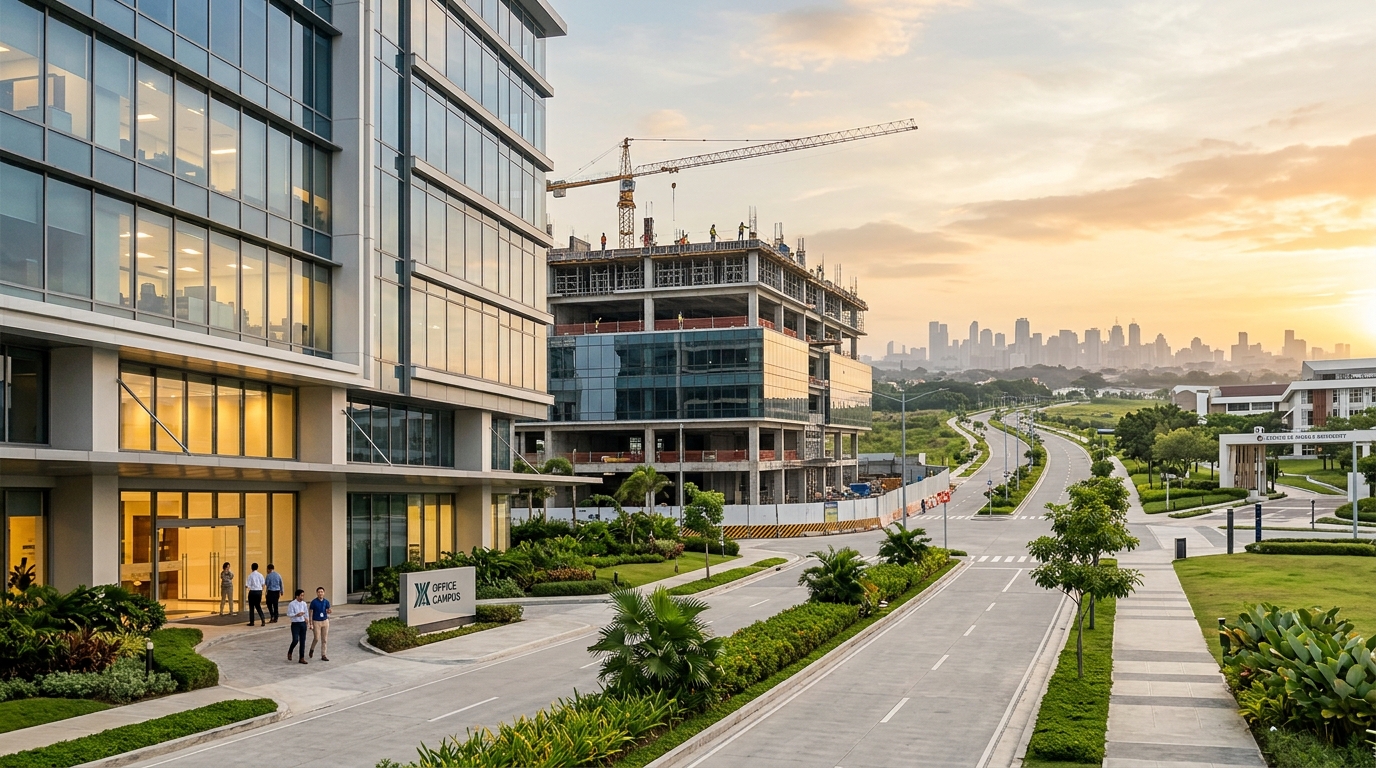
Cavite's office market is in a gradual recovery phase, with significant inquiries from both traditional firms and IT-BPO companies. Recent take-ups have reached between 3,000 to 4,500 square meters, with some prospects eyeing 5-digit space take-ups.
Steady Recovery Driven by Strong Demand
Cavite's office market is experiencing a steady recovery, buoyed by significant interest from both traditional firms and the IT-BPO sector. Based on internal requirements nationwide outside of the National Capital Region in 2025, Cavite received nearly a quarter of all annual inquiries, with more than half of these being expansion-related. Recent significant leasing transactions have ranged between 3,000 to 4,500 square meters, and some prospective tenants are now targeting five-digit space take-ups of 10,000 square meters or more. This growing demand reflects a broader trend of companies choosing to establish operations outside Metro Manila's congested business districts.
The province currently has an estimated office stock of approximately 180,000 square meters, with limited new supply expected in the next two to three years. However, new completions are still occurring in key growth hubs. In the fourth quarter of 2025, Ayala Land expanded its footprint in the south by delivering roughly 24,000 square meters of office supply through its Evo City development in Kawit. Meanwhile, Maplecrest in Cavite is set to deliver nine office buildings, each with 3,000 square meters, further catering to outsourcing firms seeking strategic suburban sites. These developments demonstrate the province's growing capacity to support large-scale business operations.
Strategic Advantages Fueling Expansion
Companies are drawn to Cavite by a powerful combination of cost competitiveness, proximity to Metro Manila, and access to a skilled workforce. By migrating just one kilometer south of Las Piñas to Cavite, businesses can access lower minimum wages at ₱550-600 per day compared to NCR's ₱695 per day. This has created a significant 32.7% difference in average monthly wages between the two regions. Office lease rates in Cavite also exhibit a clear cost advantage compared to southern NCR districts like Makati, Alabang, and Bonifacio Global City, making it a boon for cost-conscious tenants.
Cavite also offers a robust talent pool that is a key driver for this expansion. Outside of Metro Manila in Luzon, the province features the second largest density of higher education institutions, with 82 colleges and universities primarily concentrated in Dasmariñas, Silang, and Bacoor. This allows businesses to pursue "reverse migration" strategies, tapping into a workforce that already commutes from Cavite to Metro Manila. With a population growth rate of 1.51% annually from 2020-2024, Cavite's talent pool is expected to expand and sustain itself as more residents gravitate toward its developing township communities. This convergence of cost, location, and talent is steadily transforming Cavite into a premier destination for business decentralization.
A Promising Pipeline of Developments
The future of Cavite's office market looks increasingly bright with several major developments in the pipeline. Federal Land's Riverpark in General Trias—a 600-hectare "Next Gen City of the South"—will house SM City General Trias and a 15-hectare Ateneo de Manila University campus, creating a vibrant ecosystem that will attract more businesses to the area. Cebu Landmasters Inc. has also secured a 70-hectare township in Dasmariñas to build integrated, future-ready mixed-use communities that will further expand the province's office and commercial footprint. These large-scale projects signal strong confidence from the private sector in Cavite's long-term economic potential.
As these developments unfold, Cavite is steadily positioning itself as the Philippines' next premier investment destination. The province's office market is not just recovering—it is transforming into a dynamic hub that offers businesses the perfect balance of accessibility, affordability, and talent. For companies looking to decentralize while staying connected to the capital, Cavite has become the obvious choice.