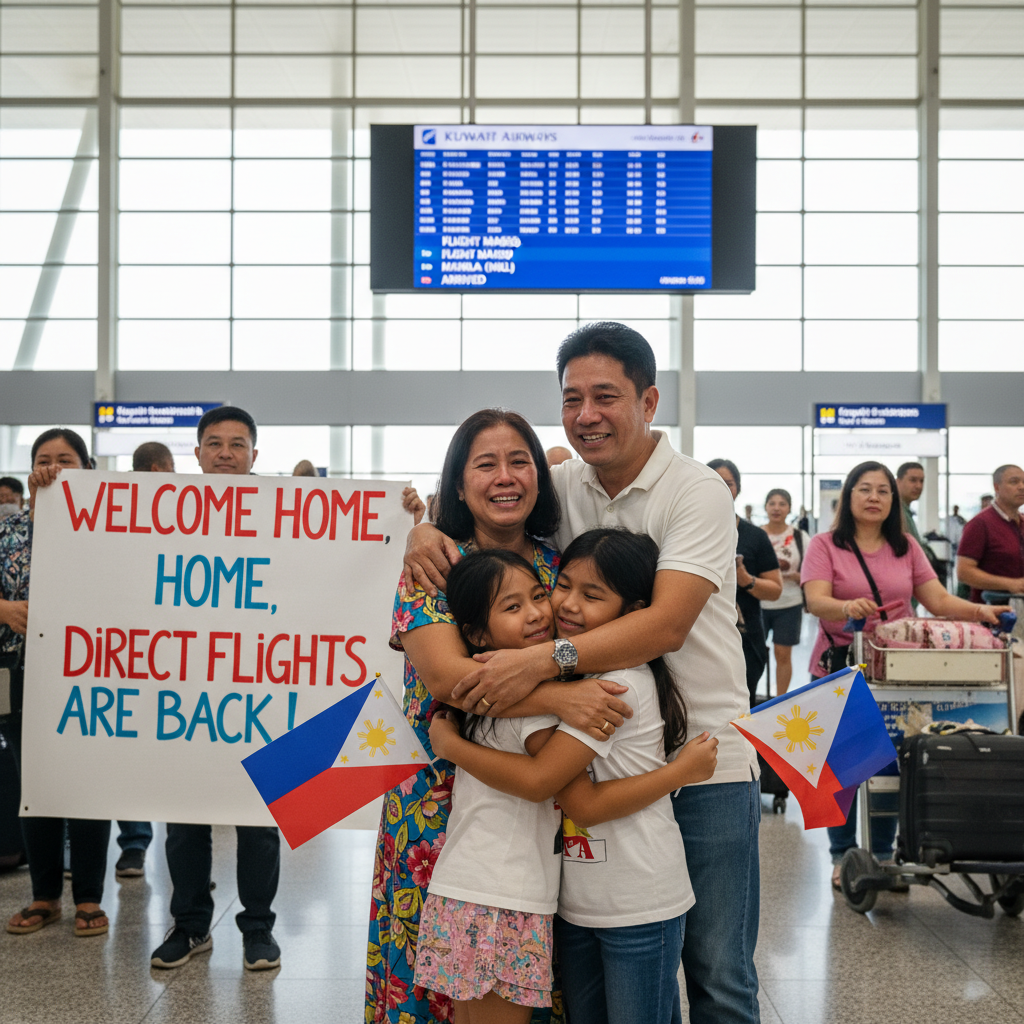
Nearly two months after being grounded by escalating Middle East tensions, Kuwait Airways has finally resumed commercial flights to the Philippines. The direct service reconnection, which began with a phased rollout in early April, is a critical development for the roughly 215,000 Overseas Filipino Workers (OFWs) in Kuwait, many of whom have struggled with canceled travel plans and costly stopovers. The restoration of this air link means that stranded workers, new hires, and families separated by the crisis can once again move between the two countries with a measure of certainty and safety.
A Phased Return: From Dammam to Manila
The airline’s comeback unfolded in two strategic stages. On April 8, 2026, Kuwait Airways launched the first phase of its resumption, operating flights via King Fahd International Airport in Dammam, Saudi Arabia. The indirect routing, while not ideal, provided an immediate safety valve for Filipinos who were anxious to return home or resume essential travel. The full restoration followed on April 26, 2026, when the carrier began flying directly between Manila and Kuwait International Airport three times weekly, alongside 34 other vital international routes. The airline had temporarily suspended operations in February following Iranian attacks on Kuwait, which triggered widespread airspace restrictions and flight cancellations across the region.
For the Philippine government and OFW advocates, the restoration of regular commercial flights was a top priority. Throughout March and April, repatriation efforts had relied heavily on government‑chartered and ad‑hoc commercial flights, which, while effective, were unable to meet the full scale of demand. By May 1, 2026, the service had expanded to 29 active destinations, with the Manila route operating smoothly as part of the airline’s regular schedule.
Nearly 8,000 Repatriated, and Counting
The reopening of the Manila route could not have come at a more urgent moment for Filipinos in the Gulf. As of April 28, 2026, over 7,900 OFWs and their dependents have returned to the Philippines through the government’s repatriation program, with hundreds more still in the repatriation queue. An estimated 40,000 newly hired OFWs have reportedly been stranded in Manila due to continued deployment bans across the Middle East, and the ongoing uncertainty has strained household finances and employment prospects.
The Kuwait Airways resumption alone has already delivered tangible results. On April 15, a special flight under carrier code KU417 carried 321 Filipinos back home from Kuwait. On April 28, another 200 returned aboard Gulf Air, with assistance from the Overseas Workers Welfare Administration (OWWA). The DMW has also reported that commercial flights from Kuwait continue to bring dozens more OFWs to Manila each week, easing the backlog that had built up following the February suspension.
Labor Protection in a Shifting Landscape
While passengers can once again book tickets with confidence, the broader OFW picture in Kuwait remains complicated. As of early April 2026, the Philippines has partially lifted its deployment ban for certain categories of workers, but a prohibition remains in place for first‑time household service workers (HSWs). The ban followed a series of high‑profile cases that strained bilateral relations, and though Kuwait lifted its visa ban on Philippine nationals in late March, the deployment restrictions have not been fully resolved.
In response, the governments of Kuwait and the Philippines signed a new agreement in March 2026 to improve protections for Filipino domestic workers. Key provisions include the right of workers to retain their own passports and mobile phones, and the requirement that contract renewals be approved by the Philippine Overseas Labor Office (POLO) in Kuwait, preventing automatic transfers that have historically been a source of exploitation. The DMW continues to advise all OFWs and job applicants to seek employment only through accredited agencies and to verify their contracts with POLO before traveling.
What OFWs Need to Know
For OFWs currently in Kuwait or planning to return, several practical steps are essential. The DMW strongly recommends that departing workers secure a valid Overseas Employment Certificate (OEC) from the DMW, which can now be processed online or through the Migrant Workers Office (MWO) in Kuwait. Those whose contracts have expired or who face labor disputes are urged to immediately contact the Philippine Embassy in Kuwait City for legal assistance.
The road ahead is not without obstacles, but the return of regular commercial flights is a vital piece of the recovery puzzle. With Kuwait Airways now operating a consistent schedule to Manila, thousands of Filipino workers can finally plan their journeys with the confidence that the air bridge between their host country and their homeland is once again open.