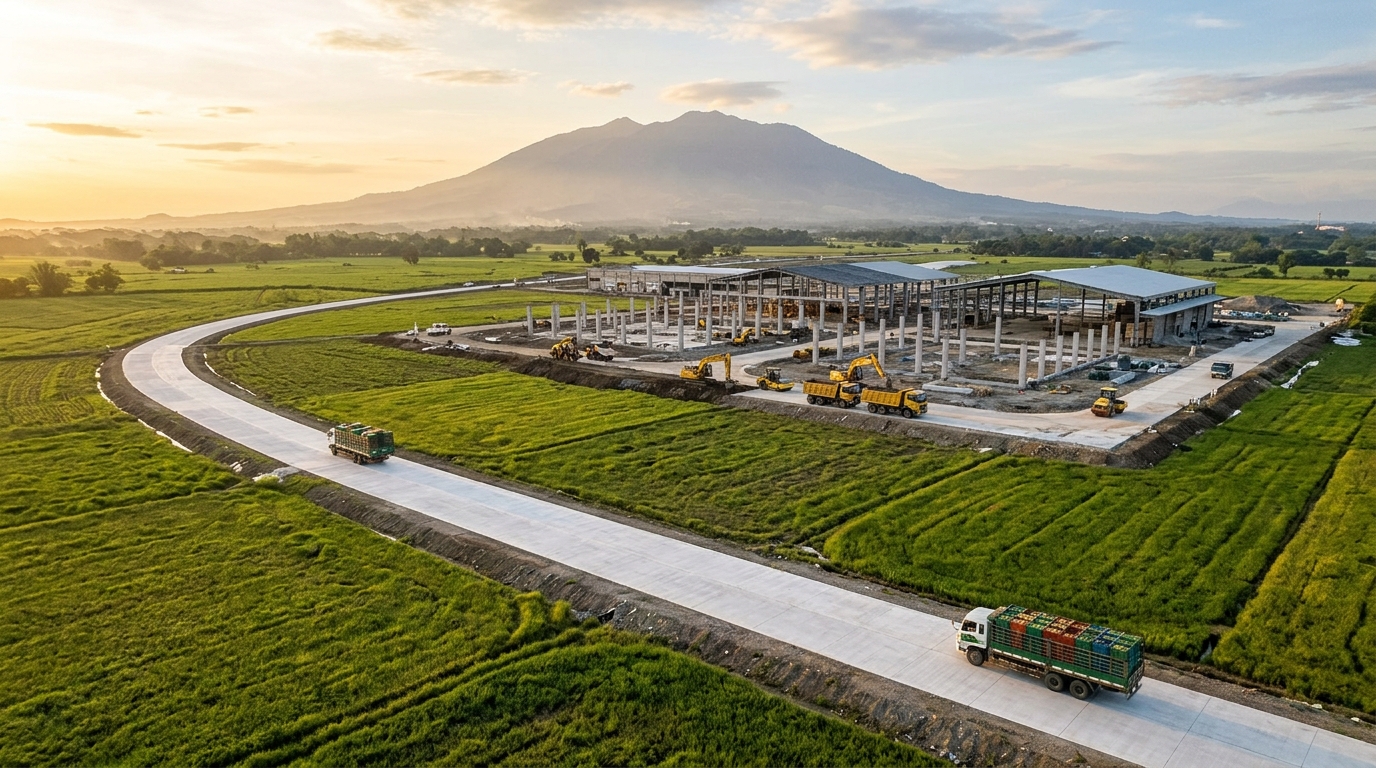
The Department of Agriculture is moving forward with a massive infrastructure push that will transform how agricultural products move in and out of Central Luzon. The agency will bid out a farm-to-market road (FMR) project in Clark, Pampanga worth between P2 billion and P4 billion to support the Clark Mega Food Hub, along with cold storage facilities ranging from P100 million to P500 million nationwide . The bidding process begins June 4, 2026, with construction targeted to start by August 2026.
The Clark National Food Hub is envisioned as a 46 to 60-hectare integrated agri-food complex inside the Clark Civil Aviation Complex, designed to serve as Northern Luzon's main food trading and logistics center . The facility will include wholesale trading areas, cold storage, food processing facilities, logistics infrastructure, and agri-tourism spaces, plus a halal-certified zone for wider market access.
From Stalled Bidding to August Construction Start
The bidding process for these FMR projects was originally targeted for April 2026 but was delayed due to two main factors. First, the global oil crisis required the DA to re-evaluate the per-kilometer cost of FMR construction. Second, the DA officially took over FMR construction from the Department of Public Works and Highways (DPWH) to ensure an agriculture-focused approach and avoid administrative delays.
DA Assistant Secretary Arnel de Mesa, chairperson of the Special Bids and Awards Committee for big-ticket FMRs, confirmed that the pre-procurement conference will be held on June 4, with bidding expected to last one to two months . "Normally bidding lasts about one to two months, so by August we can begin construction," de Mesa said in a press briefing.
The costing structure has also become more flexible. Unlike the previous uniform rate of P15 million per kilometer under the DPWH, FMR costs can now range from as low as P10 million to over P20 million per kilometer depending on terrain, materials, and labor costs.
A P33-Billion Nationwide FMR Program
The Clark project is part of a much larger national infrastructure push. The DA was allocated P33 billion for FMR projects under the 2026 budget, targeting the construction of 1,605 road works covering more than 2,300 kilometers of farm roads nationwide . Under the 2026 General Appropriations Act, all projects carry a two-year validity period and must be completed by December 2027.
Beyond Clark, the DA will also bid out FMR projects for coffee production areas in Sultan Kudarat worth approximately P2 billion, alongside the cold storage facilities . These combined investments represent a comprehensive strategy to improve agricultural logistics, reduce post-harvest losses, and boost farmer incomes across the country.
The Clark National Food Hub itself is a P3.6-billion project developed through a partnership between the Food Terminal Inc. (FTI) and Clark International Airport Corp. (CIAC), with a 25-year lease agreement signed in October 2025 . CIAC noted that approximately 50 percent of agricultural produce is currently lost during transportation—a problem the hub's cold storage and logistics facilities are designed to address.
What This Means for Pampanga Farmers
For farmers in Pampanga and surrounding provinces, the Clark Mega Food Hub and its supporting road network will create a direct, efficient route from farm to market. The hub will integrate wholesale trading, cold storage, food processing, and logistics under one roof, allowing farmers to sell their produce at fair prices while minimizing spoilage.
DA Secretary Francisco Tiu Laurel Jr. has described the initiative as part of the agency's long-term strategy to modernize the country's food supply chain, drawing from successful models in countries like Thailand . With construction of the FMRs set to begin in August and the food hub itself expected to be completed by the first quarter of 2027, Pampanga is positioning itself as a central node in the nation's agricultural logistics network.