CEBU CITY — Even as the global economic landscape grows more turbulent, Ayala Land Inc. (ALI) is charting a course defined not by panic, but by precision. At the company's Annual Stockholders' Meeting held on April 23, 2026, President and CEO Anna Ma. Margarita "Meean" B. Dy unveiled the company's strategic playbook for the year—one centered on sustaining demand, expanding recurring income, and sharpening capital efficiency.
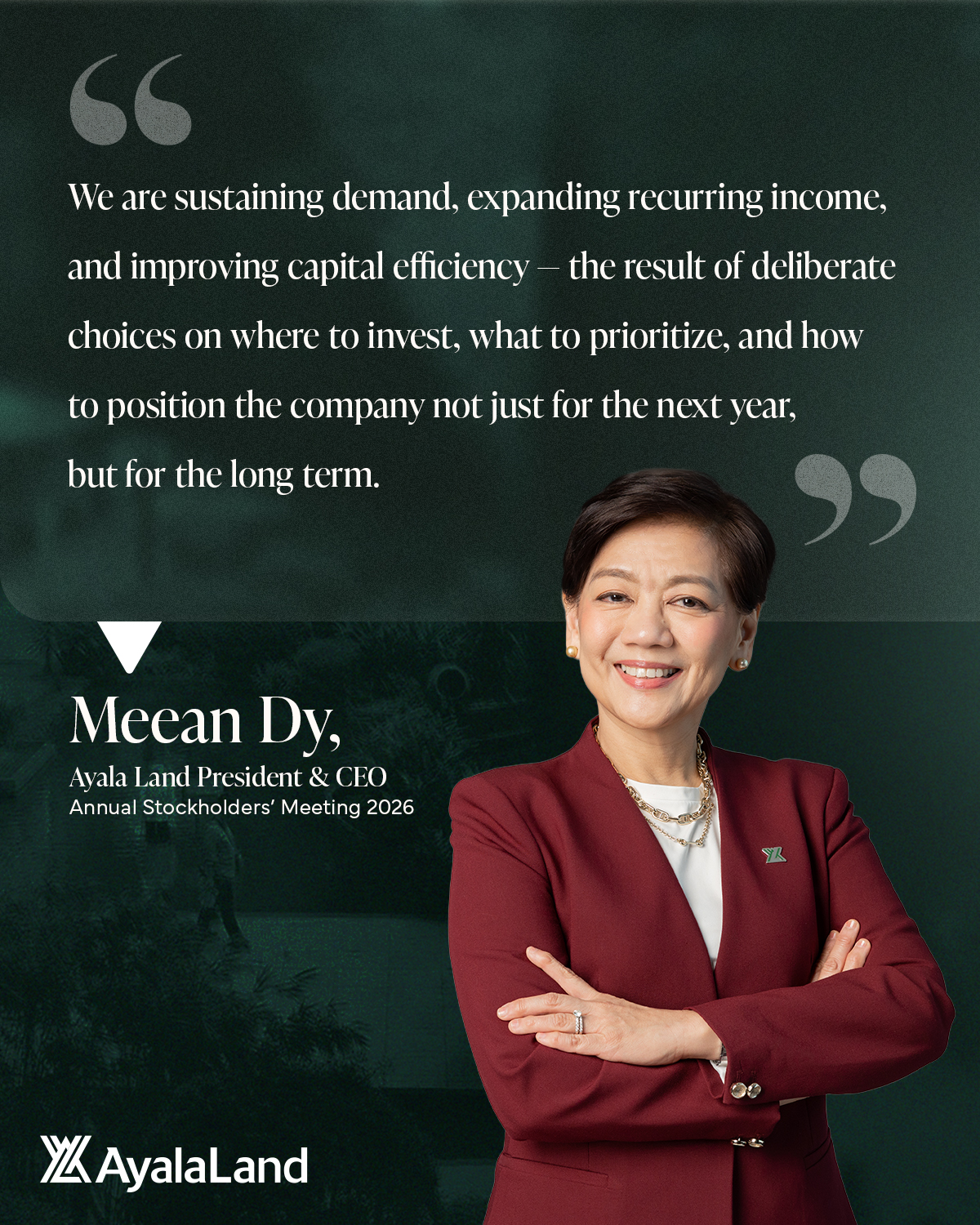
"We are sustaining demand, expanding recurring income, and improving capital efficiency – the result of deliberate choices on where to invest, what to prioritize, and how to position the company not just for the next year, but for the long term," Dy told shareholders during the meeting.
The message was clear: Ayala Land is not retreating. It is rebalancing.
A Strategic Pivot Towards Leasing Amid Global Headwinds
The backdrop for this measured confidence is a property sector buffeted by external shocks. Chairman Jaime Augusto Zobel de Ayala acknowledged that the ongoing Middle East crisis looms as a "significant disruptor," particularly for property development. Yet, rather than depleting resources on aggressive expansion, the company has chosen to lean into stability.
"In times like these, our top priority is stability over aggressive growth," Zobel told shareholders. "We have also downscaled our capex plans as part of balance sheet management."
This pivot toward leasing is now the centerpiece of Ayala Land's strategy. By expanding its leasing footprint—malls, offices, and hotels—the company is building a more predictable and resilient revenue base. Meanwhile, residential launches are being carefully managed, and inventory levels reduced, all while preserving ample liquidity to act swiftly when market conditions brighten again.
Record Retail Expansion and Strong Performance
Despite the cautious tone, 2026 is shaping up to be a banner year for Ayala Land's leasing portfolio. The company is set to unveil its largest-ever single-year retail expansion, introducing over 200,000 square meters of new shopping center space alongside more than 70,000 square meters of additional office capacity.
This aggressive leasing expansion is supported by strong fundamentals. The company has already renewed or replaced approximately 78 percent of leases scheduled to expire in 2026, ensuring high occupancy levels and stable cash flow. Across its portfolio, reinvestments in malls and hotels are projected to yield a 15 to 20 percent uplift in rental rates and room revenues once stabilized.
Behind these figures lies a deliberate capital allocation strategy. For 2026, ALI has earmarked between P70 billion and P80 billion for capital expenditures, with 38 percent of that sum dedicated directly to leasing projects. That represents a significant shift from previous years, when a larger share of capital went toward residential development.
Deliberate Choices, Long-Term Vision
Dy's emphasis on "deliberate choices" is best understood in the context of the company's recent financial performance. While ALI is pulling back on aggressive residential launches to preserve financial flexibility, it continues to sustain demand in sectors where it holds a clear advantage, particularly within its established estates.
"Yes, we will manage our residential launches and reduce our inventory. We have also downscaled our capex plans as part of balance sheet management," Zobel confirmed. "We want to preserve our flexibility so that we have the resources available when this crisis ends or when new opportunities arise."
This dual-track approach—cautious on development but aggressive on leasing—reflects a corporate philosophy refined over decades. ALI has weathered multiple economic cycles, and this disciplined recalibration positions the company not merely to survive the current disruptions but to thrive in the long run.
The Path Forward
Looking ahead, the message from the 2026 Annual Stockholders' Meeting is one of confidence tempered by realism. By 2027—two years sooner than originally planned—the company's earnings before interest, taxes, depreciation, and amortization (EBITDA) is expected to be roughly balanced between leasing and development, a major milestone in its long-running pivot toward recurring income.
Dy's pledge to position Ayala Land "not just for the next year, but for the long term"—citing deliberate spending, smart prioritization, and disciplined capital deployment as the enablers of long-term resilience—was the meeting's key takeaway. For shareholders and the broader market, the signal was unmistakable: Ayala Land is playing a careful, calculated, and confident long game.