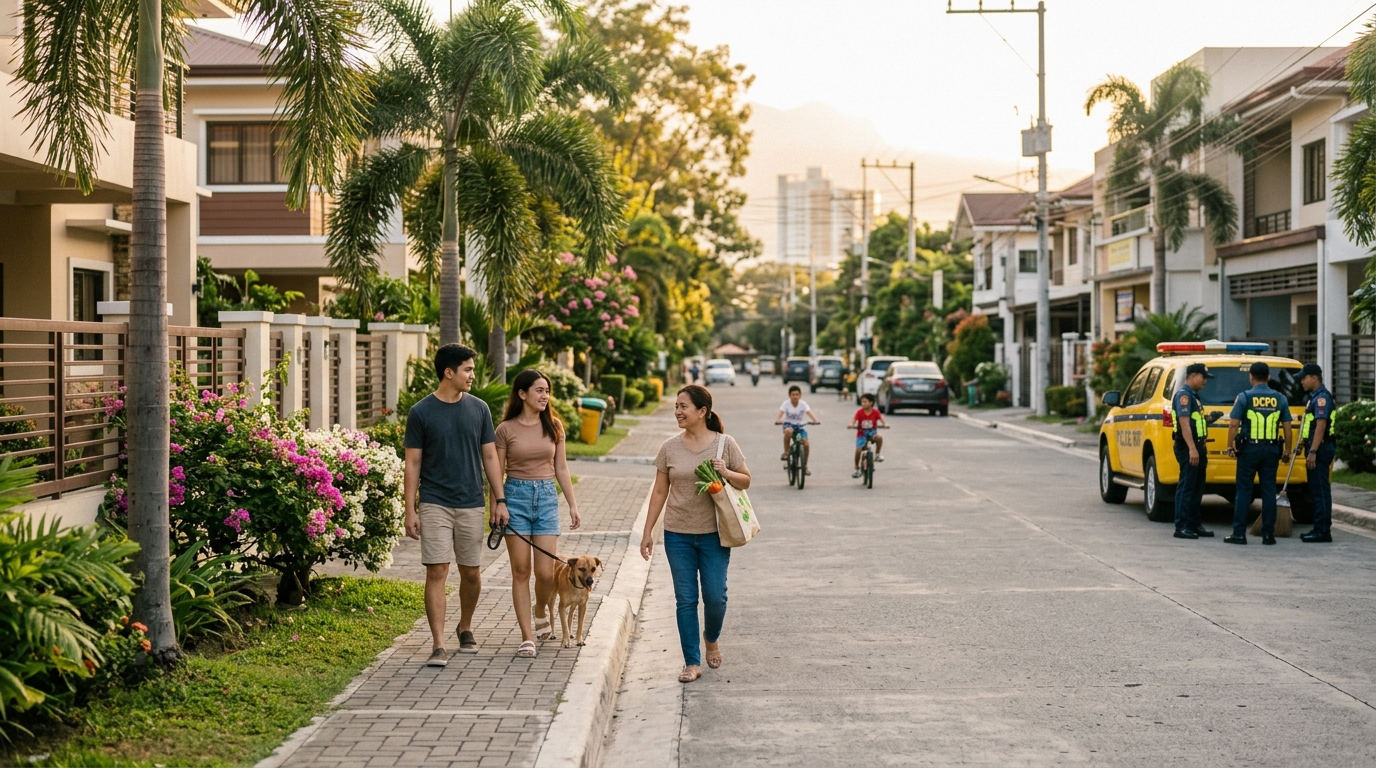
MAKATI CITY — In an era where global investors weigh quality-of-life metrics as carefully as square meter prices, Makati has just secured the kind of validation that no amount of marketing can manufacture. The city has been ranked ninth among the Top 10 Safest Cities in the Philippines in the 2026 World Travel Index, a global benchmark that evaluates destinations based on crime levels, personal safety, transportation reliability, and general traveler security perceptions. For the country's oldest and densest central business district, the recognition arrives not as a ceremonial pat on the back but as a hard quantifiable variable—a safety score of 71.07 that institutional investors, multinational lessees, and residential buyers now explicitly factor into site-selection decisions.
The World Travel Index, while widely used by travelers and tourism analysts, has become an increasingly relevant reference point for the real estate sector. The platform compiles and publishes comparative rankings of cities and countries based on multiple indicators relevant to tourism and relocation decisions, including crime levels, personal safety, transportation reliability, and traffic conditions. Makati's ninth-place finish places it behind Dumaguete City, which topped the list with a score of 82.28, Davao City (79.22), Balanga (76.71), Bulacan (75.40), Baguio (75.33), Puerto Princesa (74.84), Lucena (74.78), and Naga (73.58), while edging out Las Piñas (70.03).
Why Safety Translates Into Property Value
The real estate sector has long understood that security is not merely a quality-of-life amenity; it is a pricing mechanism. Cushman & Wakefield's Q1 2026 Philippine MarketBeat report confirmed that prime assets in Makati, BGC, and Ortigas remained stable, supported by scarcity, tenant preference, and stronger amenities. The same report documented that Prime and Grade A vacancy across Metro Manila eased to 17.1 percent from 17.9 percent in the previous quarter, with core CBDs like Makati holding at a far tighter 10 percent—a figure that reflects the district's enduring ability to attract and retain occupiers in a market where decentralized locations are grappling with vacancy rates of 24.4 percent.
Makati's office market fundamentals remain the country's most resilient. Grade-A office space in the CBD commands PHP 1,200 to 1,600 per square meter per month, with key buildings such as PBCom Tower and Pacific Star maintaining premium positioning. Colliers Philippines has projected that submarkets with below-industry-average vacancies, including Makati CBD, will lead rental recovery through 2026. The safety ranking adds a layer of qualitative reinforcement to these quantitative strengths: a multinational firm weighing a lease in Makati against a competing regional hub now has an independent, globally accessible data point confirming that employee safety risk is manageable.
City officials attributed the recognition to strengthened public safety initiatives, including increased police visibility, rapid emergency response systems, community partnerships, and proactive security programs. "These measures have helped sustain Makati's reputation as one of the country's premier business and tourism destinations where residents, workers, investors, and visitors can live and operate with confidence," officials stated. The achievement was credited to the collective efforts of the Makati City Government, the Makati City Police, barangay officials, and various community stakeholders.
The Broader Investment Context
Makati's safety designation lands at a moment when the city is actively reshaping its fiscal and physical infrastructure. Mayor Abby Binay announced on May 7, 2026, that she has ordered a comprehensive review of the Real Property Tax and other local taxes, citing ₱7.9 billion in annual savings from the removal of Embo barangay subsidies. The city has also been recognized by the Energy Regulatory Commission as the first Philippine local government unit to champion 100 percent renewable energy utilization for all 154 city government facilities. These policy moves—lowering the cost of ownership, strengthening the reliability of utilities, and now validating the safety of the streets—converge into a single investment thesis: Makati is engineering the conditions for long-term capital appreciation.
Numbeo's 2026 data reinforces the narrative. The crowdsourced global database gives Makati a Safety Index of 61.91, classified as "High," alongside a Health Care Index of 84.97, categorized as "Very High". The city's Property Price to Income Ratio sits at 35.77, reflecting the premium that buyers are willing to pay for access to its security, infrastructure, and economic density. For the institutional landlords, REIT managers, and corporate occupiers who govern the CBD's commercial property market, the 2026 World Travel Index ranking is not simply a statistic. It is an entry in the due diligence checklist—one that a growing number of foreign firms with ESG mandates and employee safety protocols consider non-negotiable. Makati has just passed that test for another year.