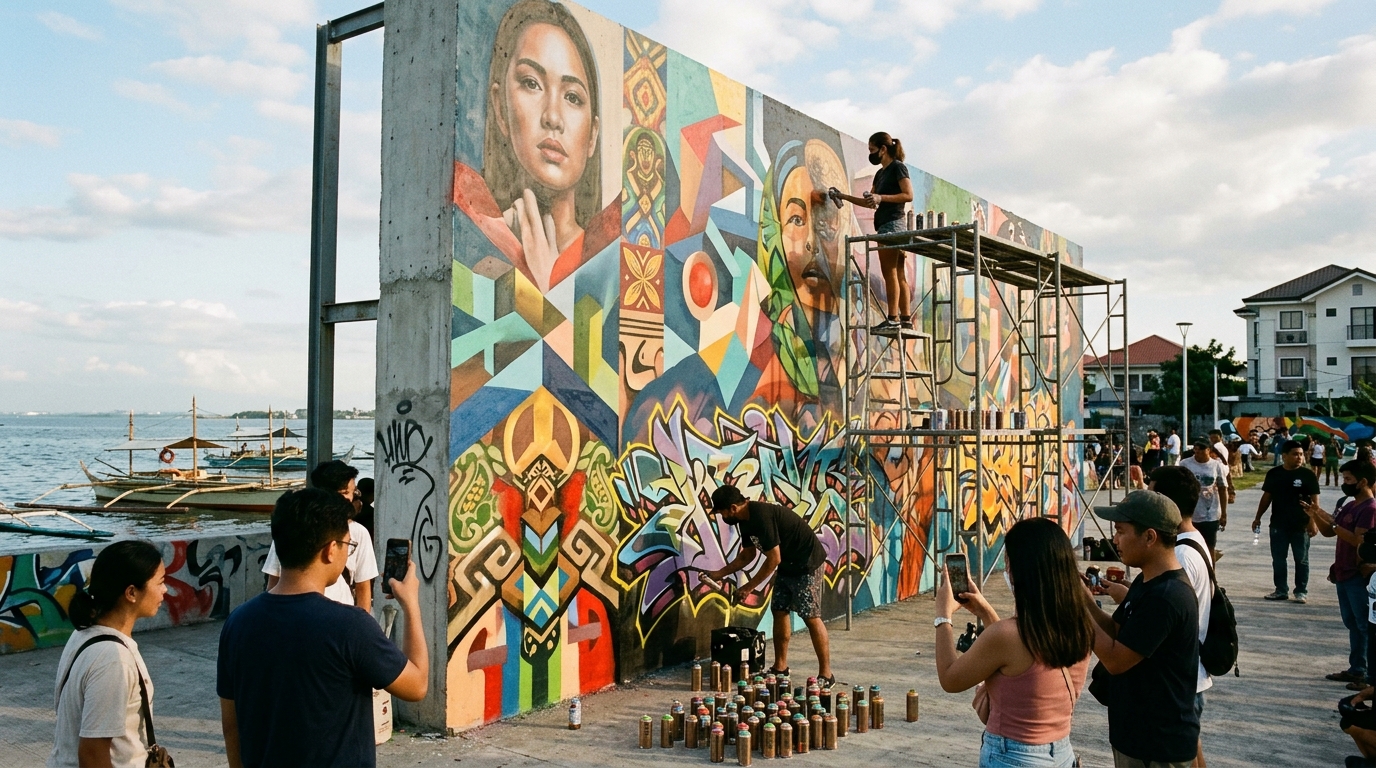
TAGUIG CITY — For three days in late April, the lakeshore of Barangay Lower Bicutan became one of the most photographable corners of the metro—not because of a new building or a landscaped garden, but because over a hundred graffiti and mural artists from across the world were given permission to transform blank concrete into a sprawling, open-air gallery. Meeting of Styles Philippines returned to TLC Park from April 24 to 26, 2026, marking its fourth consecutive year in Taguig and the 13th edition of what has become the country's largest international street art gathering. For a city more often associated with corporate towers and shopping boulevards, the festival has quietly become a tourism asset that no advertising campaign could replicate: a living, evolving attraction that visitors experience with their feet and their phones.
The festival is part of a global network that began in Wiesbaden, Germany, in 1997 and now spans cities from Chicago to São Paulo. The Philippine edition, which once rotated among venues, has found an unlikely long-term home in Taguig. City officials have embraced the event with the kind of sustained institutional support that is rare for a subculture once associated with illicit tagging. "Before, graffiti was often seen negatively," said local organizer Tripp Martinez. "Now, with the support of the city, we're able to create platforms like this. We're proud to bring in international artists and showcase Filipino talent on the global stage." The shift in perception has been so complete that Meeting of Styles now anchors a broader civic program—the Art and Music for Peace: TLC Community Fair—that frames mural painting as an act of diplomacy.
A Festival Engineered for the Spectator
What sets Meeting of Styles apart from a conventional art exhibit is that the creative process is the main event. Visitors who arrived at TLC Park on April 24 could watch artists working at scale—scaffolding and spray cans in hand—producing works that climbed several stories high on temporary walls erected for the occasion. The festival ran alongside Tugtog Taguig: Himig ng Kapayapaan, a concert series that brought OPM acts to the same grounds, effectively layering a music festival onto a visual arts biennale. Live art demonstrations featuring customized Vespa scooters, a fingerboard competition, DJ sets, rap battles, and street dance cyphers filled out the program, each activity designed to keep visitors on site for hours rather than minutes.
Mayor Lani Cayetano, who opened the event by spray-painting a ceremonial art wall, described the festival in terms that connect directly to its tourism function. "Art can inspire us. Art can give us hope, especially in trying times. In a time of crisis, it is important that we find inspiration and come together—art helps bring people closer and promotes peace." That a city mayor would personally activate a graffiti event signals to potential visitors that Taguig is a place where the official culture and the street culture have learned to coexist, a combination that appeals to travelers seeking destinations with edge and authenticity rather than sterile predictability.
The Fourth-Year Mark and What It Signifies
The 2026 edition drew more than 100 local and international artists, a figure that has held steady since the festival's first Taguig iteration. The consistency of participation is its own kind of review. Artists who travel the global circuit of mural festivals—from Wynwood Walls in Miami to Mural Istanbul—have added TLC Park to their itineraries, and their Instagram feeds do the marketing that tourism boards pay for. The murals remained on view through April 26, but their digital afterlives will circulate for months, each post geo-tagged to Taguig and functioning as a standing invitation to visit the next edition.
The festival's integration into the city's 439th founding anniversary celebrations also positions it within a broader heritage narrative. Taguig, one of the oldest settlements in Metro Manila, has been using its anniversary calendar to build a portfolio of recurring cultural events that distribute visitor traffic across its barangays. Where BGC draws the business crowd and the weekend diners, TLC Park now draws a demographic that overlaps with both but is drawn specifically by art: students, content creators, expatriates, and the culturally curious. The meeting of those audiences with local residents in a free, public setting is precisely the kind of community-based tourism that urban planners increasingly favor over high-ticket, exclusive attractions.
Looking Ahead to Year Five
With four editions now completed, Meeting of Styles Philippines has established enough of a track record for Taguig to begin marketing it as a fixture on the metro's annual arts calendar rather than a recurring experiment. The city government has indicated it hopes to host the event "for a long time," and Martinez's team has developed the operational muscle to manage the logistics of an international artist roster. For travelers planning a trip to Manila in April 2027, the calculus is becoming straightforward: time the visit to catch the murals being made, not just photographed.