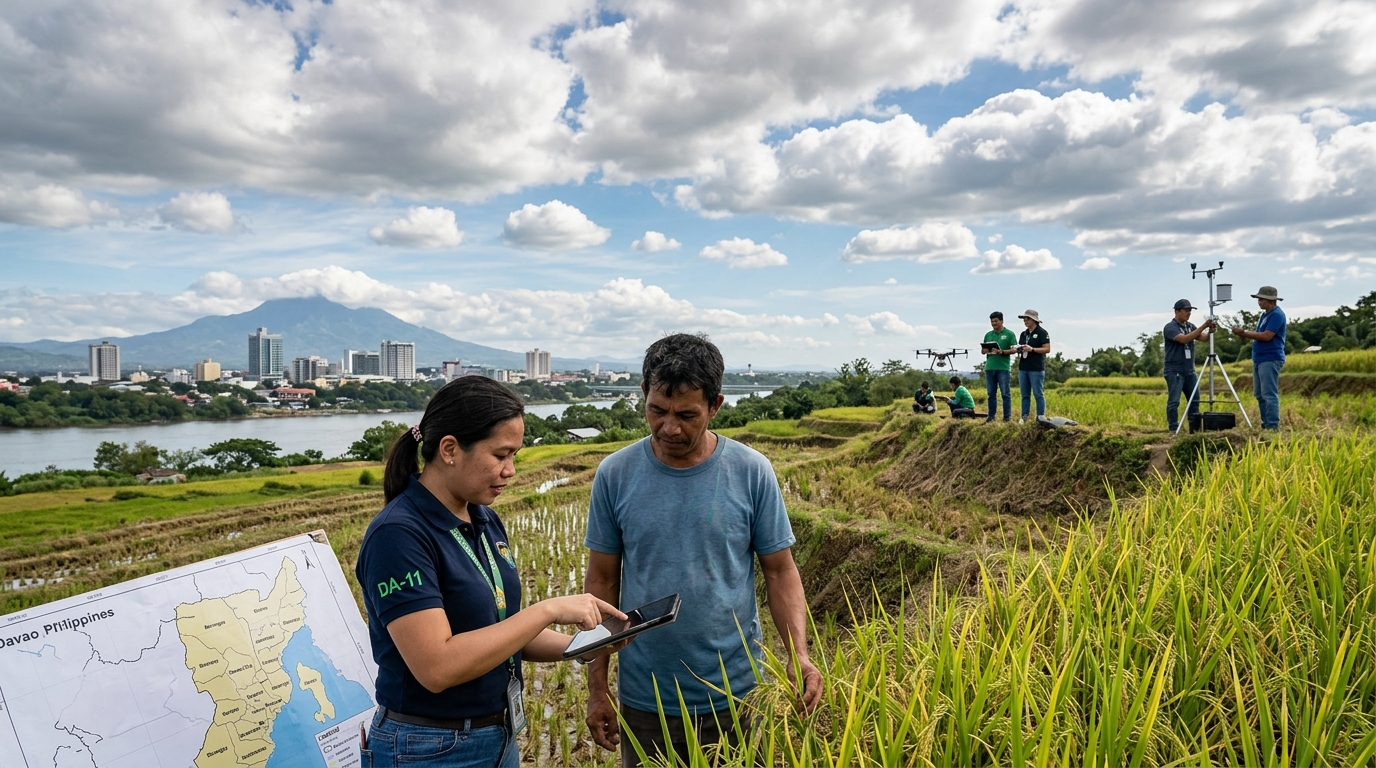
Davao is currently deploying a tactical "Climate Shield" as the Department of Agriculture (DA-11) announced a three-part mitigation strategy on May 11, 2026, to combat the looming El Niño. With moisture stress already causing ₱117 million in crop damage earlier this year, the agency has officially placed a "Standby Request" for cloud seeding operations to save vulnerable farmlands in Davao City and Davao del Sur. This isn't just a weather watch; it’s a high-stakes "Food Security Ritual" aimed at protecting the rice and high-value crops that anchor the region’s trillion-peso economy. For the 2026 resident, this proactive stance provides a "Certainty Anchor" in the face of unpredictable environmental "Friction."
The "Vulnerability Mapping" Ritual
The DA’s strategy involves a "Precision Ritual" of weekly field monitoring to identify which barangays are hitting the "Moisture Stress" threshold. Joedel Leliza, the DA-11 DRRM focal person, confirmed that the agency is currently prioritizing "Non-Vulnerable Areas" to maximize production while shifting crops in harder-hit zones. This "Tactical Flexibility" allows the region to maintain its "Supply Integrity" even when traditional water sources reach a "Breaking Point." This week, the agency is also distributing seasonal climate outlooks to help farmers time their planting cycles with the predicted "Rainfall Loops" before the dry spell intensifies.
The "Cloud Seeding" Trigger
If moisture stress escalates in the coming weeks, the "Cloud Seeding" protocol will be activated as the ultimate "Defense Shield" for the region's rice and corn fields. This specialized operation is part of a broader "Saving Production" strategy that includes the provision of agricultural facilities and water management equipment. The agency has already validated ₱783 million in potential additional damages from April, emphasizing the "Critical Integrity" of this week's intervention. By acting now, Davao is building a "Resilience Buffer" that prevents a full-scale agricultural drought from derailing the region’s consistent economic growth.
The "Services Hub" Connection
While agriculture faces challenges, Davao City continues to act as the "Economic Hub" for the region, with its service sector accounting for 62.1% of the ₱1.14 trillion economy. This "Economic Diversity" provides a "Financial Cushion" that allows the local government to fund these massive agricultural mitigation projects. On May 11, the City Business Bureau reported that retail and service contractors remain the "Primary Drivers" of urban growth, even as the rural outskirts deal with climate "Friction." This "Urban-Rural Balance" is what makes Davao a "Stability Anchor" for Mindanao, ensuring that a crisis in one sector is managed by the strength of another.