Bohol — The province is set to transform its agricultural landscape and cement its status as a premier hub for high-quality chocolate, following the launch of an ambitious 10-year public-private partnership. Announced during the celebration of World Chocolate Day on July 7, 2026, this initiative aims to plant 1 million cacao trees across the province, turning idle lands into productive farms while providing sustainable livelihoods for local growers. Spearheaded by the Bohol Chocolate Farm in collaboration with local government units (LGUs) and civic organizations, the project seeks to move the Philippines closer to its goal of becoming a competitive player in the global chocolate market.
A Strategic Expansion for Provincial Productivity
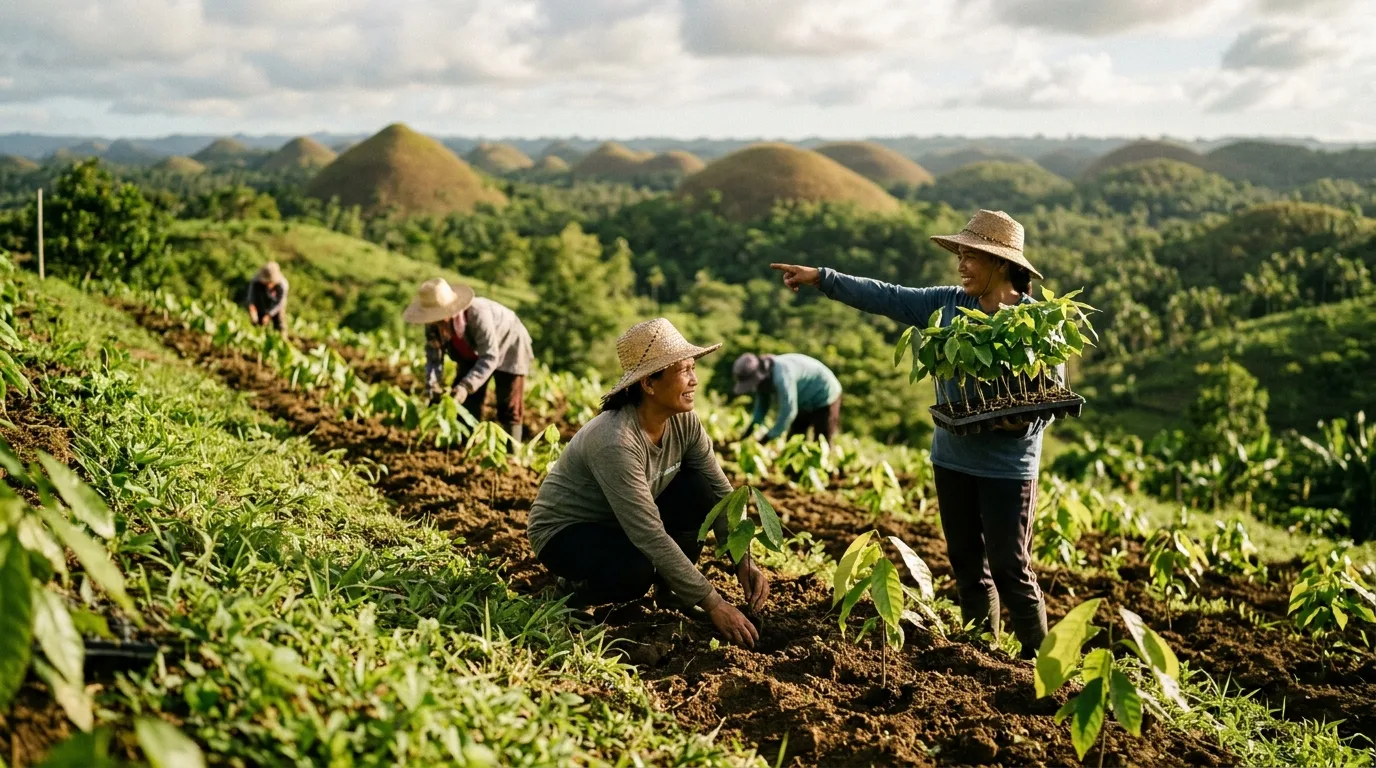
The initiative is anchored by a significant expansion in the municipality of Catigbian, where Mayor Benjie Oliva has committed to developing a 200-hectare cacao plantation on municipal-owned land. By utilizing idle and public tracts for large-scale cultivation, the project addresses the need for long-term agricultural productivity while creating a standardized supply chain for local farmers. Bohol Chocolate Farm, the first cacao nursery in the province accredited by the Department of Agriculture, will serve as the technical backbone of the operation, providing partner growers with quality seedlings, farm management guidance, and a guaranteed market for their harvested beans.
Empowering Communities and Women’s Livelihoods
Beyond large-scale plantations, the program emphasizes social impact through the "Seed to Bean" project, a collaborative effort between the Bohol Chocolate Farm and the JCI Chocolate Hills Jaycees. This component recently jump-started community involvement by donating 1,000 cacao seedlings to the Nueva Vida Sur Women’s Association in Carmen, Bohol, specifically designed to empower local women and provide them with independent income sources. By promoting cacao as a community-based enterprise, the project not only builds economic resilience but also strengthens Bohol’s identity as a sustainable origin for world-class chocolate, effectively bridging the gap between smallholder farmers and the growing global demand for specialty cocoa.
Aligning with National Export Goals
This regional push in Bohol arrives at a pivotal time as the Philippine cacao industry recently gained formal recognition as an export-oriented sector under the Department of Agriculture’s high-value crops program. With the national roadmap for 2026–2030 emphasizing clustering and value-added processing, Bohol’s commitment to planting 1 million trees is a critical contribution to the province’s goal of reducing its reliance on imported cacao beans. The initiative has secured broad support from local leaders in Sagbayan, Carmen, and Catigbian, who view the cacao expansion as a pathway to integrating tourism, health awareness, and farming into a cohesive provincial economic strategy.