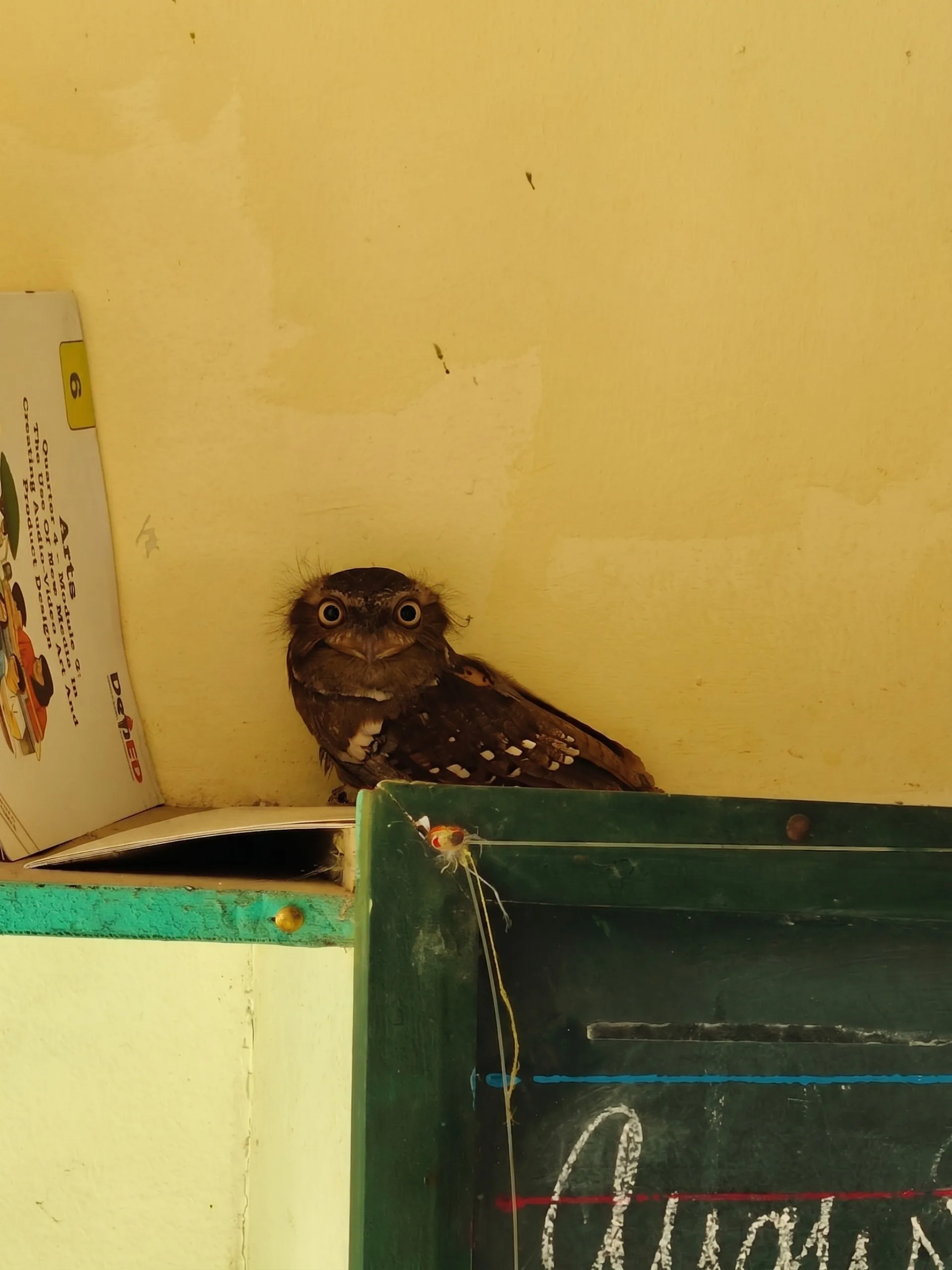
DAVAO — A rare and elusive Philippine Frogmouth brought an unexpected lesson in compassion to a local elementary school after it was discovered resting inside a Grade 3 classroom. The nocturnal bird's visit on August 3, 2026 turned an ordinary school day into a memorable encounter with wildlife.
An Unusual Visitor in the Classroom
Teacher Charmel Ann Q. Policarpio found the bird perched quietly on top of a classroom cabinet. It appeared weak and frightened, its large eyes and bark-colored feathers making it look both strange and fragile. The teacher quickly recognized that the creature needed safety, not attention.
The Philippine Frogmouth, scientifically known as Batrachostomus septimus, is one of the country's most elusive native birds. Its feathers closely resemble tree bark and dry leaves, making it nearly invisible in forests. This natural camouflage helps the bird remain hidden during the day, when it rests motionlessly.
A Lesson in Compassion and Stewardship
Instead of causing alarm, the school community responded with care. Teacher Policarpio instructed pupils to keep their distance and avoid disturbing the bird. The children watched in awe as their teachers coordinated with local officials to ensure the creature's safety.
Barangay Tacunan authorities carefully retrieved the frogmouth with minimal stress. The bird was then transferred to the Department of Environment and Natural Resources (DENR) for health assessment. The agency will prepare it for release back into its natural forest habitat.
Understanding the Philippine Frogmouth
The Philippine Frogmouth is endemic to the country, found across Luzon, Visayas, and Mindanao. It is a medium-sized bird, measuring about 24 to 26 centimeters in length. Its wide, frog-like bill and exceptionally large eyes are perfectly adapted for nocturnal hunting.
The bird feeds on insects such as beetles, moths, and cicadas. It uses a "sit-and-wait" technique, remaining still on branches before swooping down on prey. During breeding season, the female lays only one egg per clutch, making each individual bird important for the species' survival.
Conservation and Legal Protection
Under Philippine law, specifically Republic Act No. 9147, it is illegal to capture, kill, or keep wild endemic species like the Philippine Frogmouth. The school's decision to coordinate with DENR reflects proper wildlife response protocols. This includes minimizing human exposure and avoiding improper handling.
The International Union for Conservation of Nature lists the Philippine Frogmouth as Least Concern, but its population is decreasing. Deforestation and habitat fragmentation pose continuous threats. The sensitive nature of the species means that human disturbance can cause parents to abandon their nests.
A Reminder of Our Shared Environment
For the pupils of Tacunan Elementary School, the encounter was more than a rare sighting. It became a practical lesson on environmental stewardship and empathy. The school community demonstrated that even the quietest creatures deserve protection and a safe place to return home.
The event highlights the importance of coexisting with wildlife, even in urbanizing areas. It shows that ordinary citizens can play a crucial role in conservation. The story serves as an inspiring example of how education extends beyond textbooks into real-world actions.