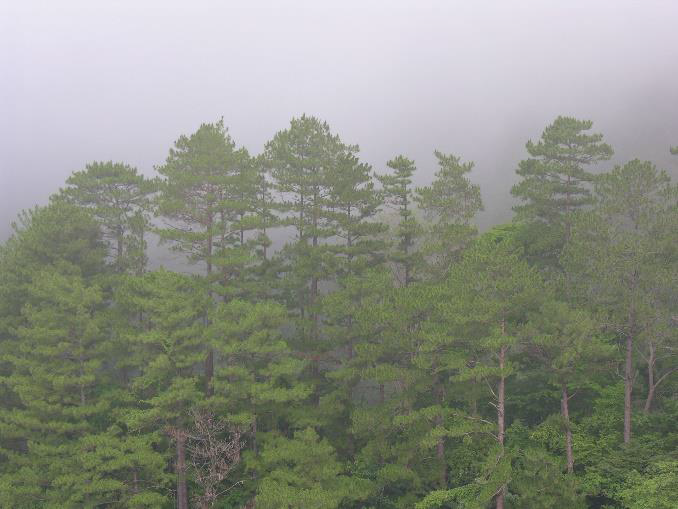
LEON, ILOILO — Roughly an hour's drive from Iloilo City, past the lowland rice paddies and the town proper, the road begins to climb into a different climate. The air thins and cools. Vegetable terraces stripe the hillsides. Then, as the elevation passes 1,200 metres above sea level, the first Benguet pines appear—tall, straight, and unmistakably out of place in the tropics. This is Bucari, the upland barangay that has earned Leon its long-standing nickname as the "Summer Capital of Iloilo." In 2026, Bucari is no longer simply a weekend retreat for overheated city dwellers. A convergence of infrastructure investment, ecological restoration, and municipal rebranding is reshaping it into something with far greater reach: a certified ecotourism destination anchored by the only Benguet pine plantation in Western Visayas.
The 1.5-hectare Bucari Pine Forest and Campsite, identified by the Regional Ecotourism Committee as a priority site for the Iloilo eco-tourism loop as early as 2023, operates as the heart of the Bucari Agri-EcoTourism Destination. Under the towering pines, which were planted decades ago and have since matured into a dense, fragrant canopy, visitors pitch tents and set up temporary shelters for overnight stays. The cool mountain breeze—temperatures frequently dip to 15 degrees Celsius—makes camping here feel closer to a Cordillera experience than a Visayan one. For day-trippers, picnic sheds are available, and the forest floor offers a soft bed of pine needles for those who prefer to simply lie back and watch the branches sway.
A Viewing Deck, a Leaning Pine, and the Peaks That Surround Them
Beyond the campsite, Bucari rewards visitors who are willing to climb. The Mansiga Viewing Deck features the 14 Stations of the Cross along winding staircases, a pilgrimage route that culminates in a summit garden planted with blooms of varying colours. From the top, the natural landscape of Leon unfolds in all directions: rolling hills, terraced vegetable farms, and the distant shimmer of the Panay Gulf. For the more adventurous, the climb to Puting Bato offers an even wider vantage point, a place where the horizon seems to stretch without interruption.
The Leaning Pine Tree, a single specimen that has grown at a dramatic angle, has become something of a social media phenomenon. Visitors line up to pose beside it, testing their balance and their nerve. It is the kind of organic attraction that no tourism planner could have manufactured, and it has quietly become one of Bucari's most recognisable images.
A Pavilion, a Road, and a Municipality Thinking Bigger
On May 13, 2026, the news broke that Second District Congressman Arcadio Gorriceta had secured funding for a Bucari Pavilion, a dormitory-type accommodation facility proposed for Sitio Tabionan. The Tourism Infrastructure and Enterprise Zone Authority (TIEZA) and the Department of Tourism committed an initial P10 million, with TIEZA General Manager Mark Lapid pledging an additional P15 million. The pavilion is timed to coincide with the completion of a P275-million to P300-million access road concreting project from Barangay Buga to Barangay Bucari, an infrastructure investment that will shave significant travel time off the mountain ascent and make the area accessible to a broader range of visitors.
These physical upgrades are unfolding within a larger strategic framework. In February 2026, the municipality of Leon launched "Leon Beyond Imagination," a rebranding campaign that seeks to position the town as more than a mountain escape. While Bucari remains the flagship, the municipality is now actively packaging farm tourism, ecological adventures, cultural heritage sites, and local products into a cohesive visitor narrative. Tourism Officer-Designate Dr. Rommel Calceña described the slogan as "concise, aspirational, and forward-looking," and noted that it has been institutionalised through a municipal ordinance. Fresh highland vegetables and fruits, native chicken delicacies, the waterfalls of Camandag, handcrafted goods from Barangay Baje, and pilgrimage sites are all being woven into a single tourism fabric.
340,000 Seedlings and a 225-Hectare Promise
Perhaps the most consequential development for Bucari's long-term ecological health is a reforestation project of extraordinary scale. In May 2026, Meralco PowerGen Corporation (MGEN), through its thermal subsidiary Panay Energy Development Corporation (PEDC), officially launched the Bucari Reforestation and Carbon Sink Project, a PHP 18.5-million initiative that will plant more than 340,000 seedlings across 225 hectares in Barangays Bucari, Cagay, and Danao over six years, from 2025 to 2030. The project is a partnership between MGEN, the Department of Environment and Natural Resources Region VI, the local government of Leon, and the Bucari Eco-Planters Association (BEPA).
Felino M. Bernardo, MGEN Thermal President and CEO, described the effort as aligned with the company's "commitment to environmental stewardship" and noted that it "supports the economic development of the local community." BEPA will lead the on-the-ground implementation, while DENR and the LGU provide technical support and monitoring. For visitors, the reforestation means that the pine forest experience—already unique in the Visayas—will be preserved and expanded for generations, rather than slowly degraded by unregulated use.