LEGANES, ILOILO — A few kilometres north of the Iloilo City boundary, where the coastline begins to fray into tidal creeks and nipa palms, a forest has quietly returned. It is not a forest of towering hardwoods but of tangled, salt‑crusted mangrove roots that grip the mudflats of Barangays Gua‑an and Nabitasan. This is the Leganes Integrated Katunggan Ecopark, a 15‑hectare reserve now recognised as one of Western Visayas’ most successful mangrove restoration projects. In March 2026 the Department of Tourism and the Department of Environment and Natural Resources formally admitted it into the Western Visayas Ecotourism Loop, a network of certified destinations that prioritise nature‑based, community‑driven tourism over mass‑market development. For a town that has long stood in the shadow of Iloilo City’s festivals and heritage mansions, the certification is both a validation and an invitation: come see what happens when a community decides to give its coastline back to nature.
The story of the park begins not with conservation but with catastrophe. When Typhoon Frank struck in 2008, it devastated the coastal barangays of Leganes, leaving behind a wasteland of abandoned, under‑utilised and undeveloped fishponds that had once been used for milkfish production. The local government unit saw an opportunity. In 2009 it partnered with the Zoological Society of London Philippines, a global conservation charity, to implement a community‑based mangrove rehabilitation project. The transformation was deliberate and science‑based: of the 39 mangrove species that can grow in the Philippines, 10 were identified as suitable for the site.
The results have been extraordinary. Mangrove species in the area have increased from six to 11, and the restored forest now supports 49 bird species, including endangered ones. Seagrass beds have returned, fish populations have rebounded, and even vulnerable species such as the dugong have been observed in the surrounding waters. The Leganes Integrated Katunggan Ecopark has become a biodiversity hub that researchers, students, and local government units from across the country now visit as a model for what community‑led restoration can achieve.
A Bamboo Bridge and a Three‑Storey Watchtower
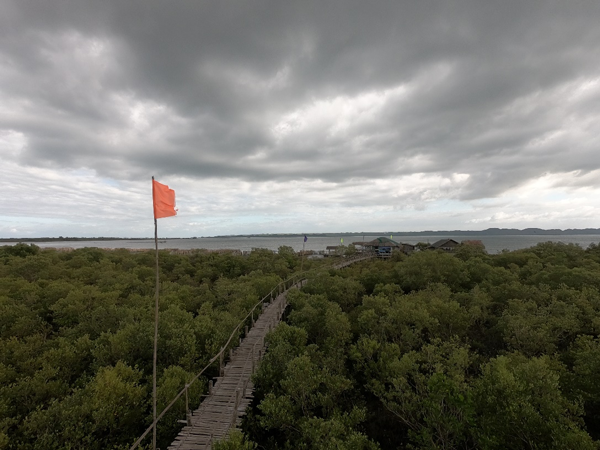
The visitor experience at the park is deliberately simple, built around a bamboo bridge that threads through the mangrove canopy and a three‑storey watchtower that offers panoramic views of the forest meeting the sea. A pavilion, gazebos, elevated concrete walkways, a community kitchen, a biodiversity training centre, and a parking area round out the infrastructure that the Iloilo provincial government committed to construct under the Provincial Katunggan Ecological and Economic Park agreement signed on 16 March 2026 by Governor Arthur Defensor Jr. and Leganes Mayor Vicente Jaen II.
The watchtower is the park’s main viewing point, a place where visitors can watch birds burst into flight over the canopy and, during the migratory season, spot species that have made the ecopark a regular stopover. The bamboo bridge, meanwhile, places visitors directly above the root systems and tidal channels that sustain the ecosystem. Both structures are designed not as architectural statements but as functional observation posts that keep the visitor close to the habitat without disturbing it.
A Community That Sold Seedlings Instead of Fish
What makes the Leganes Integrated Katunggan Ecopark different from many protected areas is that the people who live around it are not merely beneficiaries of conservation—they are its operators. The Coastal Barangay Mangrove Seedling Growers Association, a local organisation formed by residents, runs the ecotourism operations, sells mangrove seedlings, and provides tour‑guiding services. Many of the members are housewives who once relied solely on their husbands’ income and who now contribute to household earnings by maintaining the park and leading visitors through the boardwalk. The ecopark has become a training site for mangrove conservation, visited by delegations from as far away as Papua New Guinea.
The March 2026 certification places LIKE in a select cohort of 12 new sites across Western Visayas that have passed a rigorous assessment process covering ecological sustainability, visitor safety, and community participation. DENR Regional Executive Director Raul L. Lorilla emphasised that the goal is not simply to add destinations to a map but to “create a sustainable ecosystem where tourism supports the environment rather than draining it.” For Leganes, that philosophy is already visible: every entrance fee, every sold seedling, and every guided walk feeds directly back into the protection and education programmes that keep the mangroves standing.