



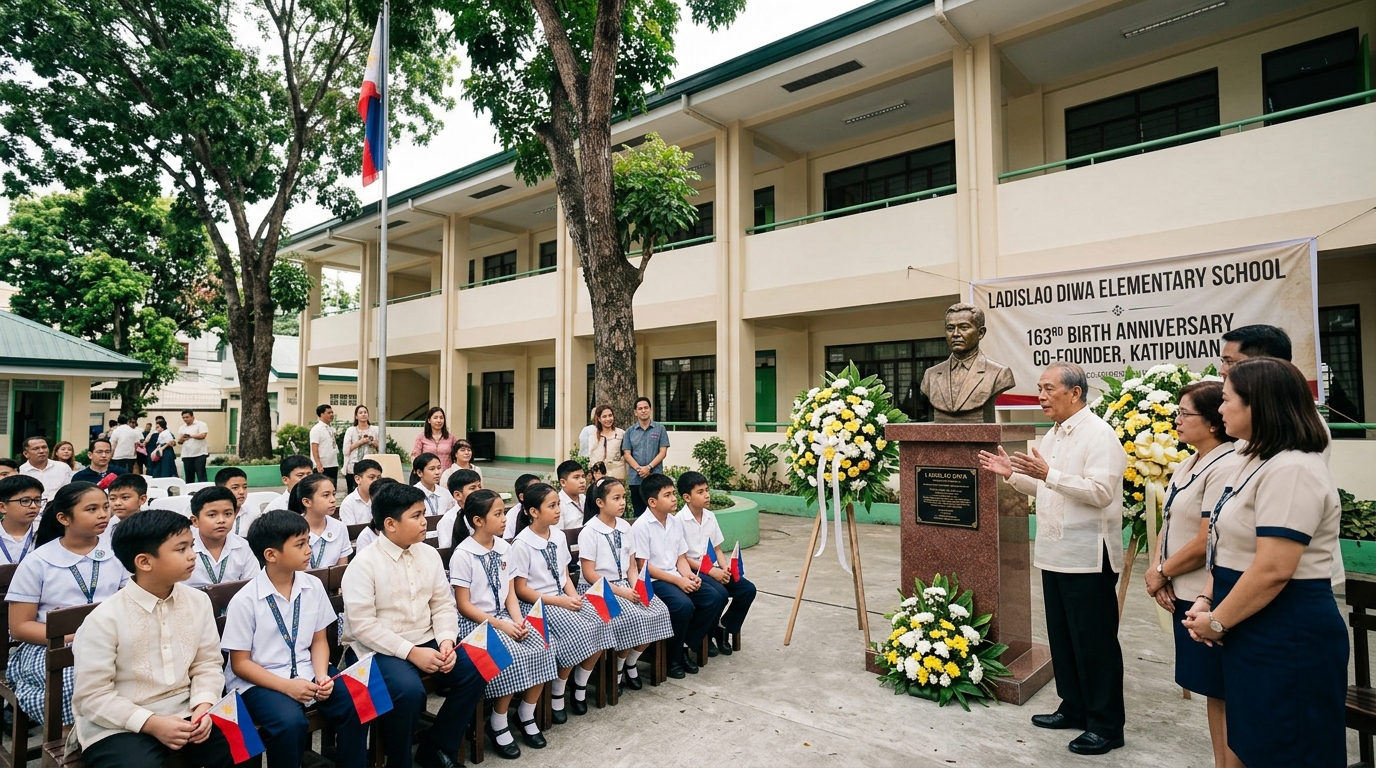
Cavite City and the Ladislao Diwa Elementary School honored the 163rd birth anniversary of Ladislao Diwa, a co-founder of the Katipunan who also served as Cavite's first civil governor and signed the Philippine Proclamation of Independence.
From Seminary to Revolution: The Making of a Patriot
Ladislao Diwa y Nocon was born in San Roque, Cavite, to Mariano Diwa and Cecilia Nocon . He initially studied for the priesthood at the University of Santo Tomas but abandoned his ecclesiastical studies just before ordination to pursue law, believing he could serve his country in a much greater capacity as a lawyer than as a priest . It was while studying law that Diwa met Andrés Bonifacio, who often distributed propaganda material by José Rizal and Marcelo H. del Pilar inside the university campus. The two became close friends, and Diwa later boarded with Teodoro Plata at Bonifacio's house in Tondo, Manila .
After completing his law studies, Diwa joined La Liga Filipina and became secretary of its council in Trozo, Tondo. However, after Rizal was arrested and deported to Dapitan, Diwa, Bonifacio, and Plata became convinced that an armed uprising was the only way to attain independence from Spain . On the night of July 7, 1892, they founded the Katipunan in a house in Tondo, joined by Deodato Arellano, Valentín Díaz, and José Dizon . Diwa formed the Katipunan's first "triangle" with Bonifacio and Plata—a three-man unit designed to guarantee secrecy—and became the society's fiscal.
A Revolutionary Leader and Cavite's First Civil Governor
Diwa played a crucial role in expanding the Katipunan to the countryside. Because of his transfer to a court in Pampanga province, he personally inducted Katipuneros in Bulacan, Tarlac, and Nueva Ecija, with one of the most notable being Francisco Macabulos, who would become one of the most successful Filipino generals of the revolution . After the Katipunan was uncovered in August 1896, Diwa was arrested in Betis, Bacolor, Pampanga and imprisoned at Fort Santiago in the same cell as Plata. Four days after Plata was executed on February 6, 1897, Diwa was unexpectedly released in a prisoner exchange between Spanish authorities and Filipino revolutionists .
Diwa fled to Cavite to join Mariano Trías's revolutionary troops and became active in combat, instrumental in the surrender of Spanish forces under Leopoldo García. Because of this, he was promoted to colonel in the revolutionary army . When the First Philippine Republic was organized, he was named the first civil governor of Cavite . He also joined other revolutionary leaders in signing the Philippine Declaration of Independence on June 12, 1898 . After the Philippine-American War broke out, Diwa rejoined Trías and served as his secretary. Following Aguinaldo's capture in Palanan, Isabela in 1901, they both surrendered to the Americans in Indang, Cavite.
Legacy: A School, A City, and A Nation's Gratitude
Diwa later served as clerk of court of the Court of First Instance of Cavite and co-founded Ligaya College, where he also taught in his hometown. He retired to his farms in Tagaytay and Mendez and died of nephritis on March 12, 1930, at the age of 66 . In November 1964, the Caridad Elementary School in Cavite City was renamed the Ladislao Diwa Elementary School in his honor . This school continues to be a living monument to his legacy, educating generations of Caviteños about the values of patriotism, courage, and service that Diwa embodied.
Diwa's contribution to Philippine history extends far beyond his roles as a Katipunan founder and public servant. He represented the Filipino's capacity for sacrifice, resilience, and unwavering commitment to freedom. Today, Cavite City remembers him not only as a founding father of the nation but as a son of Cavite who gave his all for the country's independence and democratic future. His story is a powerful reminder that the revolution was won not just by generals but by ordinary Filipinos with extraordinary courage and vision.
