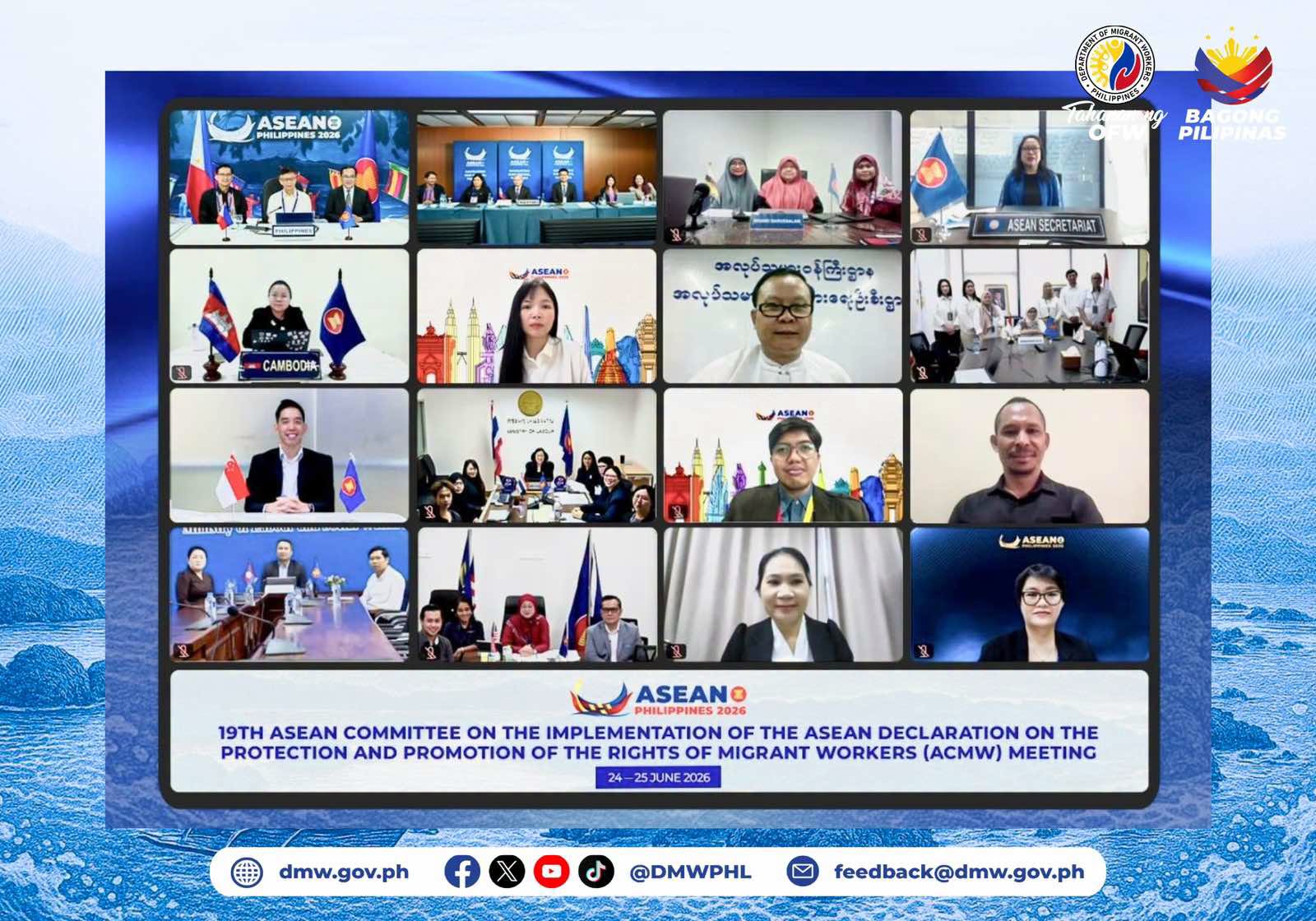
PHILIPPINES — The Philippines assumed the chairship of the ASEAN Committee on the Implementation of the ASEAN Declaration on the Protection and Promotion of the Rights of Migrant Workers (ACMW) during its 19th meeting held virtually on June 24–25, 2026. The gathering focused on regional efforts to safeguard millions of migrant workers, including Overseas Filipino Workers.
A Historic Leadership Role for the Philippines
The meeting brought together officials from ASEAN member states, the ASEAN Secretariat, and development partners to evaluate ongoing programs and coordinate policy frameworks. For the Philippines, holding the chairship reaffirms its commitment to championing the rights of migrant workers, who are vital contributors to the regional economy.
DMW Secretary Hans Leo J. Cacdac emphasized that the chairship is both an honor and a responsibility. He stressed that protecting migrant workers is a shared regional duty that requires sustained cooperation. The platform allowed the country to push for stronger enforcement of ethical recruitment and fair treatment.
Launching a New Five‑Year Protection Blueprint
Just days before the ACMW meeting, the Philippines and the International Labour Organization launched the TRIANGLE Partnerships for Fair and Effective Labour Migration in ASEAN, a five‑year program running from 2026 to 2031. This initiative directly supports the committee’s goals by promoting legal migration pathways and skills recognition.
The TRIANGLE program also focuses on portable social protection benefits, ensuring that workers like OFWs do not lose their social security when moving between ASEAN countries. The project covers eight ASEAN member states. It represents a concrete step toward the kind of regional integration that the ACMW advocates.
Building on the 2007 Cebu Declaration
The ACMW traces its roots to the landmark ASEAN Declaration on the Protection and Promotion of the Rights of Migrant Workers, signed in Cebu, Philippines, in January 2007. That declaration recognized the urgent need to address exploitation and abuse of migrant workers across borders.
Since then, the committee has worked to turn commitments into national policies, focusing on fair recruitment, safe migration corridors, and reintegration programs. The Philippines has been a consistent voice in these discussions, often drawing from its own experience as a leading labor‑sending country.
Placing Women Migrants at the Center
A critical focus of the 19th meeting was ensuring gender‑responsive labor protections. ASEAN data shows that 57 percent of intra‑regional migrant workers are women, many employed in domestic work, healthcare, and manufacturing. The committee discussed measures to combat workplace discrimination and gender‑based violence.
For Filipino women OFWs, these regional standards provide an added layer of protection, especially in host countries where local laws may be insufficient. The ACMW aims to harmonize policies so that women migrants can work in safe, dignified environments regardless of their destination.
Expanding Rights from Recruitment to Reintegration
The committee also tackled the full migration cycle, from transparent recruitment processes to sustainable reintegration programs for returning workers. Officials shared best practices on combating illegal recruitment and human trafficking, issues that continue to affect Filipino workers seeking jobs abroad.
The Philippines showcased its own reintegration initiatives through the DMW’s National Reintegration Center for OFWs. By aligning national programs with ASEAN frameworks, the country hopes to create a seamless system that protects workers before, during, and after their overseas employment.