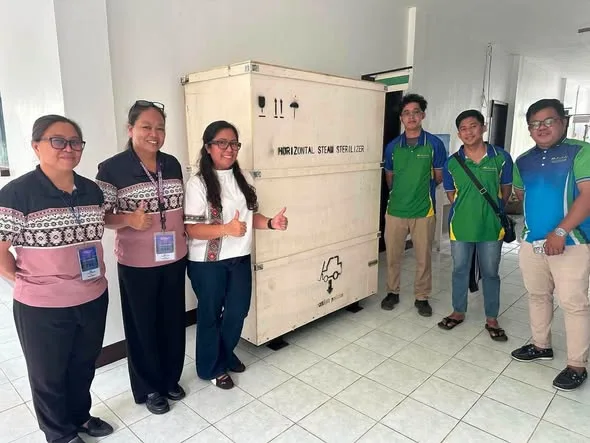
CEBU CITY — The Cebu Provincial Government has started delivering brand‑new steam sterilizers to its network of 16 hospitals, with the first units arriving at Pinamungajan District Hospital and Barili District Hospital on July 27, 2026. The province‑wide upgrade aims to replace outdated sterilization equipment that had become unreliable.
A Critical Tool for Patient Safety
An autoclave uses high‑pressure steam to eliminate bacteria, viruses, and fungi from surgical instruments and reusable medical devices. Without functioning sterilizers, even routine procedures carry a heightened risk of infection. The new machines ensure that every scalpel, forceps, and clamp is safe before it touches a patient.
Capitol Piso Health Consultant Dr. Nikki Catalan, who oversees hospital improvements under Governor Pamela Baricuatro, stressed that patient safety begins long before any procedure. She noted that many hospitals had been struggling with aging autoclaves that frequently malfunctioned or had stopped working entirely. The upgrade directly addresses that gap.
Tailored Capacity for Different Needs
The Provincial Health Office is distributing two sizes of autoclaves based on each facility’s workload. The 10 infirmaries, which handle fewer surgeries, will receive 100‑liter units suitable for daily instrument processing. These compact machines fit the needs of smaller rural hospitals without wasting capacity.
The four Level 1 hospitals and two Level 2 hospitals will each receive larger 450‑liter autoclaves. These higher‑volume centers manage more operations, deliveries, and emergency procedures, requiring a steady supply of sterile equipment. The allocation ensures that high‑demand facilities are not bottlenecked by undersized machines.
Beyond Delivery: Training and Maintenance
Dr. Catalan emphasized that the program extends beyond simply dropping off equipment. Teams will conduct on‑site installation, rigorous testing, and comprehensive staff training before any unit goes into service. Preventive maintenance schedules and a reliable supply of sterilization materials are being arranged to keep the autoclaves operational for years.
This approach aims to avoid the fate of previous equipment that fell into disrepair due to lack of technical support. The Capitol wants to build a sustainable system where hospital staff can confidently operate and maintain the sterilizers. Proper upkeep is seen as just as vital as the initial purchase.
Part of a Wider Healthcare Modernization
The autoclave rollout is one piece of Governor Baricuatro’s broader effort to modernize Cebu’s public health infrastructure. Recent projects include the construction of advanced sewage treatment plants at eight provincial hospitals and stricter medical waste management protocols. These initiatives collectively raise the standard of care across the province.
For rural communities served by hospitals like Pinamungajan and Barili, the new equipment represents a tangible improvement in the quality of local healthcare. Families can undergo surgery or childbirth with greater assurance that infection risks are minimized. The Capitol’s investment signals that accessible, safe medical treatment is a priority for every Cebuano.