


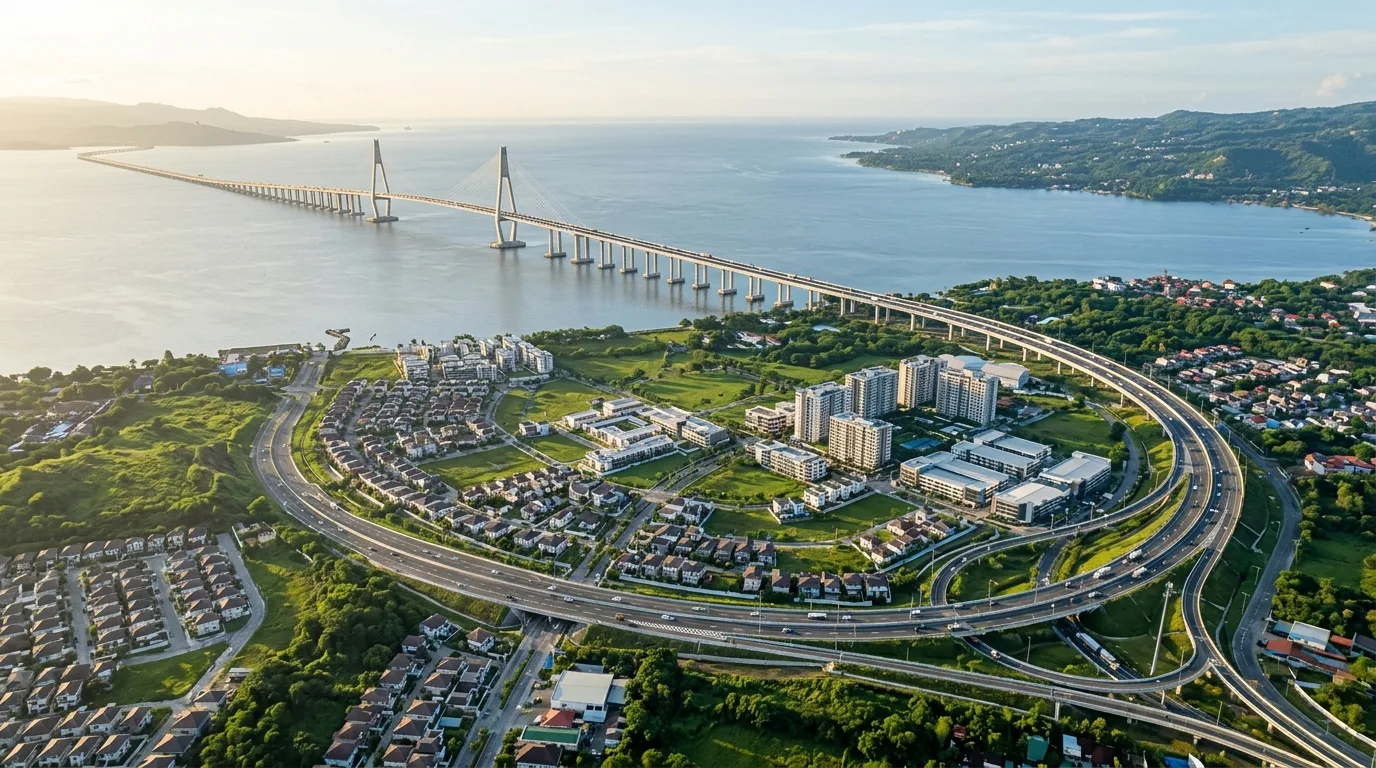
The 32.15-kilometer Bataan-Cavite Interlink Bridge made major headlines on July 20, 2026, as the government prepares to award critical contract packages. The USD3.91-billion project will slash travel time across Manila Bay from 5.5 hours to 45 minutes, revolutionizing Southern Luzon's connectivity and driving massive residential demand . Cavite's appeal as a premier residential and economic hub is accelerating, backed by several strategic factors.
Bataan-Cavite Interlink Bridge: A Game-Changer for Regional Connectivity
The Bataan-Cavite Interlink Bridge (BCIB) is one of the most ambitious infrastructure projects in Philippine history. Funded through a multi-tranche financing scheme, the project will receive USD2.1 billion from the Asian Development Bank and an additional USD1.14 billion from the Asian Infrastructure Investment Bank . Construction will be implemented in seven contract packages, with the Bataan Land Approach set to begin first .
The bridge will directly connect Barangay Alas-asin in Mariveles, Bataan to Barangay Timalan Concepcion in Naic, Cavite . Approximately 80% of the total structure will be built over water, featuring two major navigational bridges: the 400-meter North Channel Bridge and the 900-meter South Channel Bridge . President Ferdinand Marcos Jr. confirmed in his fourth State of the Nation Address that construction will begin before the end of 2025 .
CALAX and CAVITEX: Strengthening Cavite's Internal Connectivity
Complementing the BCIB, the Cavite-Laguna Expressway (CALAX) is transforming daily mobility across the province. In May 2026, President Marcos Jr. inaugurated CALAX Subsection 3, a 7.88-kilometer stretch connecting the Silang Interchange to Governor's Drive Interchange in General Trias City . The PHP4.196-billion segment cuts travel time between Biñan, Laguna, and General Trias from one hour to approximately 26 minutes .
With this milestone, CALAX's operational length now spans 26 kilometers from the Mamplasan Entry in Biñan . Once fully integrated with CAVITEX, the combined network is projected to serve up to 95,000 vehicles per day, acting as a regional backbone for trade and mobility . The newly opened segment will also decongest Governor's Drive and Aguinaldo Highway, easing mobility for an additional 6,000 vehicles daily.
Residential Market and Economic Growth
Cavite's economy expanded by 5.4% in 2024, ranking it as the country's second-largest provincial economy in terms of its share of national GDP . The province is home to over 760 locator companies and has shifted toward a services-based economy, with the sector accounting for 51.5% of GDP .
Residential demand remains strong, particularly in the affordable to lower mid-income segments (PHP2.5 million to PHP7 million), which accounted for more than 70% of total condominium take-up in 2025 . Average lot prices in Cavite reached PHP20,000 per square meter in 2025, appreciating by 5% annually since 2016 . Across Cavite, Laguna, and Batangas, residential lot prices now range from PHP59,000 to PHP62,000 per square meter .
Major developers like Ayala Land, Megaworld, and Federal Land are investing in large-scale masterplanned communities across the province, including Vermosa in Imus, Evo City in Kawit, Maple Grove in General Trias, and Riverpark in General Trias . These integrated townships combine residential neighborhoods, commercial districts, educational institutions, and open spaces, supporting the shift toward communities where daily needs are within reach . As these infrastructure and development projects converge, Cavite continues to strengthen its position as one of the country's most important growth corridors outside Metro Manila.
