


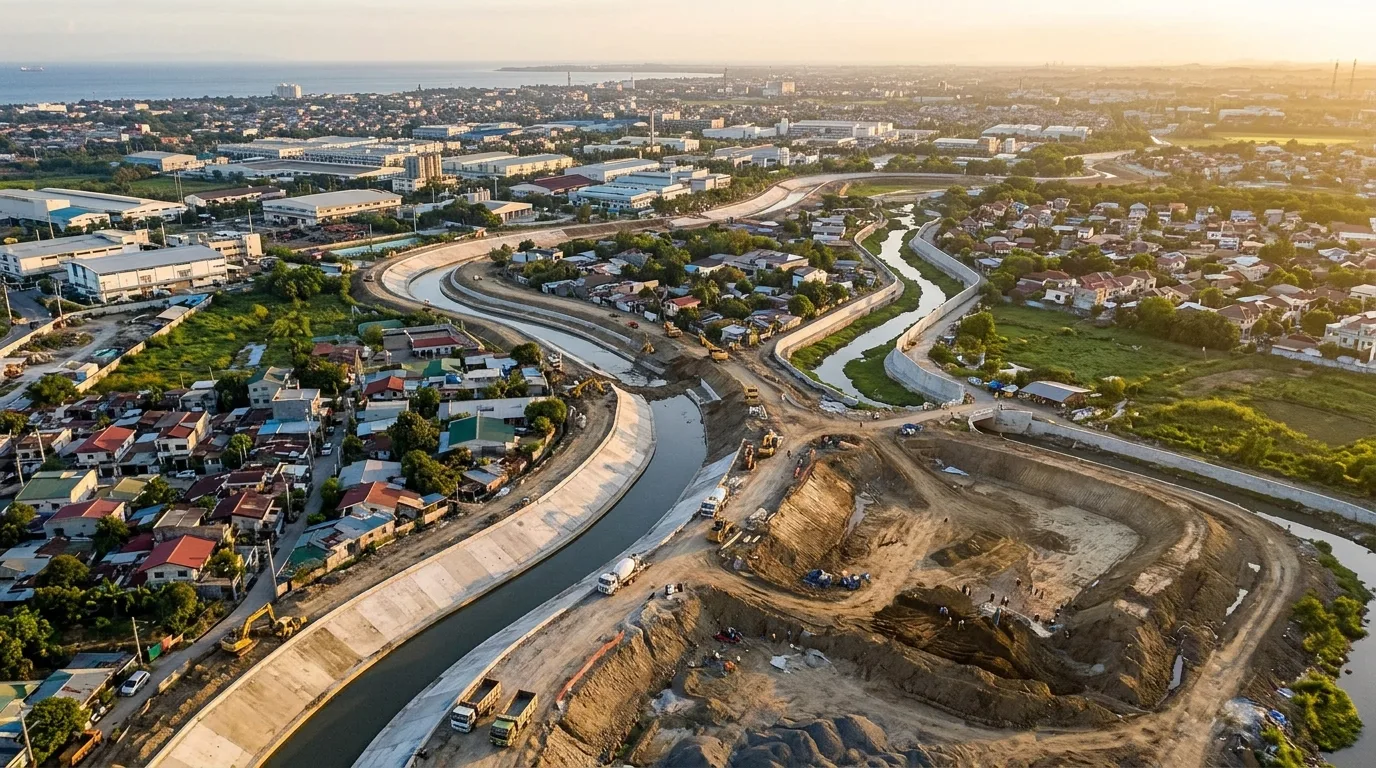
The Cavite Industrial Area Flood Risk Management Project (CIA-FRIMP) is a joint flood-reduction initiative by the Provincial Government of Cavite and the Japan International Cooperation Agency (JICA) targeting urban and low-lying zones like Bacoor, Imus, General Trias, Kawit, Noveleta, Rosario, and Tanza . With a total project cost of PHP22.03 billion and implementation extended to September 2029, the project aims to reduce flood damage in Cavite's rapidly urbanizing industrial and residential areas.
Why Cavite Needs This Project: Rapid Growth Brings Flood Risks
Cavite has experienced rapid urbanization over the past decades, resulting in increased paved surfaces, reduced natural drainage, and higher flood runoff during heavy rainfall . The province is a key economic hub, hosting 17 economic zones with 716 companies, about 23% of which are Japanese firms . Three rivers—the Imus, San Juan, and Canas—run through the province, and when major typhoons occur, flood damage affects both residential communities and industrial operations .
The problem extends beyond major typhoons. In downstream areas close to the coast, internal water fails to drain due to underdeveloped drainage channels, reduced infiltration capacity from land use change, and tidal influence, resulting in long-term flooding during the rainy season every year . In 2020, Typhoon Ulysses affected about 15,000 people in Cavite, with damage to agriculture and infrastructure estimated at around PHP1.5 billion.
Engineering Solutions: Diversion Channels, River Improvements, and a Retarding Basin
The CIA-FRIMP includes major engineering interventions designed to reduce flooding in the province's industrial and urban areas . The project involves two main phases: Phase I covers the construction of the San Juan Diversion Channel (approximately 2.6 km) and Maalimango Diversion I, while Phase II includes Maalimango Diversion II, improvements to the Rio Grande and Ylang-Ylang Rivers, and resettlement site development .
A flood retarding basin is also being built across Bacoor, Imus, and General Trias to catch and hold extra rainwater during big storms . Additional work includes improvements to riverbeds, floodways and diversion channels, drainage systems, and bridge networks to push water safely out toward Manila Bay . The project was approved by the National Economic and Development Authority Board in November 2024, with an implementation period extended to September 2029 and project cost increased to PHP22.03 billion.
Benefits and Community Impact
The project will directly benefit low-lying communities in Bacoor, Imus, General Trias, Kawit, Noveleta, Rosario, and Tanza—areas that experience regular flooding due to the San Juan River, Imus River, and Ylang-Ylang River, as well as interconnected drainage systems leading to Manila Bay . The project's objective is to mitigate flood damages in Cavite Province, contributing to sustainable and stable economic growth in the area .
The Cavite Provincial Government has also pushed local government units to pass legislation creating infrastructure audit teams and school safety officers to ensure the integrity and safety of public infrastructure . As the province continues to invest in flood mitigation infrastructure, public support remains key to strengthening disaster preparedness and recovery efforts.
