


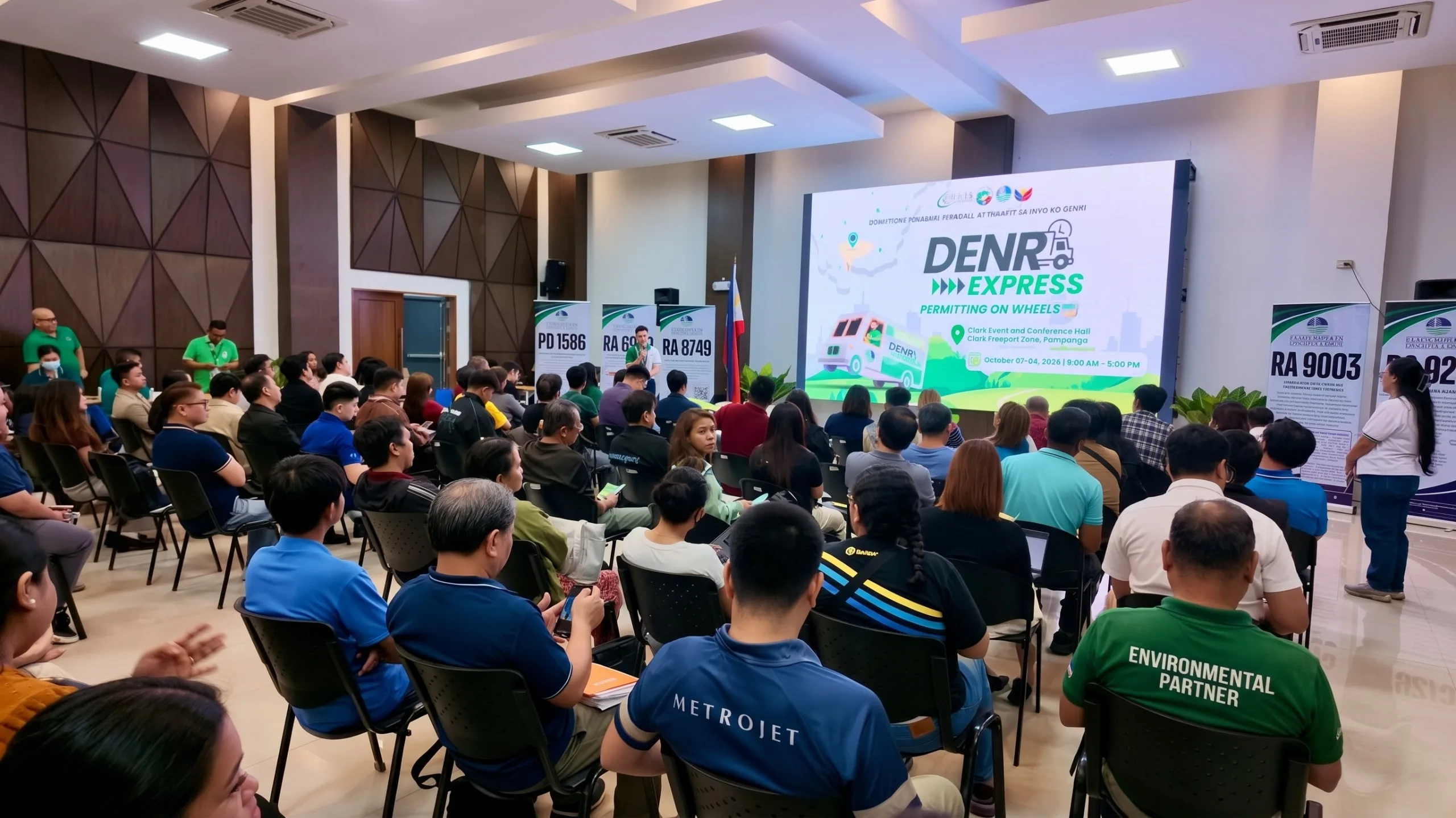
CLARK, PAMPANGA - Bringing regulatory compliance directly to the doorstep of business operators, the Clark Development Corporation (CDC) and the Department of Environment and Natural Resources – Environmental Management Bureau (DENR-EMB Region 3) successfully rolled out a two-day Permitting on Wheels (POW) initiative. Held from October 7 to 8, 2026, between 8:00 AM and 5:00 PM at the Clark Event and Conference Hall, the mobile regulatory desk slashed bureaucratic turnaround times for locators, investors, and stakeholders across the Clark Freeport Zone.
Streamlining Compliance at Ground Level
Co-facilitated by the CDC Environmental Permits Division and DENR-EMB Region 3, the outreach program replaced traditional, multi-agency office visits with an integrated, under-one-roof processing setup. The two-day service desk handled comprehensive on-site screening, application tracking, and technical assistance spanning Environmental Compliance and clearance processing, Land and Natural Resource management services, and Mining-related regulatory and permitting concerns. To ensure applicants understood the legal mechanisms behind their paperwork, the activity was paired with a specialized technical orientation seminar breaking down national environmental laws, compliance obligations, and regional regulatory frameworks. "Bringing government services directly to our stakeholders is not just about convenience—it is about making compliance predictable, accessible, and collaborative," shared CDC Management Strategy in October 2026.
Advancing the Ease of Doing Business
This environmental outreach directly supports CDC President and CEO Atty. Agnes VST Devanadera's broader administrative push to future-proof local governance through process simplification. By mirroring CDC's own mobile administrative drives—such as the One-Stop Shop (OSP) on Wheels—the initiative reinforces Clark's reputation as a frictionless investment destination. Instead of viewing environmental regulation as an operational bottleneck, the joint POW framework positions green compliance as an achievable, streamlined step for sustainable enterprise growth in the Luzon Economic Corridor. The program exemplifies how government agencies can work together to reduce bureaucratic friction while maintaining rigorous environmental standards, ultimately benefiting both businesses and the communities they serve.
