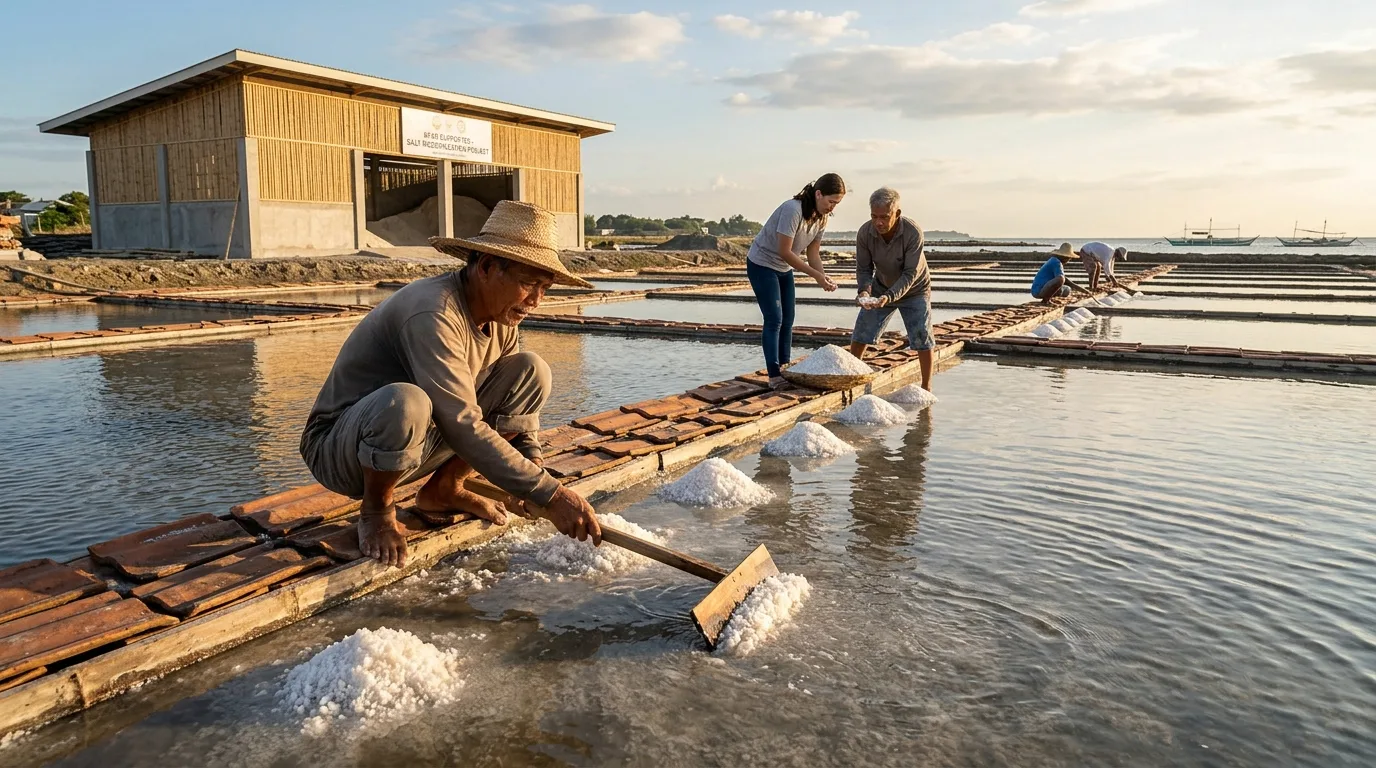
The traditional salt-making industry in Cavite is at a crossroads. Only three traditional salt farms remain, yet a powerful combination of government action, community resilience, and growing appreciation for heritage is creating a new chapter for this centuries-old craft. The industry is not just fading away—it is being actively fought for and revitalized.
A Legislative Lifeline: The Philippine Salt Industry Development Act
The most significant positive development for Cavite's salt makers is the passage of Republic Act 11985, the Philippine Salt Industry Development Act. This law provides a comprehensive roadmap to revitalize the industry by offering technology, research funding, financial support, marketing assistance, and modernization programs . For the first time in decades, local salt producers have a dedicated government agency—the Bureau of Fisheries and Aquatic Resources (BFAR)—tasked with overseeing and nurturing the industry .
The new law also addresses the long-standing burden of the 1995 ASIN Law by making iodization optional for artisanal salt, while still allowing food-grade salt to meet health requirements . This creates a space for both iodized and non-iodized salt to co-exist, serving different markets. BFAR has allocated P200 million to revive the industry across 23 salt-producing areas, including Kawit and Noveleta in Cavite . This funding covers the distribution of post-harvest materials, storage facility upgrades, and technology demonstrations that will help salt makers improve production and quality.
Community Resilience and Advocacy
Despite the challenges, Cavite's salt makers continue to demonstrate remarkable resilience. Generational families of "mang-iiras" (salt makers) maintain the labor-intensive process of solar evaporation, preserving a unique culinary identity that has been part of Cavite's heritage for centuries . A study on revitalizing Cavite's salt industry found that integrating principles from the sociology of religion highlights how salt farming traditions are embedded in local rituals, communal values, and collective identity, reinforcing social cohesion and resilience .
Advocates like Kathleen Apilado, dean of José Rizal University, have worked for nearly a decade to keep the dying art of sea salt farming alive . Through outreach activities, exhibits, forums, and direct support to farmers, she has helped increase the number of artisanal farmer families from four to twenty. Women farmers, who often go unrecognized despite being the most dedicated to the craft, are being equipped with technical and leadership skills to bring artisanal sea salt into the 21st century . Local restaurants and hotel chains, including The Fatted Calf Farm Kitchen, Sheraton Hotel Manila Bay, and New World Hotel, have shown interest in artisanal sea salt, recognizing its superior flavor and authenticity.
A Foundation for Future Growth
The future holds significant opportunities for Cavite's salt industry. Targeted promotional strategies, including leveraging social media and developing salt tourism experiences, are being explored . Salt farms could become educational destinations where visitors learn about traditional salt-making methods and purchase high-quality artisanal products. By combining traditional techniques with modern saltern technologies, quality control improvements, and infrastructure development, Cavite's salt makers can find a sustainable path forward .
The preservation of this craft is about more than just salt—it is about protecting a way of life, a family tradition, and a unique piece of Cavite's cultural identity. As one salt maker said, "Salt making is not an easy job, you need to be patient and diligent. We hope we will continue to get support... because this is part of Noveleta's livelihood and culture" . With the new law providing a framework for support, the future looks brighter for Cavite's last salt farmers.