


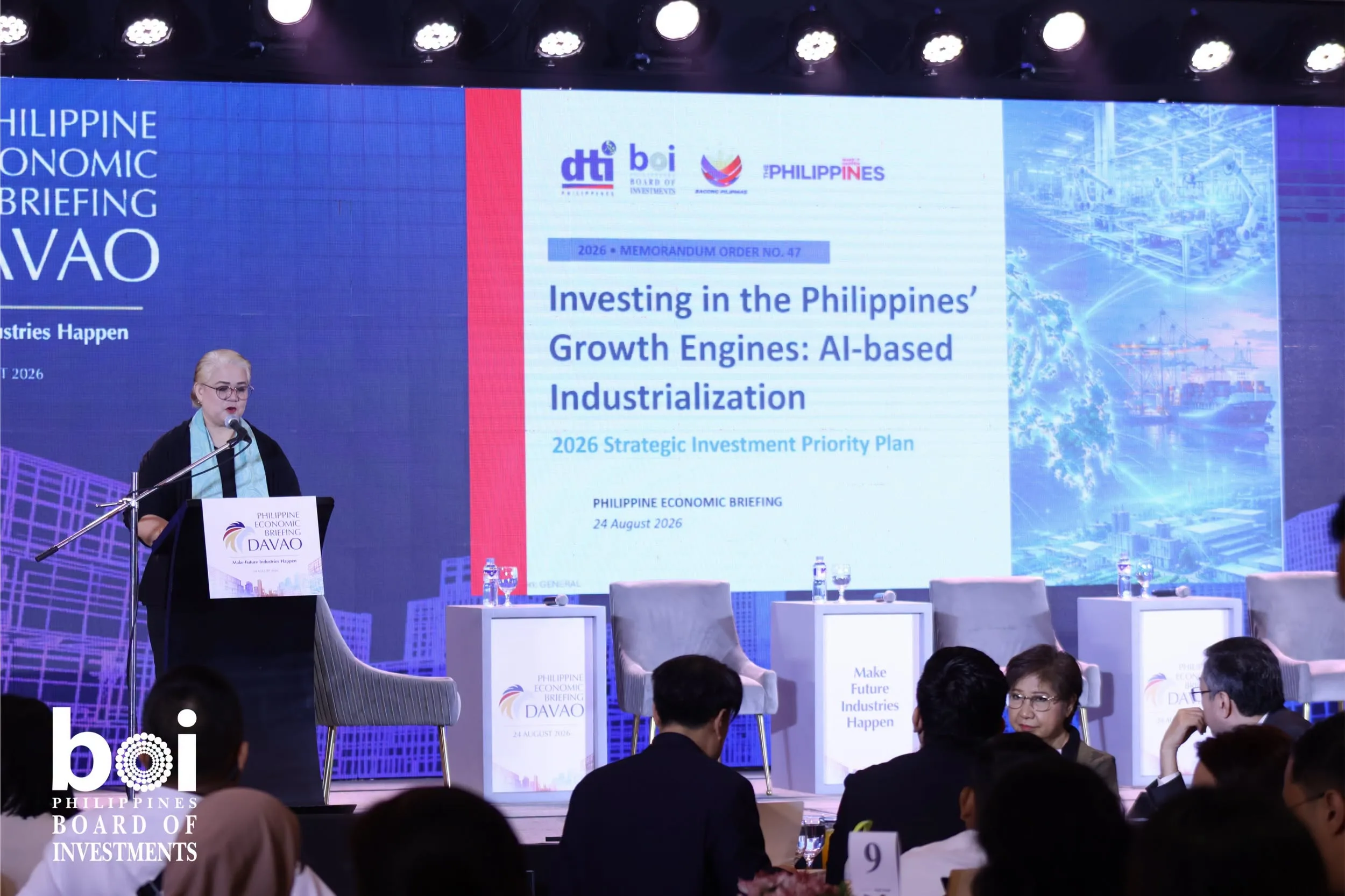
DAVAO — The Board of Investments (BOI) has put Mindanao at the center of its push to build AI-driven, higher-value industries, as it concluded the 2026 Strategic Investment Priority Plan (SIPP) Roadshow at the Philippine Economic Briefing on August 24, 2026. The message was clear: the region is poised to move beyond traditional strengths and into advanced manufacturing, mineral processing, and technology-enabled growth.
Mindanao's Unique Platform for Growth
BOI executives highlighted Mindanao's abundant resources and strategic location as a foundation for future industries. The region's strengths in agribusiness, renewable energy, logistics, critical minerals, digital services, and halal industries position it uniquely. It was identified as a strategic hub for food security, integrated circuit design, and mineral processing—key areas in high-value supply chains.
BOI Governor Marjorie Ramos O. Samaniego emphasized the need for Mindanao to accelerate downstream industrial activities. The region's rich deposits of nickel, copper, and gold offer a strong base for expanding mineral processing and manufacturing. This shift would allow Mindanao to capture more economic value locally, transforming resources into products and, ultimately, industries.
Building the Digital and Human Foundation
Investments already taking shape are laying the groundwork for this transformation. BOI-registered digital connectivity projects by Converge ICT Solutions, InfiniVAN, and Philippine Fiber Optic Cable Network are expanding the region's digital infrastructure. This network is crucial for data-driven businesses and innovation ecosystems.
BOI Industry Development Services Executive Director Ma. Corazon Halili-Dichosa stressed that future industries require not just infrastructure but a skilled workforce. The BOI's Academe-Industry Matching initiative is aligning training with industry needs through partnerships with institutions like MSU-Iligan Institute of Technology. This ensures that Filipino workers are equipped for emerging opportunities.
A Region on the Rise
The roadshow built on strong economic fundamentals. Department of Finance Secretary Frederick D. Go emphasized that Davao Region remains Mindanao's largest economy, posting a GRDP of P1.14 trillion in 2025 with 5.1 percent growth—outpacing the national average. He described Davao City as a vital gateway to Mindanao, connecting businesses, capital, and markets.
Go noted that Mindanao's investment story is evolving. The region is moving beyond agriculture and raw minerals toward higher-value industries, better jobs, and more sustainable growth. Major investments, like HD Hyundai's $300 million project in Subic and Mitsubishi Motors' P7 billion Laguna facility, reflect rising investor confidence in the country.
Turning Priorities into Projects
The 2026 SIPP is the government's roadmap to steer investments into priority sectors. Key reforms, including the CREATE MORE Act, the new Public-Private Partnership Code, and the amended Investors' Lease Act allowing 99-year leases, are designed to lower the cost of doing business. These measures aim to make Mindanao an even more attractive destination for both large corporations and MSMEs.
Samaniego concluded that Mindanao's next chapter should focus not only on what the region produces but what it can build. The goal is to turn resources into products and products into thriving local industries. This vision positions Mindanao as a driving force in the Philippines' next phase of growth.
