


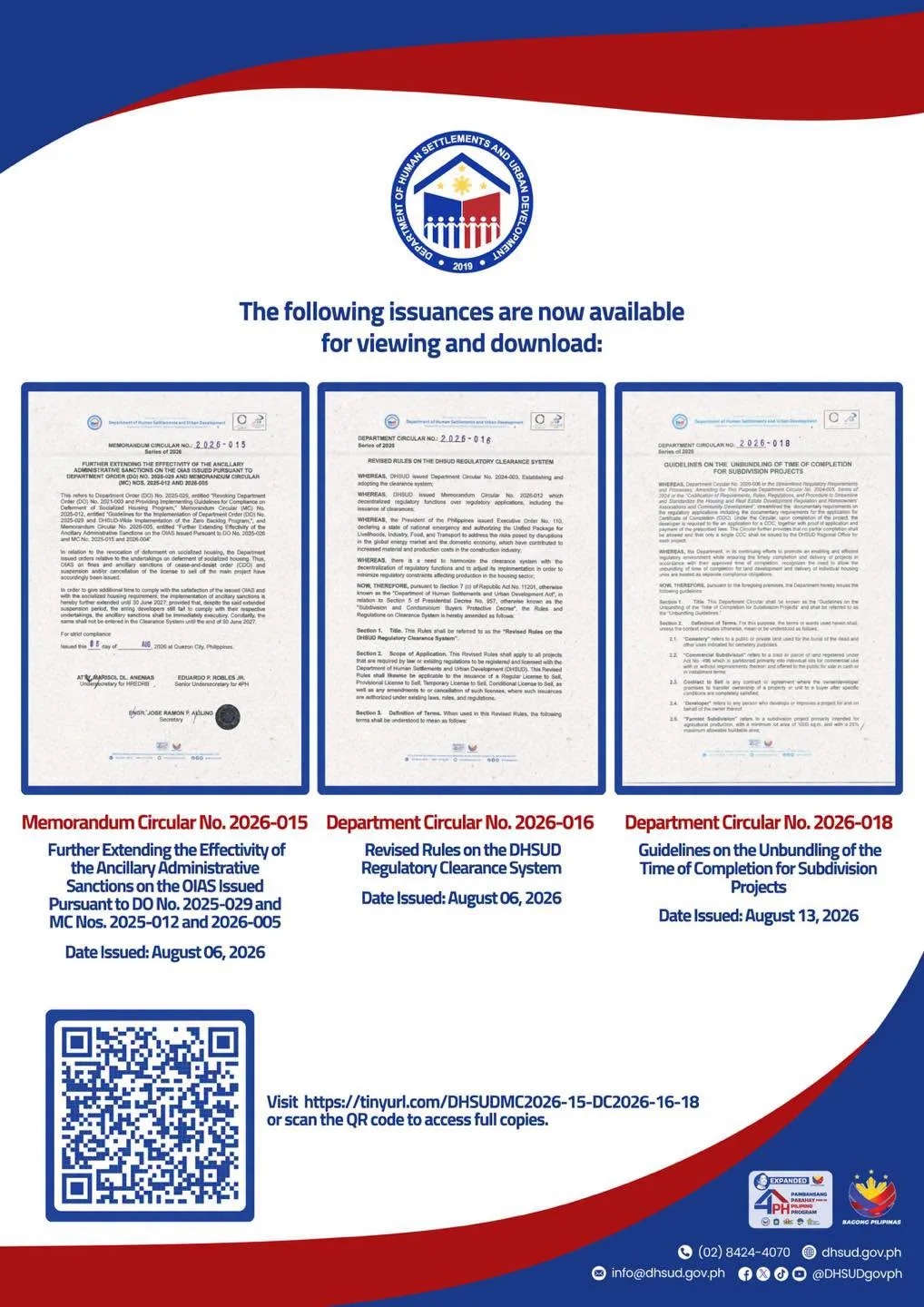
PHILIPPINES — The Department of Human Settlements and Urban Development (DHSUD) has rolled out three regulatory circulars in August 2026 designed to accelerate housing production while strengthening consumer safeguards. The changes aim to simplify processes for developers and deliver homes faster to Filipino families.
A New Framework for Faster Approvals
Department Circular No. 2026-016 overhauled the regulatory clearance system, making it easier for developers to secure Licenses to Sell. The revised rules define when a clearance is needed and allow for partial compliance if a developer is waiting on another government agency. This prevents projects from stalling due to red tape.
The system now requires regional offices to report any outstanding violations within two working days. An online database, maintained by the Knowledge Management and Information Systems Service, will track all clearances. This digital shift is part of the department's broader 8-Point Agenda to modernize housing regulation.
Separate Timelines for Land and Homes
Department Circular No. 2026-018 introduced a concept called "unbundling," which separates the completion timelines for land development and housing construction. Previously, a single Certificate of Completion covered the entire project. Now, developers can get credit for finishing roads, drainage, and parks without waiting for every house to be built.
This change addresses a major bottleneck. It allows phased projects to receive certification for each completed phase, provided each has independent access and amenities. The unbundling does not extend the original completion deadline but gives developers more flexibility in managing their work programs.
More Time for Socialized Housing Compliance
Memorandum Circular No. 2026-015 extends the suspension of ancillary sanctions against developers until June 30, 2027. This applies to those with outstanding socialized housing obligations under the balanced housing program. The extension recognizes economic pressures and gives developers time to comply without halting construction.
However, the suspension is not a waiver. If a developer fails to meet their commitments by the deadline, the sanctions become immediately executory. This balance ensures that housing production continues while keeping developers accountable to their socialized housing quotas.
Stronger Consumer Protection
For homebuyers, the new circulars introduce clearer expectations. Housing units must be completed and delivered within one year from the first payment or contract signing, unless the Contract to Sell specifies otherwise. Sales Status Reports must be filed every six months, and regional offices will conduct site inspections to verify progress.
The Housing Completion and Delivery Compliance Report adds another layer of monitoring. If a developer is non-compliant, a Notice of Violation is issued. These measures ensure that the push for faster production does not come at the expense of quality or buyer rights.
A Path to Millions of Homes
The three circulars collectively support President Ferdinand Marcos Jr.'s Expanded Pambansang Pabahay para sa Pilipino (4PH) Program. DHSUD aims to deliver over a million housing units by the end of the administration. The streamlined rules are essential for hitting that target while maintaining integrity in the real estate market.
The changes reflect a mature regulatory approach that listens to both developers and consumers. By removing unnecessary obstacles and strengthening transparency, DHSUD is creating an environment where housing can thrive. The result is a more responsive system that serves the nation's urgent need for affordable, quality homes.
