


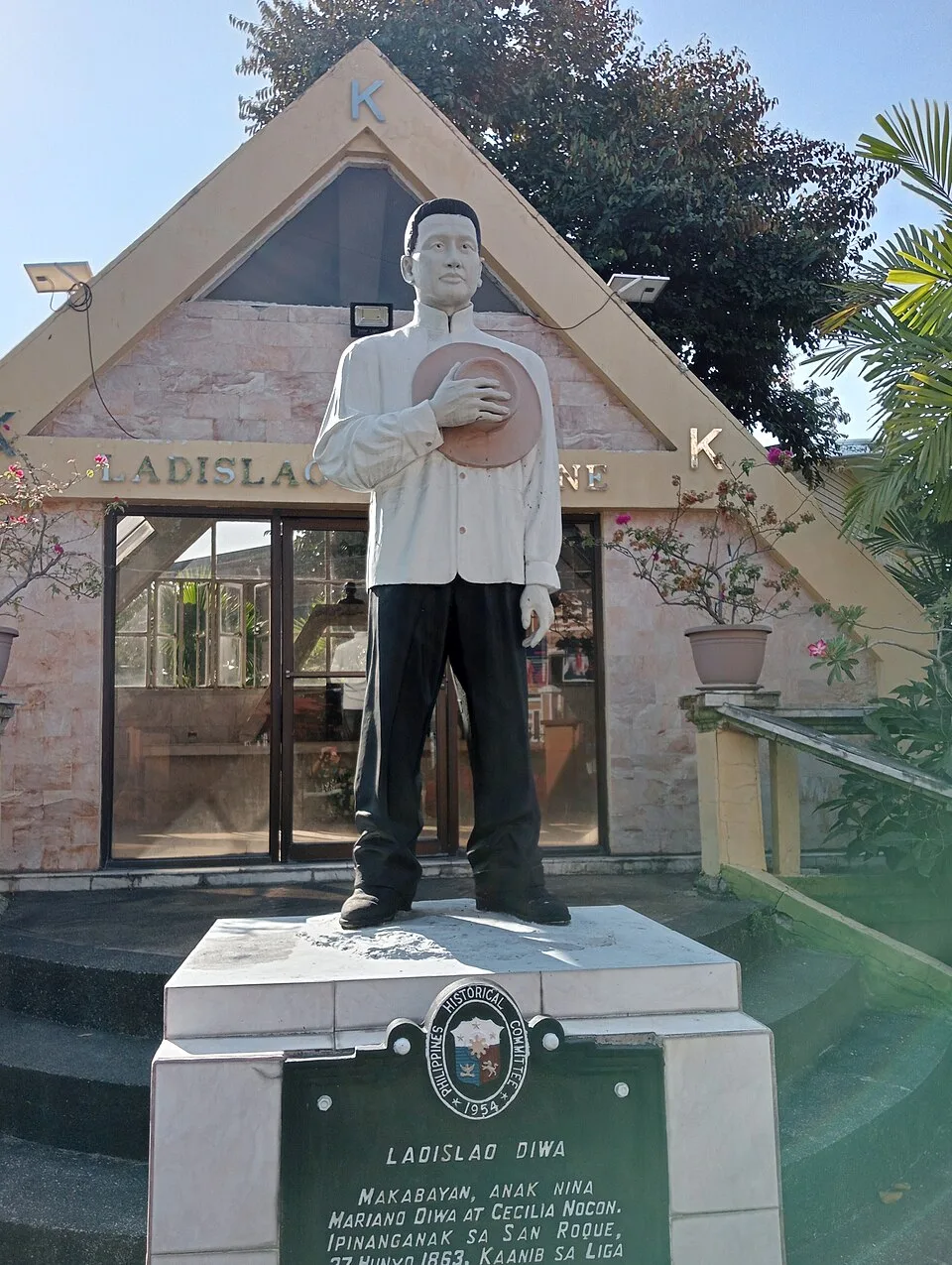
Explore the heritage paths and historical markers surrounding the Don Ladislao Diwa Shrine in Cavite City. The revered Katipunan co-founder was born in San Roque on June 27, 1863, and is laid to rest at the shrine's mausoleum in Caridad . The shrine was built to honor the patriot who, together with Andres Bonifacio and Teodoro Plata, founded the revolutionary Katipunan society that sparked the 1896 Philippine Revolution.
A Revolutionary's Resting Place in Caridad
The Don Ladislao Diwa Shrine serves as the mausoleum and historical marker for one of the Philippines' most important but often underappreciated revolutionaries. Diwa's remains were transferred to this site on November 30, 1996, in a ceremony led by the National Historical Institute (now the National Historical Commission of the Philippines) and the National Centennial Commission . The shrine's most distinctive feature is its triangular shape, which serves as a visual reminder of the Katipunan's symbol and the revolutionary society Diwa helped establish .
The shrine is located at the corner of Cabuco and de Guzman Streets in Barangay Caridad, Cavite City, near the Caridad Elementary School which was renamed in his honor in November 1964 . A historical marker on the site bears the story of Diwa's life, from his birth in San Roque to his role as governor of Cavite during the First Philippine Republic .
The Man Behind the Shrine: From Law Student to Revolutionary
Ladislao Diwa y Nocon was born on June 27, 1863, in San Roque, Cavite, to Mariano Diwa and Cecilia Nocon . He initially studied for the priesthood at the University of Santo Tomas but abandoned his ecclesiastical studies just before ordination to pursue law instead, believing he could serve his country in a much greater capacity as a lawyer .
It was during his law studies that Diwa met Andrés Bonifacio, who often distributed propaganda material inside the university campus. The two became close friends, and Diwa later boarded with Teodoro Plata at Bonifacio's house in Tondo . After Rizal's arrest and deportation, Diwa, Bonifacio, and Plata became convinced that armed uprising was the only way to attain independence . On the night of July 7, 1892, they founded the Katipunan in a house in Tondo, joined by Deodato Arellano, Valentín Díaz, and José Dizon .
Diwa adopted the symbolic name Balete and formed the Katipunan's first triangulo (triangle) with Bonifacio and Plata, becoming the society's fiscal . He later contributed significantly to the Katipunan's expansion into Central Luzon due to his transfer to a court in Pampanga, personally inducting Katipuneros in Bulacan, Tarlac, and Nueva Ecija . After the Philippine Revolution broke out, Diwa was promoted to colonel in the revolutionary army and, when the First Philippine Republic was organized, became the first civil governor of Cavite . He also signed the Philippine Proclamation of Independence on June 12, 1898.
Visiting the Shrine: What to Expect
The Don Ladislao Diwa Shrine is typically not open to the public for regular visits. It is often locked and can only be viewed from outside the gate, and is opened only on special occasions or if coordinated with the local tourism office of Cavite City . Despite this limited access, visitors can still view and admire the unique facade from outside the gate. As one visitor noted, "This site commemorates Ladislao Diwa - one of the original founders of the secret society known as the Katipunan or the K.K.K." .
Given its proximity to other heritage sites in Cavite City, the shrine is a worthwhile stop for history enthusiasts exploring the province's revolutionary past. The site is located near the San Roque Parish Church area, which has also been declared a tourism destination . If you plan to visit, it is advisable to coordinate with the Cavite City Tourism Office in advance to inquire about access.
