


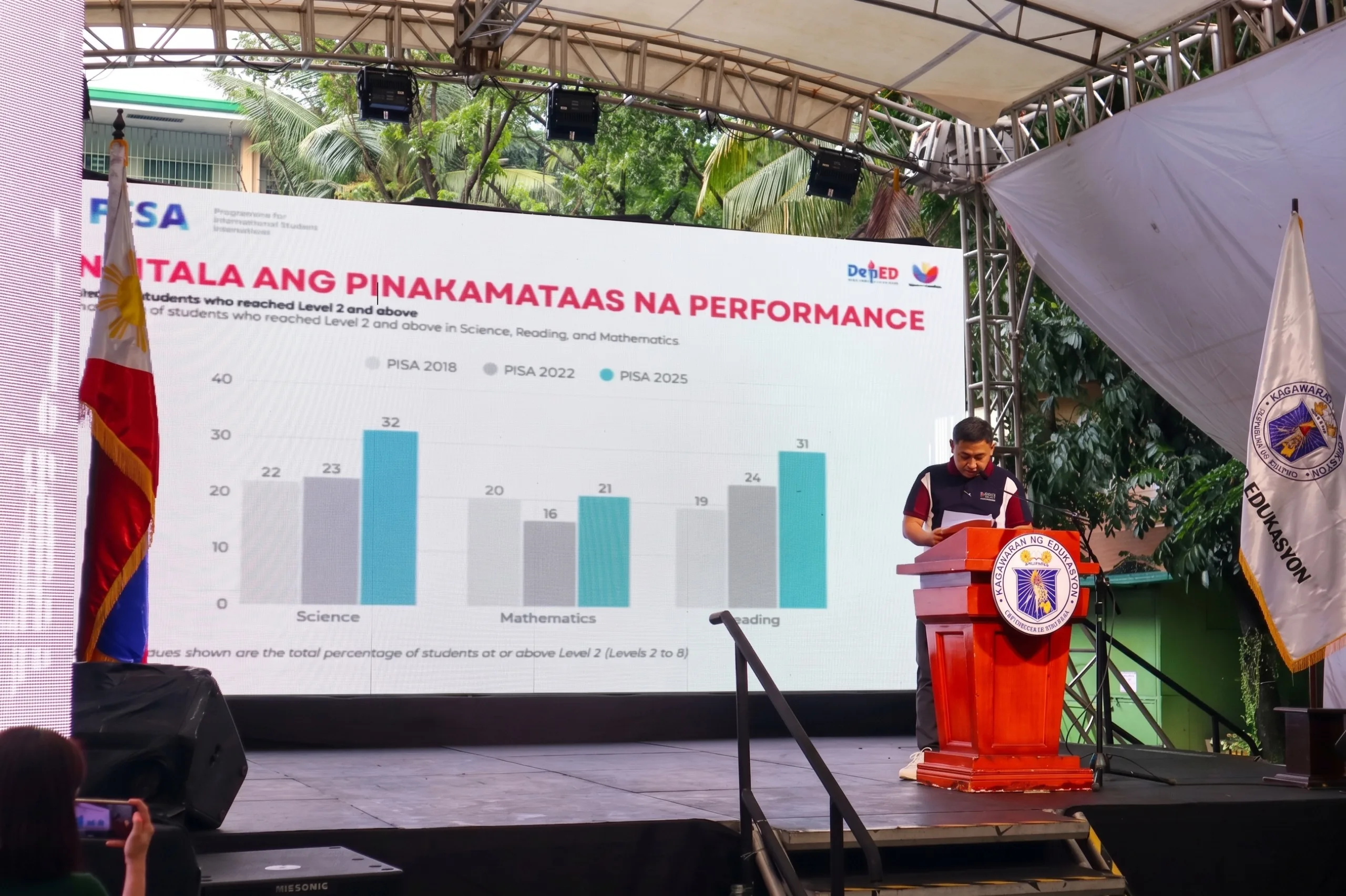
PHILIPPINES — The Philippines achieved its strongest performance yet in the 2025 Programme for International Student Assessment (PISA), posting significant gains in Reading, Mathematics, and Science. Education Secretary Sonny Angara announced the results at Caloocan City Science High School, describing the milestones as a clear sign of the country's educational momentum.
Record Gains Across All Domains
The country's mean scores climbed to 367 in Reading, 371 in Mathematics, and 373 in Science. These figures represent jumps of 20, 16, and 17 points respectively from the 2022 cycle. The improvement reverses years of stagnant or declining performance since the Philippines first joined the assessment in 2018.
The Organization for Economic Cooperation and Development (OECD) highlighted the country's exceptional progress. OECD Director for Education and Skills Andreas Schleicher praised the Philippines, noting that no country improved its reading skills faster within the PISA framework. This recognition places the Philippines on a positive trajectory despite global declines in student performance.
Outranking Other Countries
The improved scores allowed the Philippines to surpass several participating economies. In Reading, the country outranked 18 nations that previously scored higher. In Mathematics, 16 countries were surpassed, while in Science, 14 others were outranked.
These rankings reflect a school system on the move, as Schleicher described it. The gains are not merely statistical noise but represent real, measurable progress in basic education outcomes. The results validate the administration's focus on foundational skills in reading, writing, and arithmetic.
More Students Reaching Baseline Proficiency
A key indicator of progress is the proportion of students reaching Level 2 or higher, the baseline proficiency level. In Science, this share rose from 23 percent to 32 percent. Mathematics saw an increase from 16 percent to 21 percent, while Reading climbed from 24 percent to 31 percent.
While most students still fall below minimum proficiency, the upward trend is encouraging. More Filipino learners are now equipped with the essential skills needed for further learning and future employment. The improvements signal that educational reforms are beginning to take root.
A Whole-of-Society Effort
DepEd credited the improvements to a collaborative approach involving schools, families, local governments, and private sector partners. Organizations like Khan Academy and Frontlearners provided crucial support. Even barangay-level engagement played a role in preparing students for the assessment.
The focus extended beyond academics. DepEd prioritized the emotional and psychosocial well-being of learners, recognizing that stress could hamper performance. Students were also familiarized with computer-based testing, addressing a major hurdle from previous cycles.
Challenges Remain on the Horizon
Despite the record gains, the Philippines remains below the OECD average scores. Teacher groups cautioned against viewing PISA as the sole measure of educational success. Persistent issues like classroom shortages and teacher welfare continue to demand attention.
Bullying and cyberbullying also remain significant concerns, affecting the overall school environment. The government must balance celebrating progress with addressing these deeper structural problems. Sustaining the momentum requires continued investment in teachers, facilities, and student support systems.
