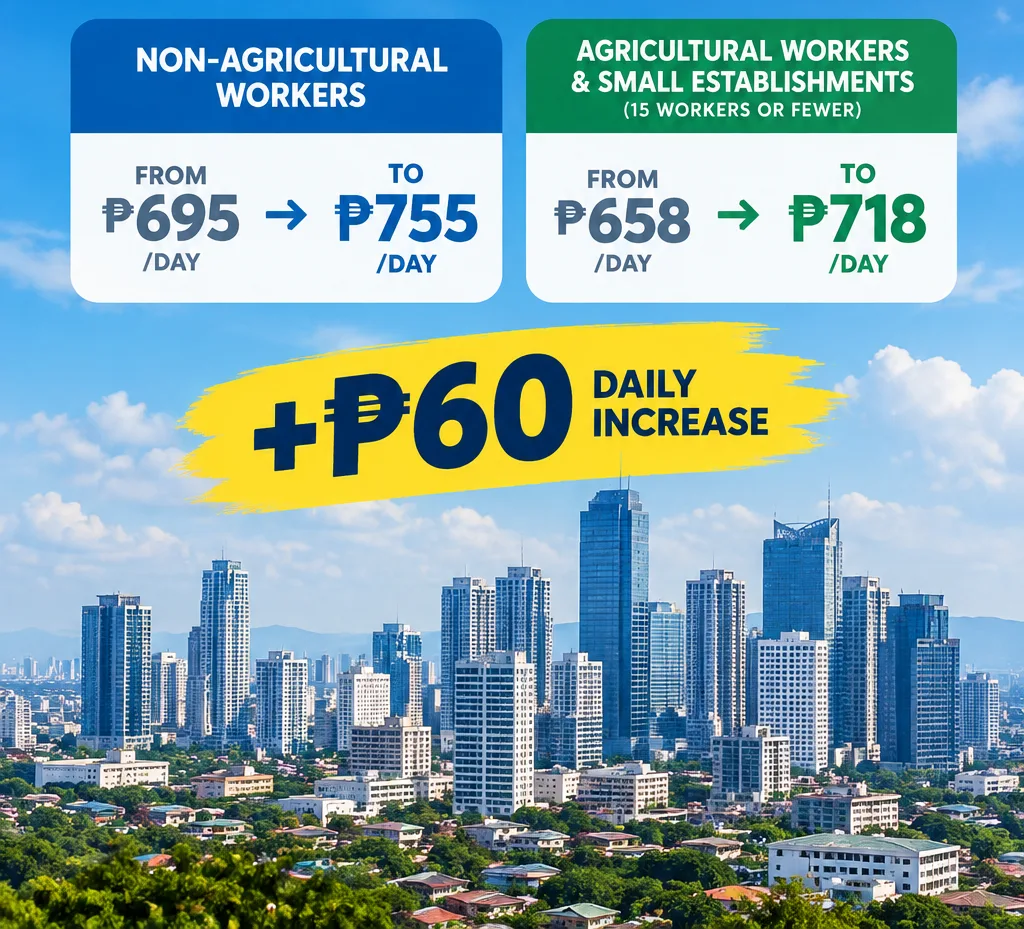
TAGUIG CITY — Minimum wage workers across Metro Manila received a long-awaited boost on September 26, 2026, as Wage Order No. NCR-28 took full effect. The ₱60 daily increase benefits an estimated 1.1 million workers, including thousands who keep Bonifacio Global City running every day.
A Milestone for Metro Manila Workers
Labor Secretary Francis N. Tolentino announced the implementation at the DOLE Central Office in Intramuros, Manila. He emphasized that the adjustment reflects the strength of the tripartite mechanism, where government, employers, and workers unite to uplift the dignity of Filipino laborers while sustaining economic growth.
Under the wage order, non-agricultural workers in the National Capital Region now receive a minimum daily wage of ₱755, up from ₱695. Workers in agriculture, small retail and service establishments with 15 or fewer employees, and small manufacturing firms with fewer than 10 workers now receive ₱718 daily, an increase from ₱658.
Tolentino called on employers to strictly comply with the new rates and ensure their payroll systems reflect the mandated increases. He stressed that DOLE will continue monitoring compliance and providing guidance to both workers and businesses on proper implementation.
The BGC Microcosm: Affluent Hub, Frontline Workforce
Bonifacio Global City presents a unique economic landscape where luxury retail, multinational headquarters, and premium dining coexist with a massive frontline labor force. Thousands of security guards, janitors, baristas, retail attendants, restaurant staff, and maintenance crews commute daily into the district to sustain its seamless operations.
For these workers, the ₱60 increase translates to an additional ₱1,320 to ₱1,560 monthly, assuming 22 to 26 working days. This increment directly helps absorb inflationary pressures on food, utilities, and transportation. Many workers travel from nearby Guadalupe, Market! Market!, and surrounding barangays, making daily commuting costs a significant portion of their budget.
The raise offers tangible relief without disrupting the district's economic vitality. It acknowledges the essential role these workers play in maintaining BGC's reputation as a world-class urban center. Their contributions often go unnoticed, yet they are indispensable to the district's daily rhythm.
Retail and Dining Sectors Adjust
BGC hosts one of the highest concentrations of food and beverage establishments, lifestyle boutiques, and specialty stores in Metro Manila. From Bonifacio High Street to Uptown Bonifacio, these businesses define the district's character. The wage increase requires immediate administrative and financial recalibration.
Restaurants and retail shops with sizable hourly or daily-wage staff will experience higher baseline labor costs. Large international chains and luxury brands can readily absorb the adjustment, but independent dining spots and small retail kiosks may need to evaluate pricing or service charges to maintain margins.
To offset higher wage costs without alienating BGC's discerning clientele, operators may increasingly leverage digital point-of-sale systems, automated ordering kiosks, and optimized shift scheduling. These efficiency measures help balance rising labor expenses with the need to preserve service quality and customer experience.
Property Management and Service Contracts
BGC's commercial office towers and luxury residential condominiums rely heavily on outsourced service providers for security, sanitation, landscaping, and mechanical maintenance. Security agencies and janitorial contractors will issue contract price adjustments to reflect the mandatory rate bump.
Building administration bodies will need to amend service contracts to comply with DOLE guidelines. Over time, higher facility maintenance and security costs may filter down to homeowners' associations and commercial tenants through incremental adjustments to monthly condo dues or common area maintenance fees.
This ripple effect underscores the interconnected nature of wage policies and property operations. While the increase benefits frontline workers, it also requires careful financial planning from property managers and service providers to maintain sustainable operations across BGC's diverse real estate portfolio.
Addressing Wage Distortion in Corporate Settings
Major BPO centers, tech firms, and multinational corporations in BGC generally offer starting salaries well above the minimum wage threshold. However, the ₱60 hike creates operational considerations related to wage distortion, where the pay gap between minimum wage earners and those earning slightly above narrows.
Human resource departments must review pay scales for lower-tier administrative, facility support, and entry-level staff to preserve equitable pay differentials. BPO and corporate leaders must also ensure third-party vendors strictly adhere to the wage order. Tolentino emphasized that DOLE will actively monitor compliance across all sectors.