


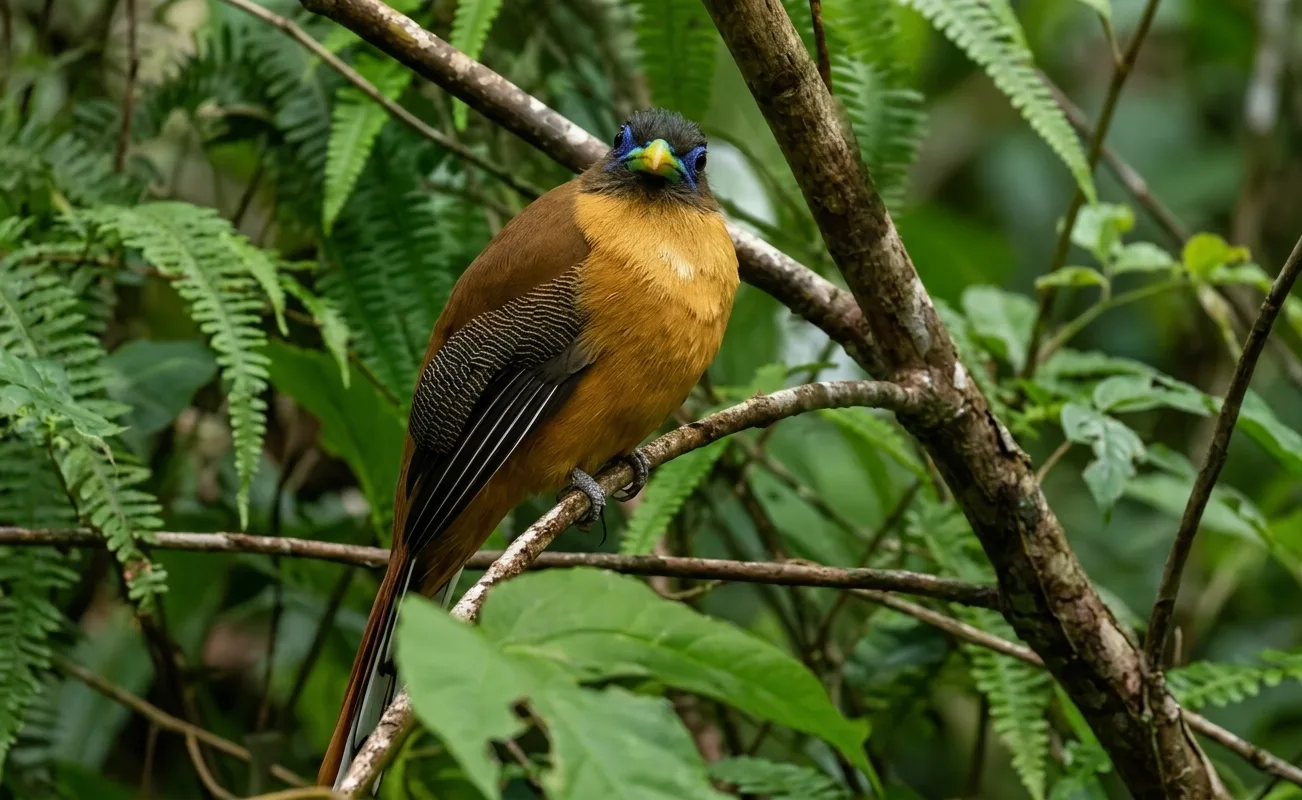
Davao — Environmental authorities and conservationists in Mindanao have recorded a remarkable win for Philippine biodiversity as confirmed sightings of the Philippine Trogon (Harpactes ardens)—locally known as the real-life Ibong Adarna—continue to grow across the lush canopy cover of Davao’s protected mountain ranges. Monitored under recent 2026 biodiversity field assessments led by the Department of Environment and Natural Resources-Davao Region (DENR-Davao), the presence of this vibrant, elusive bird highlights the ecological resilience of southern Philippine forests. Known for its brilliant plumage of deep red, blue, and yellow, the species serves as a living symbol of Philippine folklore and a key indicator of old-growth rainforest health.
Documenting Elusive Avian Populations in High-Canopy Habitats
To track and assess the local population of the Philippine Trogon, wildlife researchers employ stationary point counts and acoustic monitoring techniques tailored to high-canopy dwellers. Observers position themselves along established forest trails during dawn and dusk, relying on visual confirmation alongside the bird's distinct calls to log territorial activity. Because trogons prefer quiet, undisturbed perches beneath the dense canopy, these non-invasive surveying methods allow biologists to record nesting behaviors and population densities accurately without stressing the sensitive species or disrupting its habitat.
Highlighting the Ecological Significance of Endemic Forest Birds
Conservationists emphasize that the Philippine Trogon plays a crucial functional role in maintaining healthy tropical forest dynamics. As an insectivore and partial frugivore, the bird helps control forest pest populations while aiding in the subtle seed distribution of understory flora. Because trogons depend strictly on mature trees with natural hollows for nesting, their presence directly reflects the structural integrity of the surrounding ecosystem—making them an invaluable bioindicator for environmental management teams monitoring forest degradation and recovery.
Strengthening Protection Measures Across Mindanao Sanctuaries
The documented stability of trogon sightings in Davao aligns with broader regional initiatives aimed at safeguarding endemic wildlife across Mindanao's protected areas, including the Mount Apo Natural Park and the Mount Hamiguitan Range Wildlife Sanctuary.
Local DENR units, alongside indigenous community rangers, have intensified forest patrols and anti-poaching measures to protect key nesting grounds from agricultural encroachment and illegal logging. These continuous tracking efforts ensure that iconic native species remain protected, keeping the real-life legends of Philippine biodiversity alive in their natural wild habitats.
