


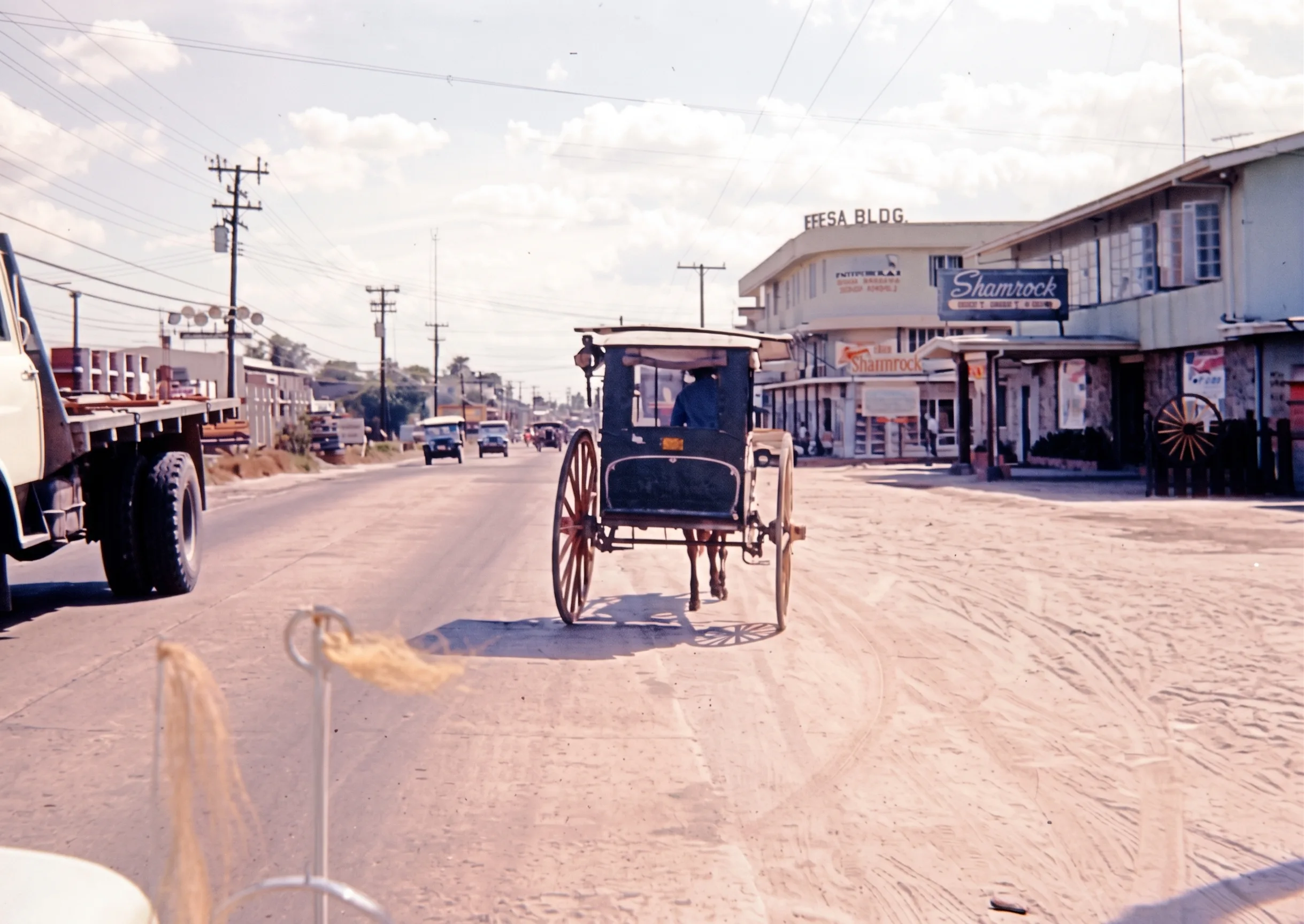
ANGELES CITY, PAMPANGA - If you stand on the edge of MacArthur Highway in Balibago today, your senses are immediately met with a rush of modern life—the roar of jeepneys, the neon signs of entertainment hubs, the glass storefronts, and the constant hum of a 24/7 commercial district. But if you could step back in time exactly where you are standing—to the year 1969—the world around you would suddenly go quiet. Thanks to an archival photograph captured by Evan Williams, we are given a rare window into a forgotten era of Angeles City, where the bustling metropolis we know today was once a stretch of wide, open dirt paths, quiet fields, and unhurried transport. This is a story of how Balibago transformed from a pastoral landscape into one of the most vibrant commercial districts in Central Luzon.
The Reign of the Kalesa and the Marlim Mansion
Before asphalt and multi-lane traffic jams took over MacArthur Highway, the primary mode of moving through Balibago was the kalesa (horse-drawn carriage). Williams' photograph beautifully captures these carriages passing gracefully through the open space, creating a scene that feels almost pastoral. It's hard to imagine that these same paths, once trodden by horses, would eventually become the main artery for hundreds of thousands of motorized vehicles, commuters, and tourists every single day.
Across from where these kalesas roamed stood the iconic Marlim Mansion. In the late 1960s, it was a striking landmark of mid-century architecture—a quiet sentinel standing watch over an evolving landscape. At the height of the Clark Air Base era, structures like Marlim Mansion were the early pioneers of the city's commercial expansion, serving as recognizable meeting points for both local residents and visiting American servicemen. Today, while the building's presence has shifted from a quiet architectural marvel to an anchor in a highly packed urban district, its name still echoes in local geography. The intersection of Marlim Boulevard and MacArthur Highway serves as a direct bridge between the town's history and its current commerce.
What Replaced the Quiet Fields?
The transformation of Balibago didn't happen overnight, but it was aggressive. Driven by the economic boom of Clark Air Base and the resilient spirit of Angeles City after the base's closure, those open, wide paths were rapidly paved over. Where horse-drawn carriages once paused, major establishments now dominate. Today, that exact corridor is packed with bustling hubs like Casino Filipino, vibrant dining spots, local corporate offices, and the famous Walking Street nightlife district just a short distance away. The quiet fields have been entirely replaced by concrete, commerce, and a relentless energy that never sleeps.
Looking at Evan Williams' 1969 photograph isn't just an exercise in nostalgia; it is a vital reminder of how quickly our landscapes shift. The next time you find yourself stuck in traffic or walking past the commercial blocks of modern Balibago, take a look out the window. Just over five decades ago, that exact spot was a wide-open path, a passing kalesa, and a quiet moment in history.
