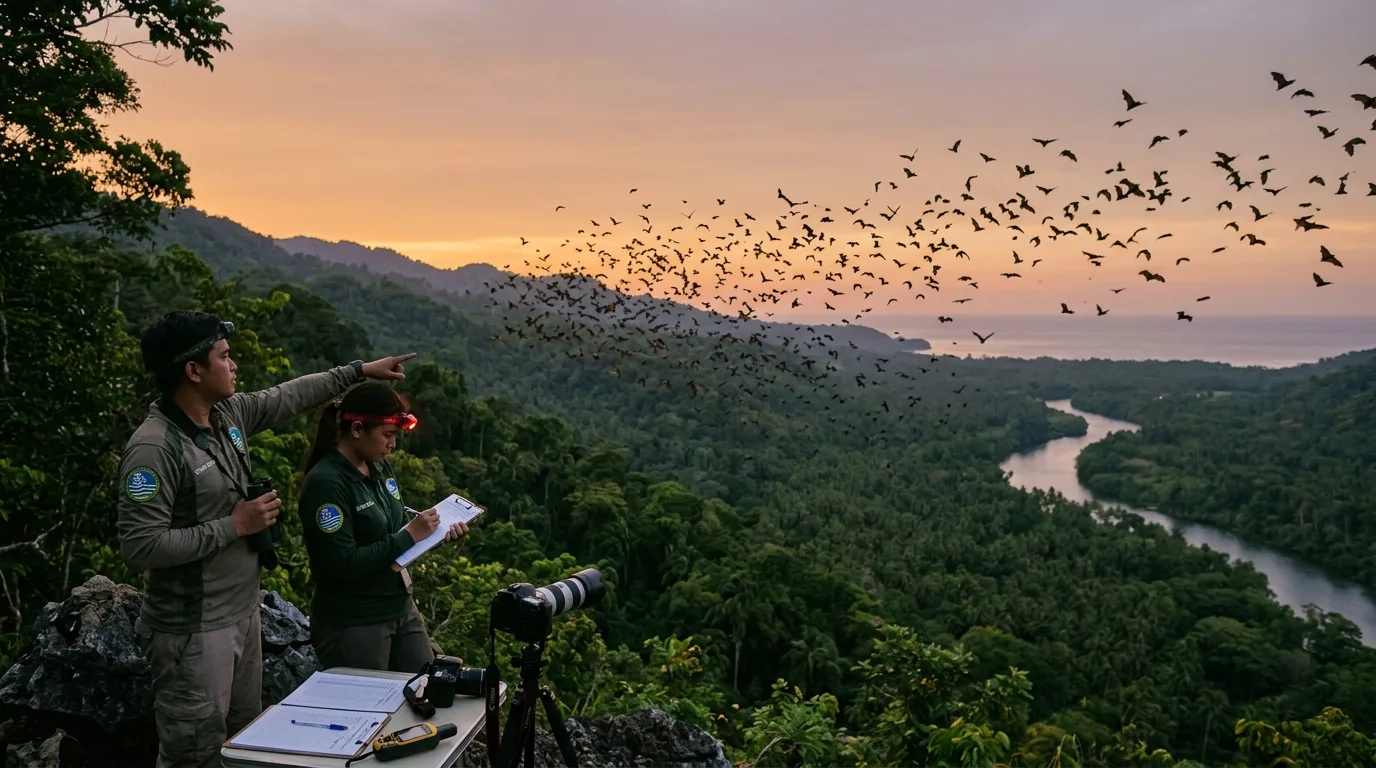
Davao — Environmental authorities in Mindanao have achieved a major milestone in regional biodiversity research as the Department of Environment and Natural Resources-Davao Region (DENR-Davao) successfully documented over 17,000 flying foxes in Jose Abad Santos, Davao Occidental. Conducted as part of the 2026 Monitoring of Threatened Species initiative in Barangay Bukid, the comprehensive survey highlights the crucial ecological roles played by island flying foxes (Pteropus hypomelanus) and large flying foxes (Pteropus vampyrus). By tracking these native populations, conservationists gain vital insights into habitat health while reinforcing active protections for key species across southern Philippine ecosystems.
Employing Precise Exit Count Methodology for Population Surveys
To accurately gauge the scale of the colony, DENR personnel utilized the established exit count method during evening field assessments. Observers monitored roost locations beginning approximately 30 minutes before sunset until active flight movement ceased, capturing reliable data on population size and behavioral patterns. This systematic technique allows wildlife specialists to map roosting sites effectively and measure changes in colony distribution over time, providing a dependable baseline for regional environmental planning and habitat protection.
Highlighting the Critical Ecological Role of Fruit Bats
Environmental experts underscore that fruit bats serve as indispensable agents of forest regeneration, acting as natural pollinators, seed dispersers, and pest controllers. As they forage across fragmented landscapes, these flying mammals transport seeds over long distances, helping restore indigenous plant species and maintaining the structural integrity of tropical forest canopies. Monitoring their numbers also enables agencies to track potential zoonotic reservoirs and ensure balanced co-existence between local communities and vulnerable wildlife populations.
Expanding Regional Biodiversity Tracking Across Protected Areas
Beyond the recent counts in Davao Occidental, large flying fox populations continue to be monitored across other vital sanctuaries in the country, including the Mount Hamiguitan Range Wildlife Sanctuary and the Mount Apo Natural Park. These ongoing surveys reflect the government's broader commitment to safeguarding threatened endemic species against pressures from land conversion and habitat disruption. As regional environmental agencies scale up their conservation programs, these baseline studies ensure that Mindanao remains a flourishing refuge for diverse and irreplaceable Philippine wildlife.